Effectively nothing is blooming outdoors here; a witch hazel might. Toronto's average first fall frost arrives on October 13, according to the Old Farmer's Almanac, so the field season ended weeks before anyone hung a wreath. A December bouquet in Canada is built from four supply routes instead: heated greenhouses, imported stems, bulbs forced indoors on a timetable, and cut branches that hold colour without a petal. That is the honest answer to what winter flowers are. Cindy's Flowers hand-ties those stems in our Toronto studio and delivers across the GTA Monday to Saturday, same day on orders placed before 3 PM.
Does anything bloom outdoors in Toronto in December?
No. The Old Farmer's Almanac puts Toronto's average first fall frost at October 13 and the average last spring frost at May 4, a growing season of 161 days calculated from Environment Canada climate normals. Search for winter flowers and the results fill with hellebores, snowdrops and winter heather. Those are gardening lists written for milder places. They describe a plant that survives a mild winter outdoors, not a stem you can buy and put in water in Etobicoke in the third week of December.
Ontario does grow cut flowers in a field. Agriculture and Agri-Food Canada counted 166 hectares of field-grown cut flowers in Ontario in 2024, 36.1 per cent of the national 460 hectares, worth $18.9 million in provincial sales. All of it is a growing-season crop. By the solstice, which falls on Monday, December 21, 2026 at 3:50 p.m. EST and is the shortest day of the year, those fields have been finished for two months. If you want the last of the outdoor stems, that conversation belongs to the flowers that close out a Toronto fall.
What "in season" means when the ground is frozen
In December it means "in production or in transit", not "grown nearby". Canada is a net importer of cut flowers: $222.4 million imported against $155.9 million exported in 2024, a trade deficit of $66.5 million, per Agriculture and Agri-Food Canada's reading of Statistics Canada trade data. Four routes fill a Canadian winter vase, and they behave differently.
- Greenhouse crops. Grown under glass and light through the dark months, cut and shipped inside the country.
- Imports. Flown in from growers whose season is running while ours is not. The United States is the largest single source of Canada's floriculture and nursery imports at 44.0 per cent, ahead of Colombia at 17.2 per cent, the Netherlands at 12.8 per cent and Ecuador at 7.7 per cent. That category also counts nursery stock and Christmas trees, so read it as a direction of travel rather than a stem count.
- Forced bulbs. Amaryllis and paperwhites, coaxed into flowering indoors out of sequence.
- Cut branches. Berried and bare wood taken while the plant is dormant.
A December mixed bouquet usually draws on three of those four at once, which is why it looks nothing like a June one.
Which winter flowers come out of a Canadian greenhouse?
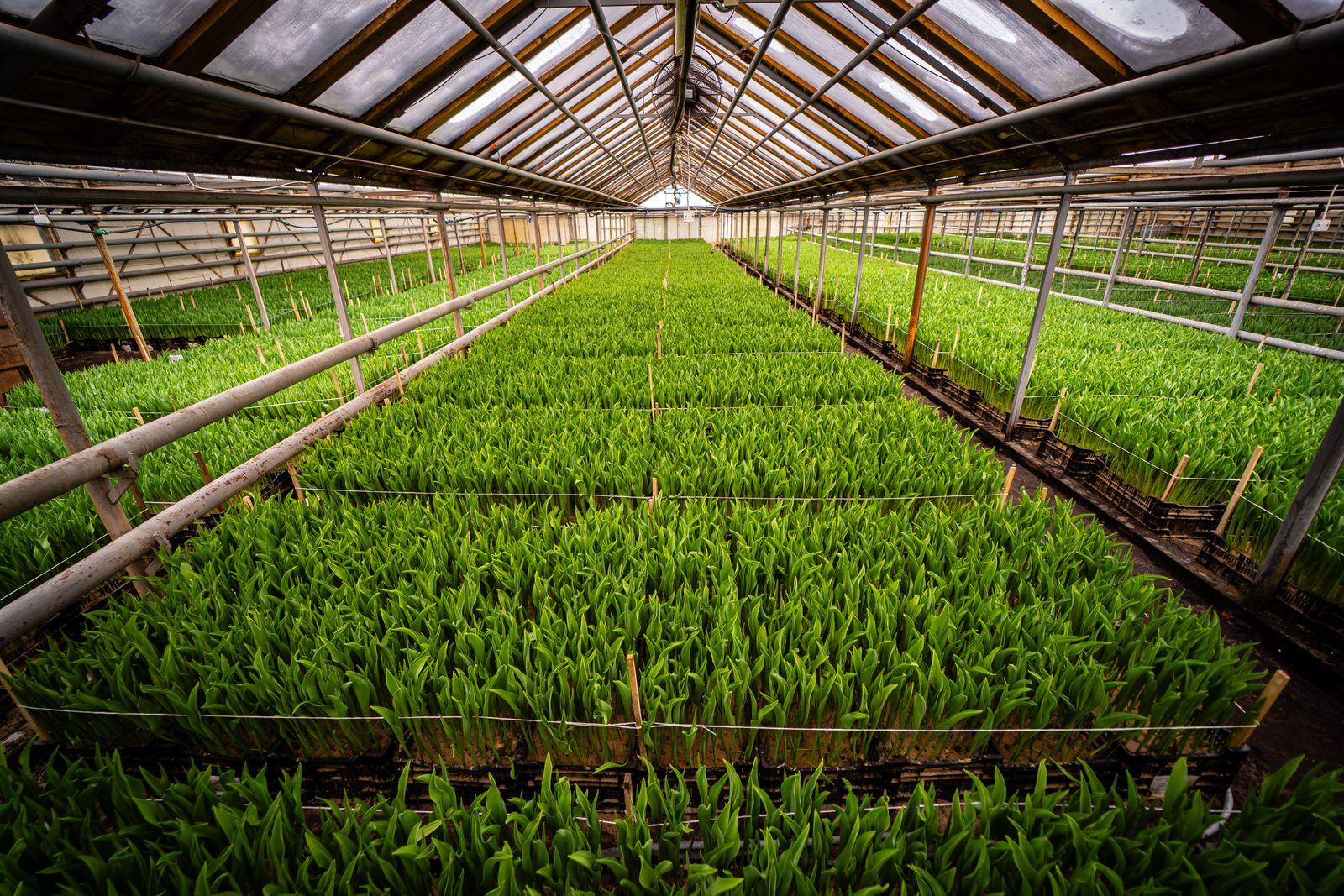
Tulips and gerberas, and it is not close. Canada produced 417.99 million greenhouse cut-flower stems in 2024. Tulips accounted for 212.3 million of them, 50.8 per cent of everything cut under glass, with gerberas second at 85.0 million stems, or 20.3 per cent. The figures come from Agriculture and Agri-Food Canada's statistical overview of the ornamental industry, drawing on Statistics Canada.
The rest of the order tells you what a Canadian winter arrangement can lean on:
- Snapdragons: 31.6 million stems (7.6 per cent)
- Chrysanthemums: 25.5 million (6.1 per cent)
- Lisianthus: 13.9 million (3.3 per cent)
- Lilies: 12.9 million (3.1 per cent)
- Alstroemeria: 5.0 million (1.2 per cent)
- Roses: 3.6 million (0.9 per cent)
Roses come last of that group, under one per cent. The rose in a December bouquet almost certainly flew. Ontario holds just over half of the country's specialized greenhouse flower and plant area, 3,800,613 square metres out of 7,559,320, but that is a national annual production figure and not a receipt: it does not prove the particular tulip in your hand grew in Niagara.
Tulips are still the most dependable stem of the Canadian winter. Greenhouse tulips arrive tight, open in the warmth of a room, and keep growing in the vase for days after they are cut. The ASPCA lists tulips as toxic to dogs, cats and horses, which matters further down. For the flower's history and meaning rather than its supply chain, what tulips symbolize covers it.
Forced bulbs and berried branches
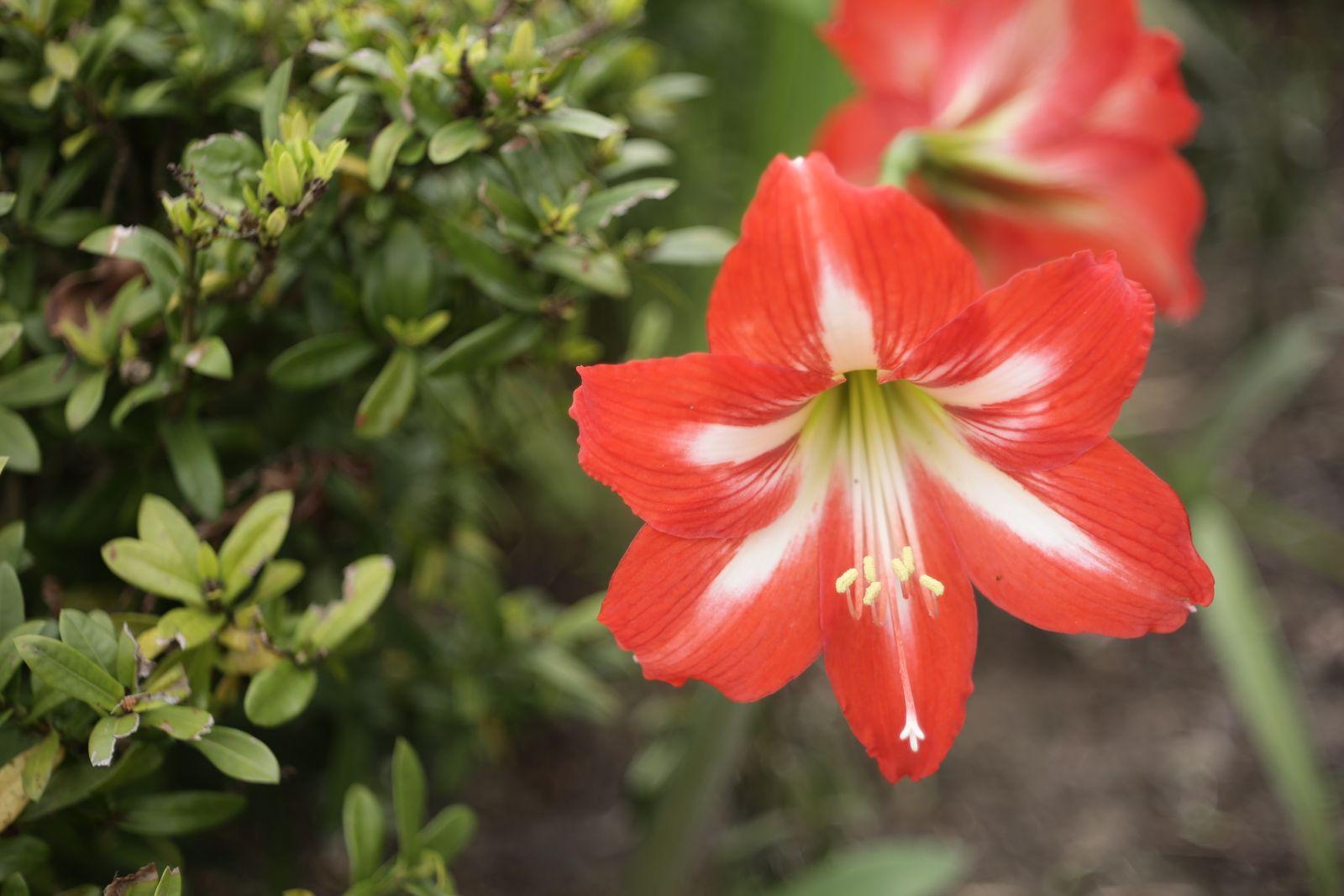
Forcing is the one genuinely wintry act on this list. An amaryllis bulb (Hippeastrum) is sold with next season's flower already formed inside it, so warmth and water are most of what it needs to open on a kitchen counter in January. Paperwhite narcissus work the same way and skip the cold period other bulbs demand. Neither is in season in any field sense. Both are simply running on a clock somebody else set.
Branches do the other half of the work. Winterberry (Ilex verticillata) is a deciduous holly native to eastern North America: it drops every leaf and holds bright red fruit on bare stems into the new year. Red-osier dogwood pulls the same trick with stem colour instead of berry. Cut evergreen brings scent no imported rose can match, whether that is spruce, cedar or pine. Berry, branch and bulb together are what most people actually picture when they order Christmas flowers, and they are the part of a December arrangement most likely to have been cut close to home. Potted colour follows the same seasonal logic, and our poinsettia care guide covers the best-known example, another the ASPCA lists as toxic to dogs, cats and horses, though it calls the toxicity over-rated.
Which winter flowers are a problem in a house with pets?
Most of the December list, which is worth knowing before the box is opened. The ASPCA lists tulips, narcissus (paperwhites included), amaryllis, chrysanthemums, ranunculus and holly as toxic to dogs and cats, all but the Hippeastrum amaryllis to horses as well. Amaryllis deserves the closest attention of the group: the bulb is the most toxic part of the plant, and the bulb is exactly what gets handed over in a gift box, often potted shallow at nose height.
True lilies and daylilies sit in a worse category again. They cause fatal kidney failure in cats, and the pollen and the vase water are hazards in their own right, so no rearranging of the room makes them workable. The advice is to keep them out of a cat's home entirely, and our guide to lilies and cats explains why.
Other winter stems avoid that problem. Gerbera daisies, alstroemeria, snapdragons and roses all appear on the ASPCA's non-toxic list for dogs and cats, and every one of them is available through a Canadian December. Ask for those four by name if there is a cat in the house.
Buying winter flowers that hold up in a heated room
Cold is not what shortens a winter bouquet indoors. Dry forced-air heat is. A vase on a radiator or in the path of a floor vent loses days, and the whole room is running at low humidity from November onward. Four habits carry a December arrangement further:
- Ask for stems in bud, tulips especially, since they finish opening in the room.
- Unwrap and recut the moment flowers come in from a cold doorstep, rather than leaving them sleeved.
- Never leave a bouquet in an unheated car or on a porch overnight. Freezing damage shows up a day later as translucent, limp petals.
- Top the water up more often than you would in July. Heated rooms drink.
Our guide to making cut flowers last longer has the full routine. On the seasonal question this post is about, the short version is that the winter list is narrower than the summer one and far more dependent on the greenhouse and the airport. Cindy's Flowers hand-ties every winter arrangement in our Toronto studio, so the most useful way to see what December really offers is the bouquets in stock this week rather than a chart of what theoretically blooms.