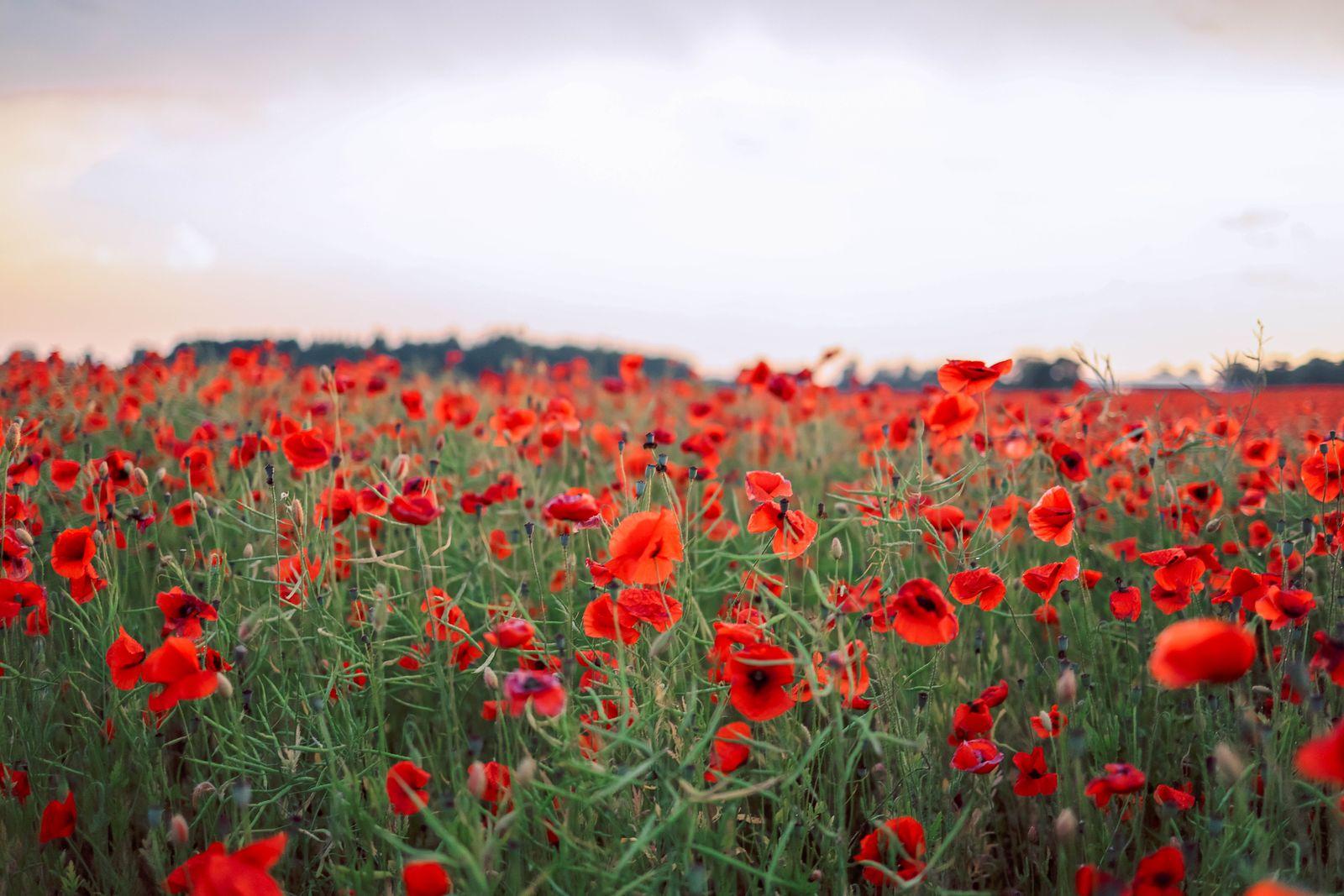
Canadians wear a red poppy on 11 November because that flower grew where the fighting was worst. Papaver rhoeas, the field poppy, keeps a long-lived seed bank that germinates the moment soil is disturbed, and from late 1914 artillery churned the fields of Flanders and northern France. A Guelph-born army surgeon, John McCrae, turned the sight into a poem. Remembrance Day marks the anniversary of the 1918 Armistice that ended the fighting in the First World War, and ceremonies hold two minutes of silence at 11 a.m. For flowers to mark the day at home, Cindy's Flowers hand-ties arrangements in our Toronto studio.
Why is the poppy the flower of Remembrance Day?
Because the poppy is a weed of disturbed ground, and the Western Front was disturbed ground on an industrial scale. The Canadian Encyclopedia puts the mechanism plainly: "The seeds of the flower may remain dormant in the earth for years, but they will blossom in abundance when the soil is disturbed." The barrages began in late 1914, and by the following spring scores of red poppies had appeared across Flanders and northern France.
There is a second mechanism, and Veterans Affairs Canada supplies it. The little red flowers grew around soldiers' graves because soils in France and Belgium "had become rich in limestone from the rubble and debris caused by the fighting". Shelling broke open the seed bank and sweetened the ground it was sitting in. Two forces, the same result.
The symbolism is older than the war that made it famous. The poppy carried a sense of death and renewal as far back as the Napoleonic Wars. The First World War simply gave a very old association a specific address.
Who was John McCrae, and where was the poem written?
John McCrae was a Canadian soldier, physician and poet, born in Guelph, Ontario on 30 November 1872. The Royal Canadian Legion credits him as "the person who first introduced the Poppy to Canada and the Commonwealth".
Major John McCrae, promoted to lieutenant-colonel when he moved to No. 3 Canadian General Hospital in June 1915, treated the wounded at the Essex Farm dressing station near Ypres during the Second Battle of Ypres, fought from 22 April to 25 May 1915. On the morning of 2 May, Lieutenant Alexis Helmer was killed. Helmer was 22, a civil engineer and a McGill graduate, and McCrae's friend. McCrae officiated at the graveside service himself, then wrote the poem the following morning. The Legion dates "In Flanders Fields" to 3 May 1915.
He never came home. McCrae died on 28 January 1918 of pneumonia and meningitis at the No. 14 British General Hospital in Wimereux, France, aged 45.
What happens at a Remembrance Day ceremony
The silence is the centre of it. The Royal Canadian Legion calls the two minutes "the most sacrosanct and central element in Remembrance", observed at the eleventh hour of the eleventh day of the eleventh month, the month, day and time in 1918 when the First World War ceased hostilities. Public services usually add the playing of "Last Post" and a reading of the fourth stanza of the poem "For the Fallen". In 2026, 11 November falls on a Wednesday.
Most people assume the wreaths come first. They do not. The Legion's published order of service for the national ceremony at the National War Memorial in Ottawa, which begins at roughly 10:30 a.m., runs: Last Post, First Gun, the two minutes of silence at 11:00, Second Gun, Lament, Rouse, Act of Remembrance, 21 Gun Salute, Prayers, Placing of Wreaths, Benediction. Wreaths are laid near the end, after the country has already been quiet together.
One of them carries a particular weight. The National Silver Cross Mother "places a wreath at the National War Memorial on 11 November on behalf of all Canadian mothers who have lost a son or a daughter in the military service of Canada." She is chosen by the Legion from nominations made by Provincial Commands and by individuals, and her tenure starts on 1 November. The Memorial Cross behind the title was first authorized on 1 December 1919.
Local services follow the same shape at cenotaphs across the region, including the one outside Toronto's Old City Hall, and at Legion branches through the GTA. If the family you are thinking of lives west of the city, we deliver flowers across Mississauga too.
The rules for wearing a poppy
There is no law here, only convention, and in Canada the convention is well settled:
- Wear it on the left lapel, over the heart.
- The remembrance period runs from 24 October to 11 November.
- One poppy is enough. It is a mark of respect, not a collection.
- Lost one? Replace it rather than going without.
The Royal Canadian Legion distributes poppies through volunteers and donation boxes in shops, banks and branches, and the poppy itself is always free, with donations to the Poppy Fund gratefully accepted. That is the honest answer to "where do I buy a poppy": you do not, exactly.
Nothing obliges you to take it off at 11:01 either. Many people wear the poppy through the whole of 11 November and then leave it at the cenotaph, or pin it to a wreath, at the end of a service. Others keep theirs in a drawer for the year. If you want something physical from the day, a stem from the bouquet on the table presses well, and our guide to drying and preserving flowers covers the method.
Why the November poppy is a made flower, not a picked one
Field poppies are a June-to-August flower; there is no Ontario supply in November, so the lapel poppy is artificial. The Missouri Botanical Garden lists Papaver rhoeas as an annual for zones 3 to 10, growing 0.75 to 1.50 feet tall in full sun, flowering June to August, with scarlet red blooms to about two inches across, each carrying a distinctive black blotch at the base. Late spring to mid-summer. The garden also calls it "a vigorously self-seeding annual", which is the polite way of saying it behaves like the agricultural weed it is.
The plant is a difficult cut flower on top of that. Each bloom lasts a single day, and broken tissue leaks a white to yellowish latex, so growers who do cut them sear the stem ends to slow the bleed. A flower that thrives on ploughing, opens for a day and then bleeds when you touch it was never going to survive two weeks pinned to a winter coat. The lapel poppy is a manufactured stand-in, and it was always meant to be one.
One caution if you grow them: the Pet Poison Helpline lists Papaver as toxic to pets, so keep garden or cut poppies away from dogs and, to be safe, cats. The same species also serves as August's secondary birth flower, and our guide to August's birth flowers covers that side of its story. For what is genuinely fresh in a Toronto November, see what is in the studio this week.
What flowers do you send for Remembrance Day?
Red, mostly, and kept simple. Red roses are the closest living stand-in for a poppy, and the ASPCA lists roses as non-toxic to dogs and cats, which makes them straightforward for a home with animals. Alstroemeria is the other dependable pick, also listed by the ASPCA as non-toxic to dogs and cats, and it holds far longer than a week in a vase. Red and white together reads as remembrance and as Canadian at once, so a red and white mixed bouquet does more work than a single-variety bunch (roses and alstroemeria where there are pets in the house).
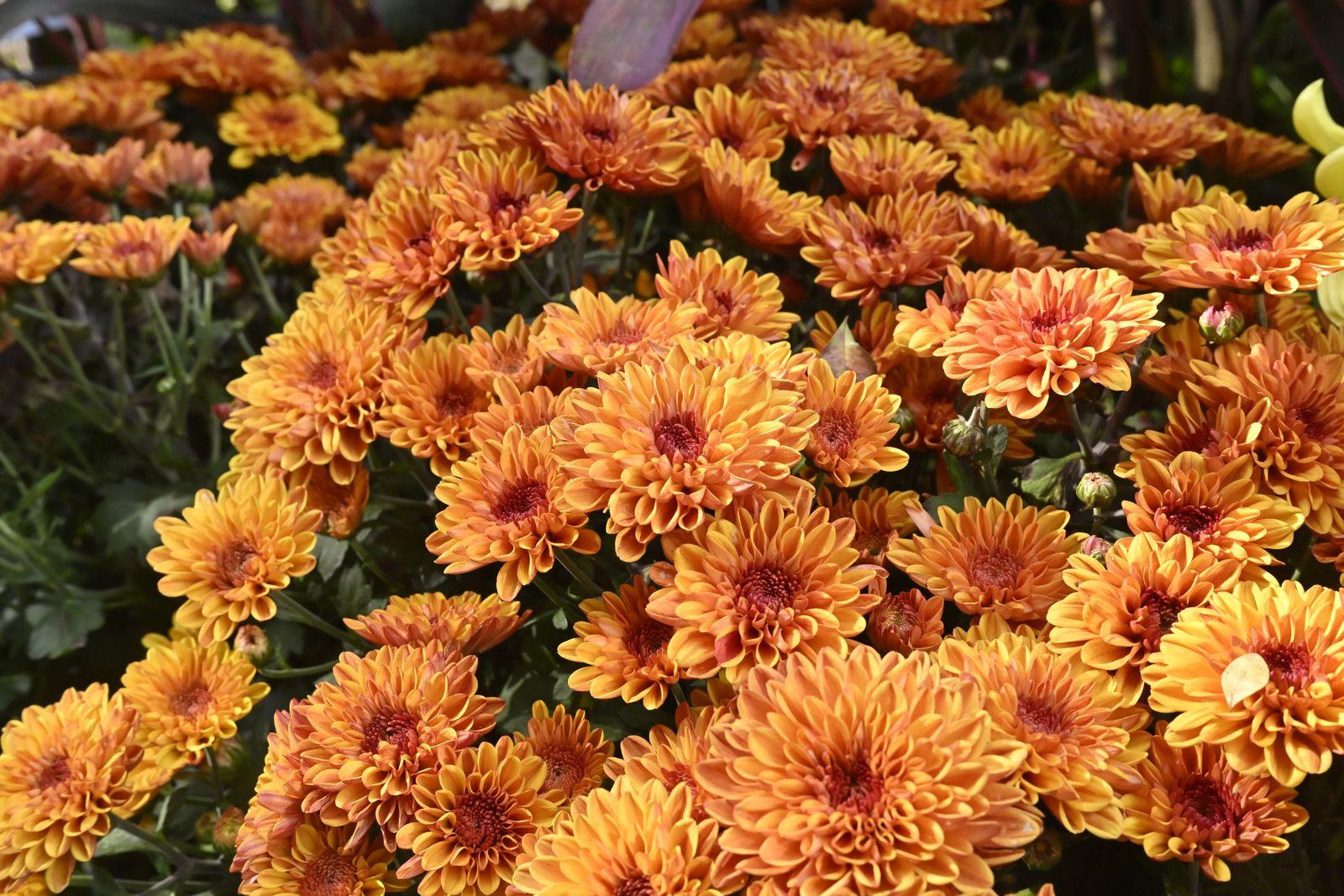
Two traditional tribute flowers need a caveat before you order them. Chrysanthemums and carnations both appear constantly in remembrance and funeral work, and the ASPCA lists both as toxic to dogs, cats and horses. Chrysanthemum foliage also causes contact dermatitis in people who handle it often, florists included. Where pets or handling matter, roses and alstroemeria carry the same tone without the problem.
If the flowers are for a family whose loss is recent rather than historical, that is a different errand. Flowers sent in sympathy follow their own etiquette, and our guide to the best flowers for sympathy walks through colour, form and timing. Cindy's Flowers hand-ties every arrangement in our Toronto studio and delivers same-day across Toronto and the GTA on orders placed before 3 PM, Monday to Saturday. Keep the card short. On 11 November the flowers are not the message, they are the punctuation.