Keep a poinsettia alive past the holidays by treating it as the tropical plant it is. Give it six hours of bright indirect light, room temperatures of roughly 18°C to 21°C by day and 13°C to 18°C at night, and never let it sit below 10°C, not even for the walk to the car. Water only when the soil surface feels dry, then pour off everything that drains. Do that and the colour holds long after the tree comes down. That cold walk from shop to car is also the best argument for having one delivered instead: Cindy's Flowers sends plants and bouquets same-day across Toronto and the GTA on orders placed before 3 PM.
Those red "petals" aren't flowers at all
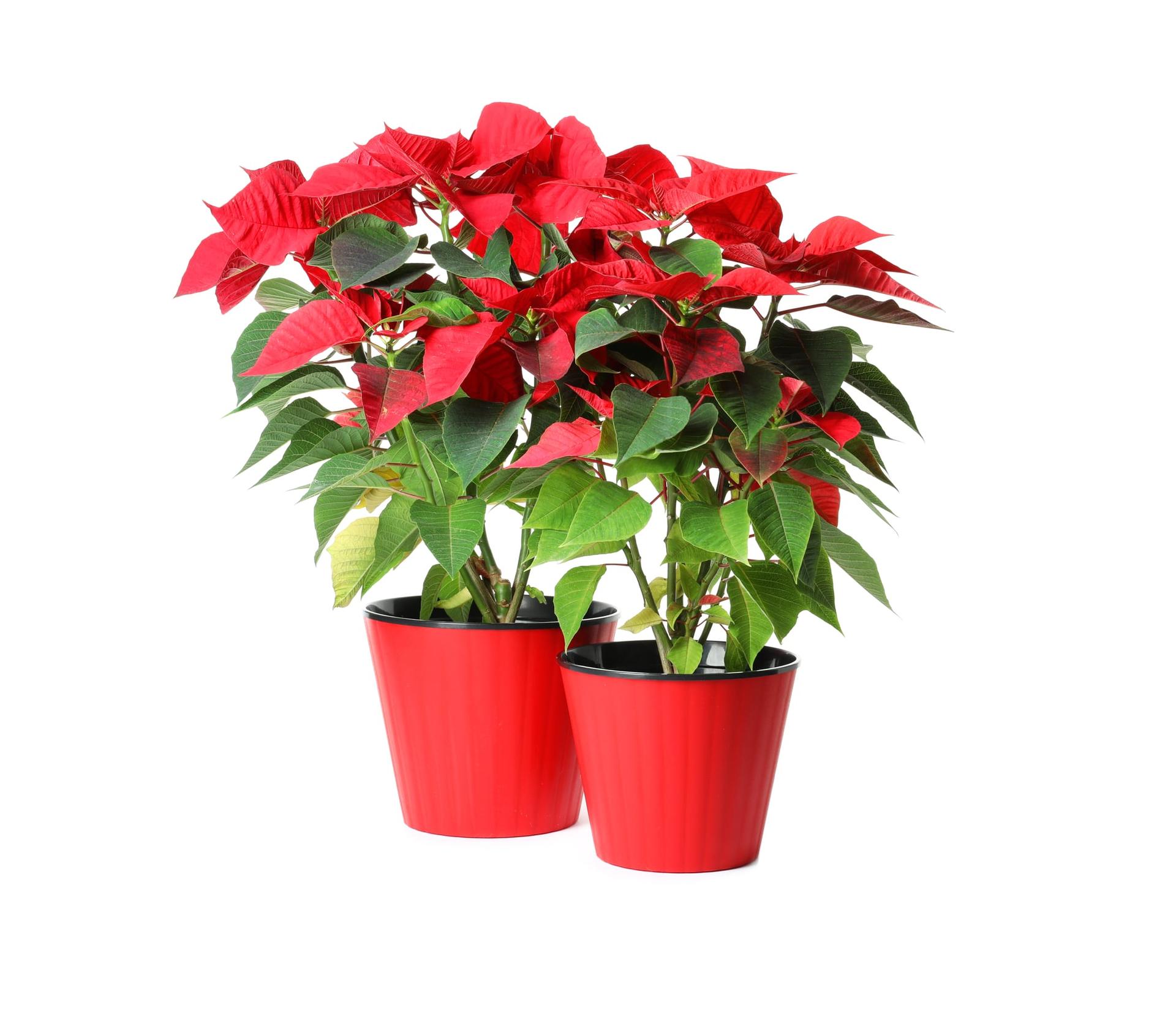
Start with the thing almost everyone gets wrong. The red, pink, cream, and marbled parts of a poinsettia are bracts, which are modified leaves, not petals. The true flowers are the small green-and-yellow buttons clustered at the centre of each rosette, called cyathia. Landscape Ontario tells shoppers to look for exactly that: the little flowers sitting in the middle of the coloured bracts. It doubles as a freshness test. Cyathia still green, tight, and intact means the plant left the greenhouse recently. A centre where the cyathia have already dropped, leaving the bracts bare, or where they are shedding yellow pollen, means it has been sitting on display and will shed bracts sooner.
The plant itself is Euphorbia pulcherrima, a member of the spurge family, indigenous to Mexico and Central America, with wild populations running from Mexico down into southern Guatemala. It is nothing like the tidy pot on a garden-centre table in its native range: there it grows as a shrub or small tree, anywhere from 0.6 to 4 metres tall. European botany only caught up in 1834, when the German scientist Johann Friedrich Klotzsch formally described it. In Mexico it's the flor de Nochebuena, the Christmas Eve flower, and the English name honours Joel Roberts Poinsett, the first United States minister to Mexico, who sent the plant north in the 1820s.
What kills a poinsettia in a Toronto December?
Cold, and faster than you would think. Poinsettias have to be protected from anything under 10°C, because chilling makes them drop their leaves. Landscape Ontario puts it bluntly: never expose the plant to cold temperature for more than a few minutes, since a chilled or frozen plant will drop leaves very quickly. So the riskiest moment in a poinsettia's life isn't your living room. It's the twenty metres between a shop door and a cold car, or a streetcar ride home in a paper sleeve.
Two habits solve it. Keep the plant sleeved for the trip, warm the car first, and go straight home instead of running three more errands with it in the trunk. Then take the sleeve off the minute you're inside; left on for days it traps the ethylene the plant gives off, and the leaves droop in protest. If a cold snap makes the trip a gamble, having one sent with the rest of your Christmas flowers skips the parking lot altogether.
How often should you water a poinsettia?
Check the soil, not the calendar. Water when the surface feels dry to the touch, soak the pot until water runs out the bottom, then empty the saucer. Poinsettias are killed far more often by a permanently wet pot than by a forgetful owner, because roots standing in water rot. If yours arrived wrapped in decorative foil, punch a few holes through the bottom or lift the pot out to water it. Foil turns a drainage hole into a reservoir.
The room matters just as much as the watering can:
- Utah State University Extension puts the ideal range at about 18°C to 21°C during the day and 13°C to 18°C at night.
- Nothing below 10°C, ever, including a windowsill behind closed curtains on a January night.
- Landscape Ontario notes that bract colour stays bright longer when temperatures don't exceed 22°C, so a hot room shortens the show.
- Keep it clear of radiators, forced-air registers, fireplaces, and the draft that comes through a front door.
- Bright light near a sunny window, with the bracts not pressed flat against freezing glass.
Why are the leaves dropping off my poinsettia?
Leaf drop is this plant's one all-purpose complaint, so work through the likely causes in order:
- Cold shock. A few minutes under 10°C on the way home, or a spot beside a drafty door, will do it days later.
- Soggy roots. Constant moisture suffocates them, and the plant sheds leaves while the soil is still wet.
- A bone-dry pot. The opposite extreme wilts the plant fast, and leaves shed after a hard wilt rarely come back.
- Dry heat. A radiator or a register blowing straight at the pot dehydrates it faster than you can water it.
- The sleeve left on. Trapped ethylene bends the leaves downward within a day or two.
Move it somewhere bright, steady, and draft-free, then adjust one thing at a time. Poinsettias respond to consistency more than to intervention.
Can you make a poinsettia rebloom next Christmas?
You can, and it takes real discipline. Poinsettias are short-day plants, so the bracts only colour up after roughly eight to ten weeks of at least fourteen hours of uninterrupted darkness a night, paired with plenty of bright light by day. Uninterrupted is the operative word. A hallway lamp flicked on at 9 p.m. resets the whole clock. Landscape Ontario publishes the Ontario schedule:
- April: the colour fades. Keep the plant near a sunny window, fertilize once new growth appears, and cut the stems back to about 20 cm.
- June 1: repot if it needs it, feed with a balanced 20-20-20, and move it outside into light shade only if temperatures stay above 10°C.
- Late August: bring it back indoors, cut the stems back leaving three or four leaves per shoot, and return it to a sunny window.
- September 20 to December 1: light only from 8 a.m. to 5 p.m., then complete dark, no lights at all, from 5 p.m. to 8 a.m.
Utah State University Extension frames the same treatment slightly differently: beginning the first of October, put the plant in complete darkness as soon as the sun sets, allowing a minimum of fourteen hours, and by the end of November it will start to colour. The Calgary Horticultural Society publishes a near-identical calendar, right down to the dark closet from 5 p.m. to 8 a.m. and a March cutback to 15 cm. This is standard horticulture, not folklore.
My honest read? Almost nobody keeps the nightly closet routine going past the second week of October. If you want a flowering plant that comes back without that kind of babysitting, a moth orchid is a much easier promise to keep, and the ASPCA lists Phalaenopsis as non-toxic to cats and dogs.
Are poinsettias safe around cats and dogs?
The deadly-poinsettia story is a myth, but "harmless" overshoots the other way. The ASPCA lists poinsettia as toxic to dogs, cats, and horses, describing the signs as irritation of the mouth and stomach, sometimes with vomiting, while calling the plant's toxicity generally over-rated. Treat that qualifier as context rather than a green light: a pet that chews a leaf will more often drool or vomit than come to real harm, but whether it needs treating is a call for your vet, and the ASPCA's own page tells you to contact one as soon as possible. Keep the pot off the floor where a curious kitten patrols. The milky sap is a skin and eye irritant for people too, and it can trigger a reaction in anyone with a latex allergy, so wash your hands after pruning and keep it away from your eyes.
If you're stocking a home with pets this month, the flower that genuinely deserves your caution is the lily. True lilies (Lilium) and daylilies (Hemerocallis) are highly toxic to cats, and a nibbled petal, pollen groomed off a paw, or a sip of vase water can cause fatal kidney failure, so don't bring them into a cat's home at all. A poinsettia is an irritant. A lily in a cat's home is an emergency.
The short version, and when to send one instead
Bright light, water only once the surface dries, nothing under 10°C, nothing over 22°C, and no radiators. That's poinsettia care indoors in a single line; everything else is patience. Kept that way, the bracts routinely hold colour deep into winter, with both the Ontario and Alberta care calendars marking the fade somewhere between February and April, months after the tree has gone out to the curb.
Cindy's Flowers hand-ties every arrangement in our Toronto studio and delivers same-day across Toronto and the GTA, Monday to Saturday, on orders placed before 3 PM. If you're weighing a plant that wants a routine against a bouquet that doesn't, our current collection lays this week's options side by side.