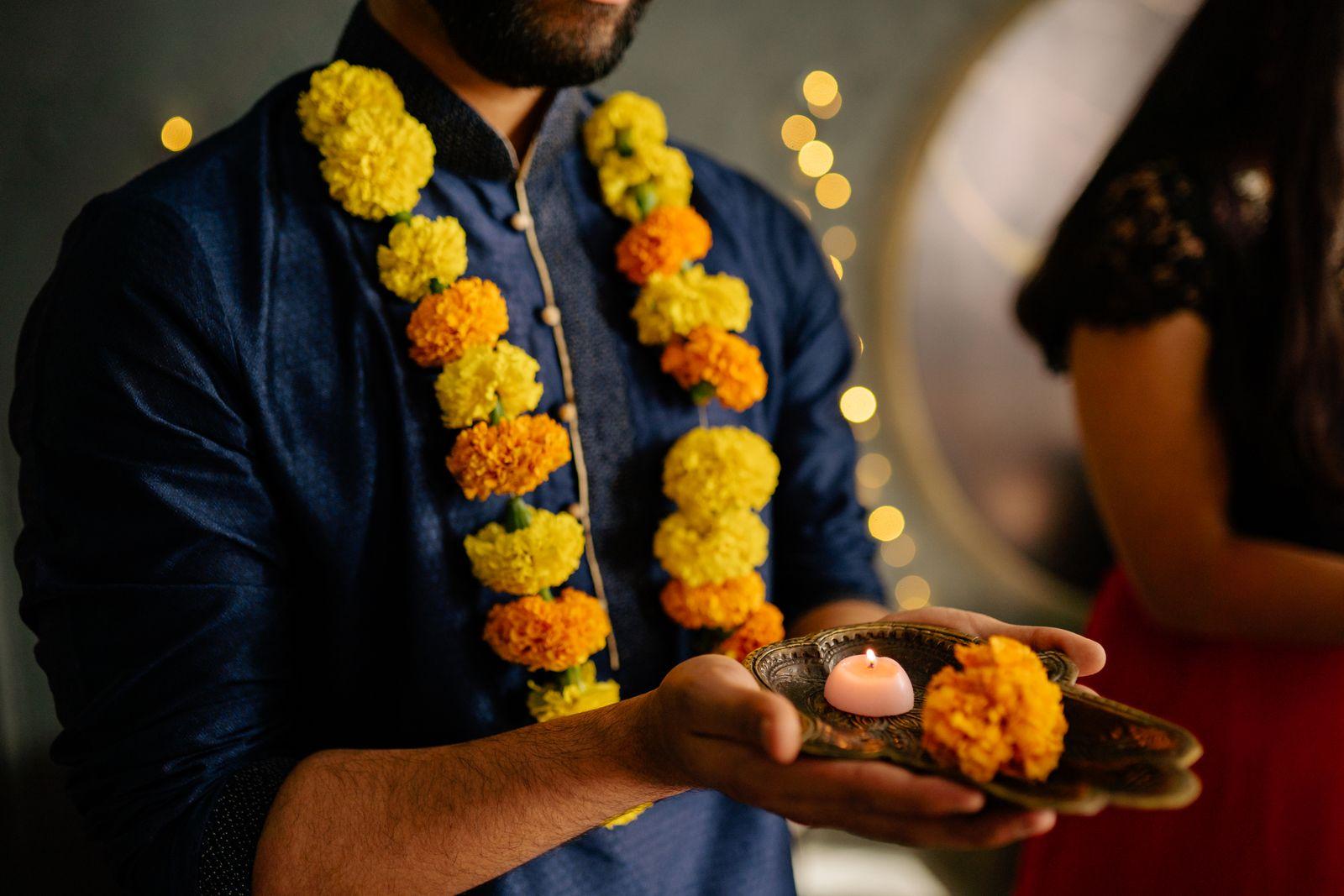
Diwali 2026 falls on Sunday 8 November, and the flower doing most of the work is the marigold. It gets threaded into garlands, tied across the front door as a toran alongside mango leaves, and pulled apart petal by petal to fill in a rangoli on the floor. Britannica describes those floor designs as elaborate patterns made of coloured rice, sand or flower petals. Because the main night lands on a Sunday and Cindy's Flowers delivers Monday to Saturday, Saturday 7 November is the last delivery day we can reach a GTA doorstep before it.
What is the flower of Diwali?
The marigold. Genda in Hindi, Tagetes erecta in the botanical books. Kew's species profile describes plants that grow 50 cm to 1 m tall, carrying flower heads "made up of over 100 individual flowers", and that density is the entire reason the plant took over the festival. One head gives you a hundred small florets that stay put when threaded, hold their colour off the plant, and can be stripped by the handful into a rangoli without the design looking thin.
Nothing else in a florist's cooler behaves quite like it. Rose petals bruise where your fingers land. Most other heads are either too heavy for a thread or shed once they start to dry. A marigold takes a needle straight through the centre and hangs there for days, which is why garland makers have never really needed an alternative.
Loose marigold by the bunch is seasonal here and not always sitting on a shelf the week you want it. If you are after the palette rather than the garland, orange gerberas, sunflowers and deep-gold roses carry the same heat, and you can see what is actually in stock across our full range of bouquets.
Where the marigold actually comes from
Not India. Kew puts the native range of Tagetes erecta at Mexico and Guatemala and nowhere else, and lists India, Bangladesh, Assam, Nepal and Pakistan among the places it was introduced. Trade histories put its arrival in India in the sixteenth century, the same period Kew records it spreading along the North African coast, which is how a Mexican plant picked up "African marigold" as one of its English names.
In Mexico the same species is known as "the flower of the dead" and is grown to decorate ofrendas. In India it became the flower of a festival of light and prosperity. Same plant, opposite emotional work, and both traditions are now old enough that the botany is beside the point. Still worth knowing, because it explains the one thing everyone notices about marigold: it is abundant and cheap almost everywhere, because it grows fast in almost any warm place you put it.
How do you make a marigold garland and a door toran?
A toran is the auspicious hanging tied across the main entrance, traditionally made by tying mango leaves and flower garlands over the doorway of a house or a pandal, and usually built from marigolds and mango leaves. The classical architectural treatise Manasara classifies several types, the pushpa toran, or flower toran, among them. So the thing being assembled on your kitchen table has a name in a text about temple architecture.
The method is simple and slow:
- Cut heads with about a centimetre of stem attached. That stub is what stops the head sliding down the thread.
- Use a long darning needle and doubled cotton thread. Fishing line or any thin, sturdy string works too.
- Push the needle up through the base of the head and out through the centre, then slide each head down tight against the last one. Wear thin gloves for a big batch: Tagetes sap is a known skin irritant, which Pet Poison Helpline and DermNet both note.
- For a doorway, thread one long garland and hang it in a shallow curve rather than a straight line, adding mango leaves in pairs at each end, gloves on again, since mango leaf and sap carry urushiol, the same contact allergen as poison ivy.
- Bag the finished garland and keep it in the fridge until the moment you hang it. Heat is what turns a marigold brown.
The threading logic carries over from our step-by-step guide to making a flower crown, which is the same needle-and-thread work at a smaller scale.
One caution before anything goes up at nose height: Pet Poison Helpline lists Tagetes marigolds as toxic to dogs and cats. Height is no barrier to a cat, and the real hazard is eaten plant material: shed heads under a hung garland and loose florets on the floor. Sweep up as you go, keep a flower rangoli out of reach of animals, and if you would rather the plant were not in the house at all, roses, gerberas and sunflowers are all named non-toxic by the ASPCA and come in exactly the right colours. Artificial marigold garlands are also worth a thought for an exterior door that has to look good across all five days of a Toronto November.
What is a flower rangoli, and which petals hold up?
Rangoli is threshold floor art. The word comes from the Sanskrit rangavali, "line of colour", from ranga, colour, and avali, line or row, which makes it a grammatical twin of deepavali, "row of lights". Britannica records it being made with flowers, rice flour, coloured powders, chalk and coloured sand, and notes the designs are deliberately temporary. It travels under other names too: kolam in Tamil Nadu, muggu in Andhra Pradesh and Telangana, alpana in West Bengal, mandana in Rajasthan.
The function is welcome. Britannica describes homes decorated and floors covered with rangoli, with doors and windows kept open in the hope that Lakshmi will find her way inside. Diwali designs frequently include lotuses and the footprints of the goddess, and the practice as a whole reads as a mark of auspiciousness and a way of turning misfortune away from the door.
For petals, work in this order (and keep animals off the design, since Pet Poison Helpline lists Tagetes marigolds as toxic to dogs and cats): marigold florets for the mass fill, rose petals for the deep reds and pinks, and something small and pale for the outlines. Lay the outline first in rice flour or chalk, then fill inward. Petals curl within a few hours indoors, so if the design has to look its best after dark, build it late in the afternoon. If you are choosing a palette rather than following a family pattern, what flower colours traditionally mean is a reasonable starting point.
Ordering Diwali flowers in Toronto for 2026
Diwali 2026 runs Friday 6 November to Tuesday 10 November, with the main night on Sunday 8 November. The Old Farmer's Almanac and Drik Panchang's Toronto calendar agree on the sequence (Drik also counts Thursday 5 November, Govatsa Dwadashi, as a first day):
- Friday 6 November: Dhanteras
- Saturday 7 November: Kali Chaudas and Narak Chaturdashi
- Sunday 8 November: Lakshmi Puja, the main day of Diwali
- Monday 9 November: Govardhan Puja and Bali Pratipada
- Tuesday 10 November: Bhai Dooj
The dates move every year because the Hindu calendar is lunisolar. Britannica places it from the thirteenth day of the dark half of the lunar month Ashvina to the second day of the light half of Karttika, which lands in late October or November on a Gregorian calendar.
Two practical points for the GTA. First, Diwali is not a public holiday anywhere in Canada. Timeanddate lists it as an observance and states that businesses keep normal opening hours, so the working week runs straight through it and nobody gets the Monday off. Second, we deliver Monday to Saturday, which makes Saturday 7 November the last delivery day before Lakshmi Puja, and Friday 6 November, Dhanteras, the comfortable one to aim for. Govardhan Puja on the Monday and Bhai Dooj on the Tuesday are both deliverable days. Same-day orders need to be placed before 3 PM. Flower delivery across the GTA runs on the same schedule, including Brampton and Mississauga, where Diwali orders concentrate most heavily.
What flowers do you send to someone else's Diwali?
Something bright, and something that does not assume. A mixed bouquet in orange, gold and deep pink fits the palette without making a statement about how a particular household keeps the festival, which a single-variety bunch can accidentally do.
Customs vary by region and by family. Rangoli alone answers to at least eight regional names across a dozen states, so there is no single correct flower to send to a home you do not know well. If you are close enough to ask, ask. If not, keep it bright, keep it fresh, and steer away from anything heavily scented, which competes with the food and the diyas rather than adding to them.
Cindy's Flowers hand-ties every bouquet in our Toronto studio and delivers across the GTA Monday to Saturday, so a Dhanteras or Kali Chaudas arrival is straightforward to arrange. After that the ordinary rules take over, and how to make cut flowers last longer covers the recut and water routine that gets a bouquet through all five days.