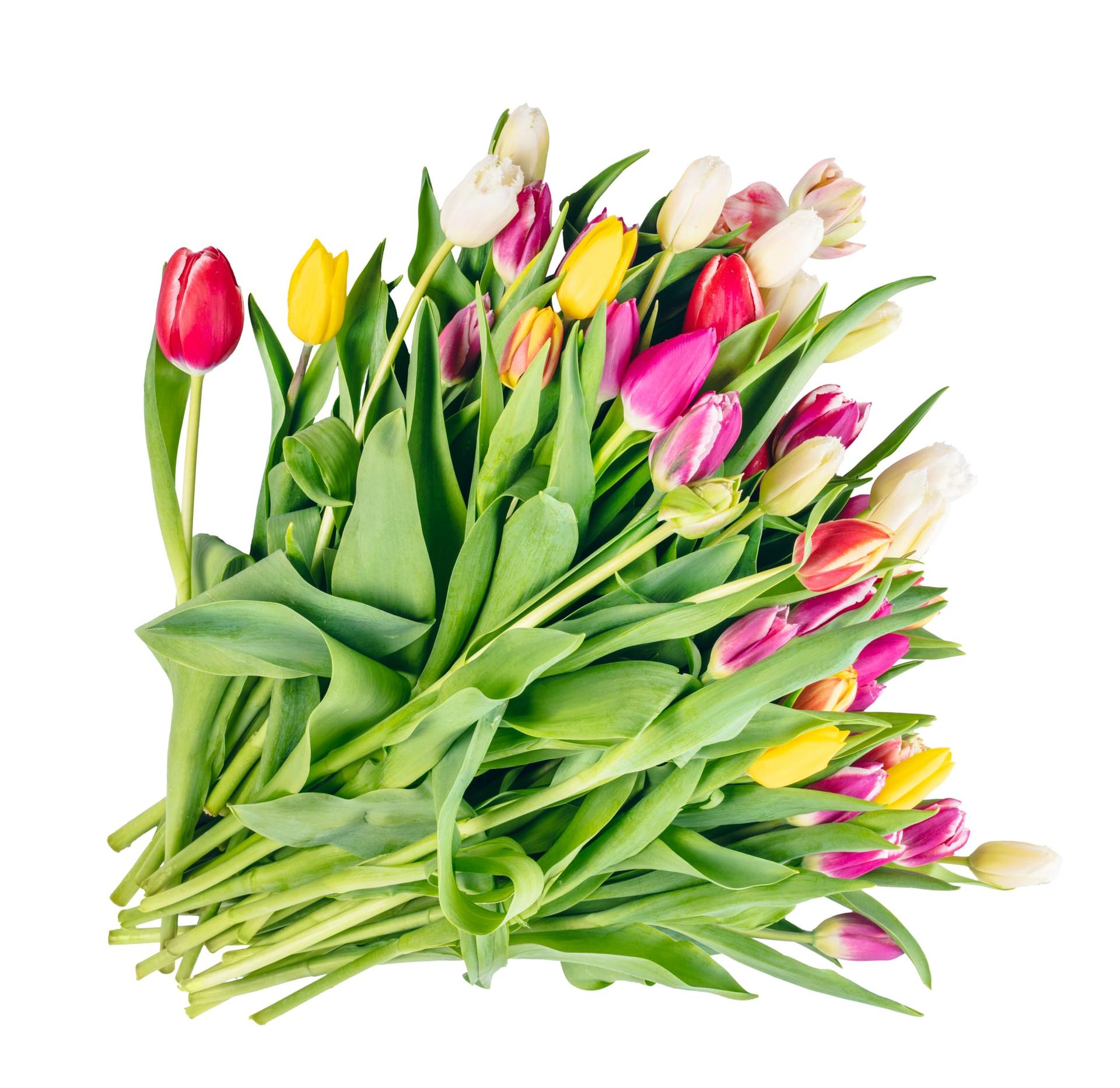
A tulip means love, above all else. Modern florists read it as a symbol of perfect, enduring love, while Victorian flower dictionaries filed the tulip under a single blunt word: fame. Colour does the fine-tuning. Red tulips are a declaration of love, white carries purity and apology, pink softens into affection, purple leans regal, and yellow means cheerfulness today, though it meant hopeless love a century and a half ago. The flower's deeper symbolism splits by culture: paradise on earth in Ottoman Turkey, the briefness of life in the Netherlands. Once the colour is settled, Cindy's Flowers hand-ties the bunch in our Toronto studio for same-day delivery across Toronto and the GTA on orders placed before 3 PM.
What does a tulip symbolize?
Perfect love is the answer most florists give, and it sticks because it stretches: a partner, a parent, a friend you would drop everything for. The printed record is stingier. Kate Greenaway's *Language of Flowers*, the standard Victorian reference, gives the tulip exactly four entries:
- Tulip: fame
- Tulip, red: declaration of love
- Tulip, variegated: beautiful eyes
- Tulip, yellow: hopeless love
Four lines, and three of them turn on colour. With tulips, the shade has always carried more of the message than the flower itself.
The grander symbolism sits outside the dictionaries, in two cultures that read the same bloom in opposite directions. In Ottoman Turkish culture the tulip was a symbol of paradise on earth with almost divine status, and the empire's wealthiest stretch is still called the Tulip Era, Lale Devri. In the Dutch Republic, the same flower came to stand for the briefness of life. Paradise in one place, mortality in the other.
Worth saying plainly: none of this is botany. Floriography is a code people agreed on and then quietly revised. It is genuinely useful, because enough of us still recognize it, but no tulip has ever read a dictionary.
What does each tulip colour mean?
Colour is where the message gets specific. Here is the shorthand most florists work from:
- Red tulips: a declaration of love. This is the one meaning with an unbroken line back to the Victorian books, and it is why red tulips hold their own against roses every February.
- Yellow tulips: cheerfulness, sunshine, warm thoughts. A complete reversal of the old entry, and worth its own section below.
- White tulips: purity and respect, and by common convention, apology and forgiveness. The right choice when the message is "I got that wrong."
- Pink tulips: affection, care, good wishes. Softer than red, which makes them a natural for a Mother's Day bunch in May, when tulips are at their seasonal best anyway.
- Purple tulips: royalty and dignity, borrowed from the long association between the colour purple and rank rather than from anything tulip-specific.
- Variegated tulips: "beautiful eyes," the oddest entry in the book and the one with the best backstory.
One caveat most colour guides skip: Greenaway lists only those four tulip entries. The meanings pinned to white, pink and purple are later florist convention, not Victorian code. Widely understood, certainly. Ancient, no.
Why did the yellow tulip flip its meaning?
Because the code drifts, and yellow drifted furthest of all. In Victorian floriography a yellow tulip meant hopeless love, the flower you sent when the answer was no. The same stems now read as cheerfulness and sunshine, which is close to the opposite message.
Nobody legislated the change. Colour symbolism follows the mood of a century, and bright yellow simply stopped looking melancholy to people buying flowers for pleasure rather than for coded correspondence. This only ever causes trouble when someone finds an old dictionary online and panics. Send yellow tulips just because and they land as pure warmth, not as a rejection letter.
Where do tulips actually come from?
Not the Netherlands. Tulips are the genus *Tulipa*, roughly 75 species in the lily family, and in the wild they grow in a band running along about 40 degrees north: southeast Europe and Turkey, through the Levant and Central Asia, out to the Pamir-Alai and Tien Shan mountains. They are steppe and mountain plants adapted to temperate climates, flowering in spring and going dormant over summer once the flowers and leaves die back.
The name travelled with them. "Tulip" first appears in western Europe around 1554, seemingly through the Turkish Letters of the diplomat Ogier Ghiselin de Busbecq. It is thought to derive from the Ottoman Turkish *tulbend*, meaning muslin or gauze, and ultimately from the Persian *dulband*, a turban, after the shape of the flower. That naming may even have started as an early translation error, which feels like a fitting origin for a bloom this fussed over.
The Dutch chapter starts late and moves fast. Carolus Clusius planted tulips at the Vienna Imperial Botanical Gardens in 1573 and finished the first major work on the genus in 1592, noting its colour variations. Dutch cultivation began in earnest around 1593, after he took up a post at Leiden University's new Hortus Botanicus, and spring 1594 is treated as the tulip's first flowering in the Netherlands. Everything that looks quintessentially Dutch about this flower is younger than that.
Did tulip mania really ruin the Dutch economy?
No, and that is the most repeated falsehood attached to any flower. The bubble itself was real: prices accelerated from 1634 and the market collapsed dramatically in February 1637, in what is generally considered the first recorded speculative bubble in history. At the peak, certain bulbs sold for more than ten times the annual income of a skilled artisan, who earned roughly 300 guilders a year. A bulb called the Viceroy was listed in a 1637 auction catalogue at 3,000 to 4,200 guilders depending on weight, and the celebrated Semper Augustus reached 10,000 guilders, equivalent to something like 130,000 euros in 2024.
What did not happen was national ruin. That version comes from Charles Mackay's 1841 book *Extraordinary Popular Delusions and the Madness of Crowds*, and economists have been dismantling it since the 1980s. Anne Goldgar's archival research found the trade was conducted almost exclusively by wealthy merchants and skilled craftsmen rather than by desperate crowds, and that fewer than half a dozen prominent participants ran into financial trouble. Tulip mania had no critical influence on the prosperity of the Dutch Republic.
The famous stripes were a virus
Here is the part that reframes the whole story. The flamed and feathered petals driving those prices were not a breeding triumph. They were a symptom: infection by a mosaic virus known as the tulip breaking virus, so called because it breaks one petal colour into two or more. The same virus progressively impaired the bulb's production of daughter bulbs, so the most coveted stock stayed permanently scarce, which is exactly what a speculative market feeds on. Truly broken tulips are no longer cultivated; the closest modern equivalents are the group known as Rembrandts.
So when a Victorian dictionary praised a variegated tulip for its "beautiful eyes," the beauty in question was a disease.
How to send tulips in Toronto
Buy them tighter than instinct suggests. Tulips keep growing after cutting, often another inch or two in the vase, and they bend towards the light, so stems chosen in bud with a hint of colour showing give the longest display. Cold water suits them far better than tepid, and a long first drink in a deep vase helps the stems firm up. Our tulip care guide covers the rest, including why yours are leaning at the window by day three.
On timing: in the wild these are spring flowers that vanish by midsummer, though bulbs forced under glass keep cut tulips in the market across a much longer stretch of the year. A grey Toronto March is when a bunch of them does the most work in a room.
One note for pet homes. Tulips sit in the lily family but are not true lilies, and the ASPCA lists them as toxic to cats and dogs, with the trouble concentrated in the bulb rather than the cut stem. True lilies (*Lilium*) and daylilies (*Hemerocallis*) are a different order of risk: they are highly toxic to cats, where even pollen or vase water can cause kidney failure.
Cindy's Flowers hand-ties tulips in our Toronto studio and delivers same-day across Toronto and the GTA, Monday to Saturday, when the order lands before 3 PM. If you are stuck between colours, our current bouquets will show you which tulips are in this week.