Three of the classic Christmas plants keep going long after the tree goes out to the curb. Christmas cactus can outlive the person who bought it. Norfolk Island pine carries on as an ordinary houseplant. Amaryllis dies back after flowering, then reblooms from the same bulb the following winter. Poinsettias hold their colour for months in a bright room, while paperwhites and forced cyclamen are the short ones by design. Cindy's Flowers delivers living plants alongside hand-tied flowers across Toronto and the GTA, same-day on orders placed before 3 PM.
Which Christmas plants actually live past December?
Five of them, and one can be handed down a generation. Here is what to expect from each of the plants that turn up in a December living room, roughly in order of staying power.
- **Christmas cactus (Schlumbergera).** A Brazilian epiphyte rather than a desert cactus, so it wants bright indirect light and water once the top of the mix dries. Established plants get passed between family members. Coaxing buds out of it a second time is a light and temperature trick, and our Christmas cactus care guide walks through the schedule.
- **Norfolk Island pine (Araucaria heterophylla).** Neither a pine nor a fir, but a subtropical conifer endemic to Norfolk Island in the South Pacific. Give it bright light, never let the rootball dry out completely, and it grows on as a houseplant for years.
- **Amaryllis (botanically Hippeastrum).** The flowers are finished in two or three weeks. The bulb is not. Feed the strappy leaves through spring and summer, rest the bulb in autumn, and it flowers again.
- Rosemary tree. A culinary shrub clipped into a cone. It wants the brightest window in the house and drinks more than people expect. When it stops looking festive, it goes in the roasting pan, provided the grower raised it as a culinary herb rather than an ornamental, which may have been sprayed.
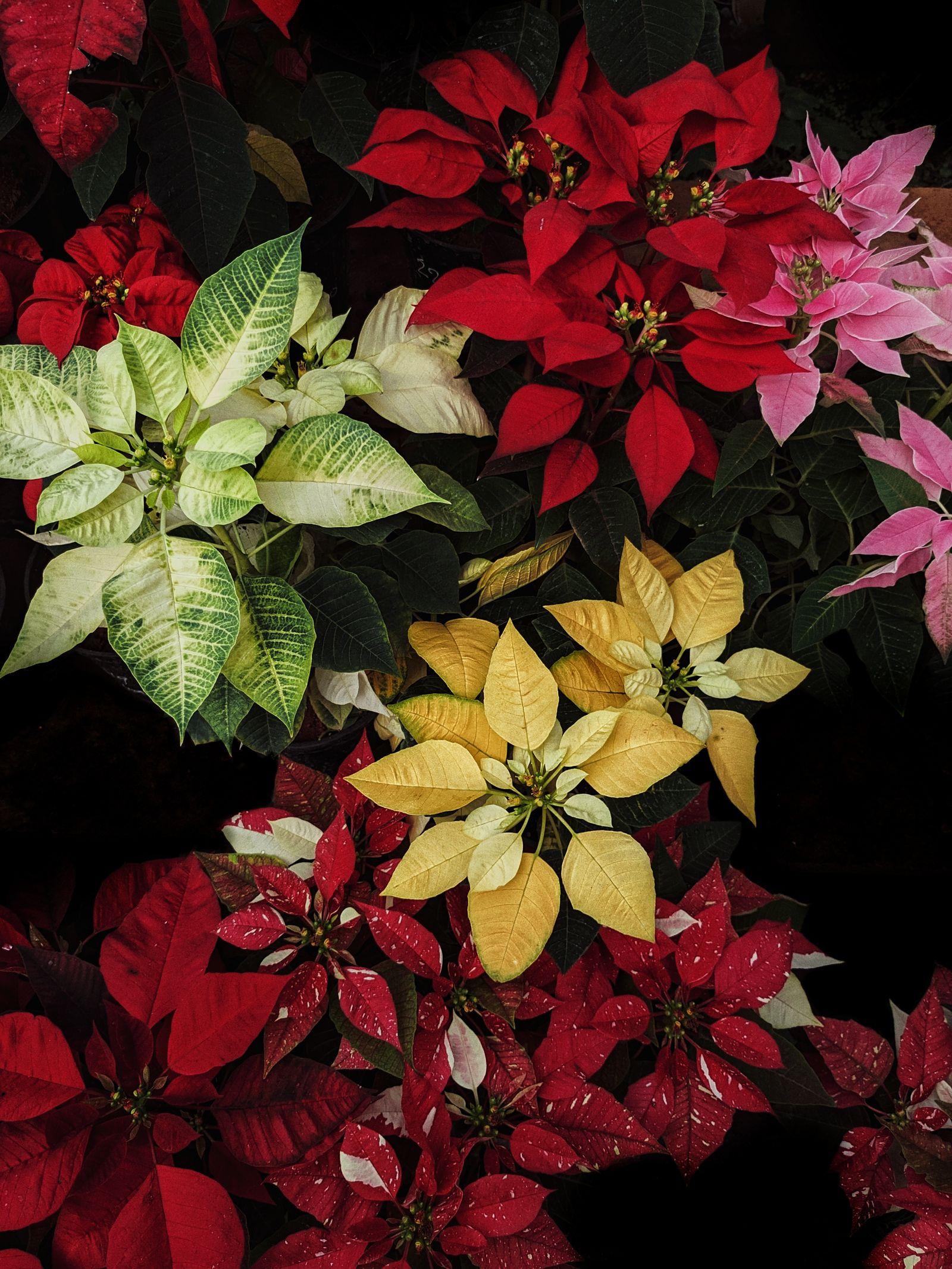
- Poinsettia. The red "petals" are bracts, which are modified leaves, and they hold colour for months indoors. The true flowers are the small yellow cyathia at the centre, and once those drop the display is on borrowed time. Getting the colour back next year takes a strict autumn routine, set out in our poinsettia care guide.
None of that is difficult growing. If you would rather start with something chosen for staying power, the plants and orchids we deliver sit in the same bright-indirect-light bracket, and our roundup of the easiest indoor plants to keep alive covers the year-round versions.
Why some holiday plants outlast others
Whether it is still growing, or only spending. Paperwhites and most florist cyclamen are performing on stored energy that a grower built up over a full season and then timed to release on cue. Once the bulb or tuber has spent it, nothing is queued behind it. Amaryllis sits in the middle: forced in the same way, but the bulb rebuilds itself if you keep the leaves fed and lit.
Room temperature decides more than anything printed on the label. Paperwhites in a warm apartment stretch, flop and finish inside two weeks; the same bulbs in a cool hallway stay compact and hold on considerably longer. Florist cyclamen (Cyclamen persicum) is the clearest case of all. It flowers for months in a cool room, sulks beside a radiator, and its summer dormancy asks for a cool rest that most apartments cannot give it.
The poinsettia's reputation, and its actual ASPCA entry
No, and the correction is worth stating precisely rather than loosely. The ASPCA lists poinsettia (Euphorbia pulcherrima) as toxic to dogs, toxic to cats and toxic to horses, giving irritant sap as the toxic principle. In the clinical-signs line of that same entry it describes the plant as "Irritating to the mouth and stomach, sometimes causing vomiting, but generally over-rated in toxicity."
The human data is blunter still. Writing in the American Journal of Emergency Medicine in 1996, Krenzelok, Jacobsen and Aronis reviewed 849,575 plant exposures reported to American poison centres. Of the 22,793 poinsettia exposures, there were no fatalities. 92.4% of those exposed developed no toxicity at all, and 96.1% were never treated in a health care facility. Those are human poison-centre figures, not veterinary ones, so they say nothing about a dog's stomach.
The myth has a paper trail. It begins with a 1919 story about a two-year-old said to have died after eating a poinsettia leaf, repeated in H. L. Arnold's 1944 book Poisonous Plants of Hawaii, which Arnold later admitted was hearsay. In 1970 a US Food and Drug Administration publication stated erroneously that one poinsettia leaf could kill a child. An attempt to find a poisonous dose in rats failed at roughly the equivalent of 500 leaves.
Practically: a dog that chews one will probably drool and may vomit, which is a call to your vet rather than an emergency. The sap is a real skin irritant, particularly for anyone with a latex allergy, so wear gloves when you prune.
Which Christmas plants are safe around cats and dogs?
Two December regulars sit on the ASPCA's non-toxic list for dogs, cats and horses: Christmas cactus (Schlumbergera bridgesii) and Norfolk Island pine, which the ASPCA files under "Australian Pine" (Araucaria heterophylla). NC State Extension's Plant Toolbox independently tags Schlumbergera non-toxic for cats and dogs, and Araucaria heterophylla non-toxic for cats, dogs and horses, with no poison section on either. The ASPCA also lists rosemary (Rosmarinus officinalis) as non-toxic to all three, and Phalaenopsis orchids the same.
The ones that need thinking about:
- Amaryllis. Toxic to dogs, cats and horses per the ASPCA, with lycorine among the toxic principles; the listed signs include depression, diarrhea, abdominal pain, hypersalivation, anorexia and tremors, plus vomiting in dogs and cats. Pet Poison Helpline notes that the raphide oxalate crystals "are more concentrated in the bulbs", and the bulb is exactly what gets gifted, sitting at nose height in a glass jar.
- Paperwhites. The ASPCA files "Paper White" under its Daffodil entry (Narcissus spp.), toxic to dogs, cats and horses, with the bulb the most poisonous part.
- Cyclamen. ASPCA-listed toxic to dogs, cats and horses, the tuber most of all.
- Holly, mistletoe and English ivy. The oldest Christmas greenery is the toxic end of the list, all three toxic to dogs, cats and horses.
If the plant turns up inside a mixed arrangement, check what came with it. True lilies and daylilies cause fatal kidney failure in cats, the pollen and the vase water included, and the answer is not to stand them somewhere high. It is to keep them out of a cat's home altogether, as our guide to lilies and cats explains.
What a Toronto winter does to a plant between the shop and the table
Cold damage is the part nobody sees coming. December here sits around freezing, poinsettias are tropical shrubs, and even a short spell below about 10°C is enough to trigger leaf drop days later. That plastic sleeve at the greenhouse door is doing real work. Do not leave a plant in a parked car while you finish the shopping; carry it inside first, then go back out.
Indoors, the opposite problem starts. Forced-air heat in a December apartment is drier than anything these plants meet in the wild, so keep pots off radiator tops, away from the draft at the front door, and water when the top centimetre of mix is dry rather than on a fixed day of the week. Room-temperature water only. Cindy's Flowers hand-ties and packs every order in our Toronto studio and delivers across the GTA Monday to Saturday, which spares a plant the walk across a windy parking lot.
Which Christmas plant should you give?
Match the plant to the person, not to the wrapping paper.
- The host who owns everything already: a rosemary tree. Decoration in December, dinner in January.
- A first apartment or a new house: a Norfolk Island pine, festive now and a plain green houseplant by March. It sits comfortably beside the rest of what we send as a housewarming gift.
- Someone who enjoys an event: an amaryllis bulb, because watching the stalk climb is half the gift. Given the ASPCA listing above, it is toxic to cats as well as dogs, and height is no barrier to a cat, so it is not the gift for a home with either.
- A household with a cat: a Christmas cactus, or a moth orchid from our orchid and plant collection. Both are on the ASPCA's non-toxic list for dogs, cats and horses.
- Someone who wants the room to look like Christmas by Friday: flowers rather than plants. Our Christmas flower delivery covers the table centre, and the full bouquet collection shows what is on the bench this week.
A plant gift is a slower thing than a bouquet. It asks for a windowsill and a little attention, and it pays that back in February, when nothing else in the room is green.