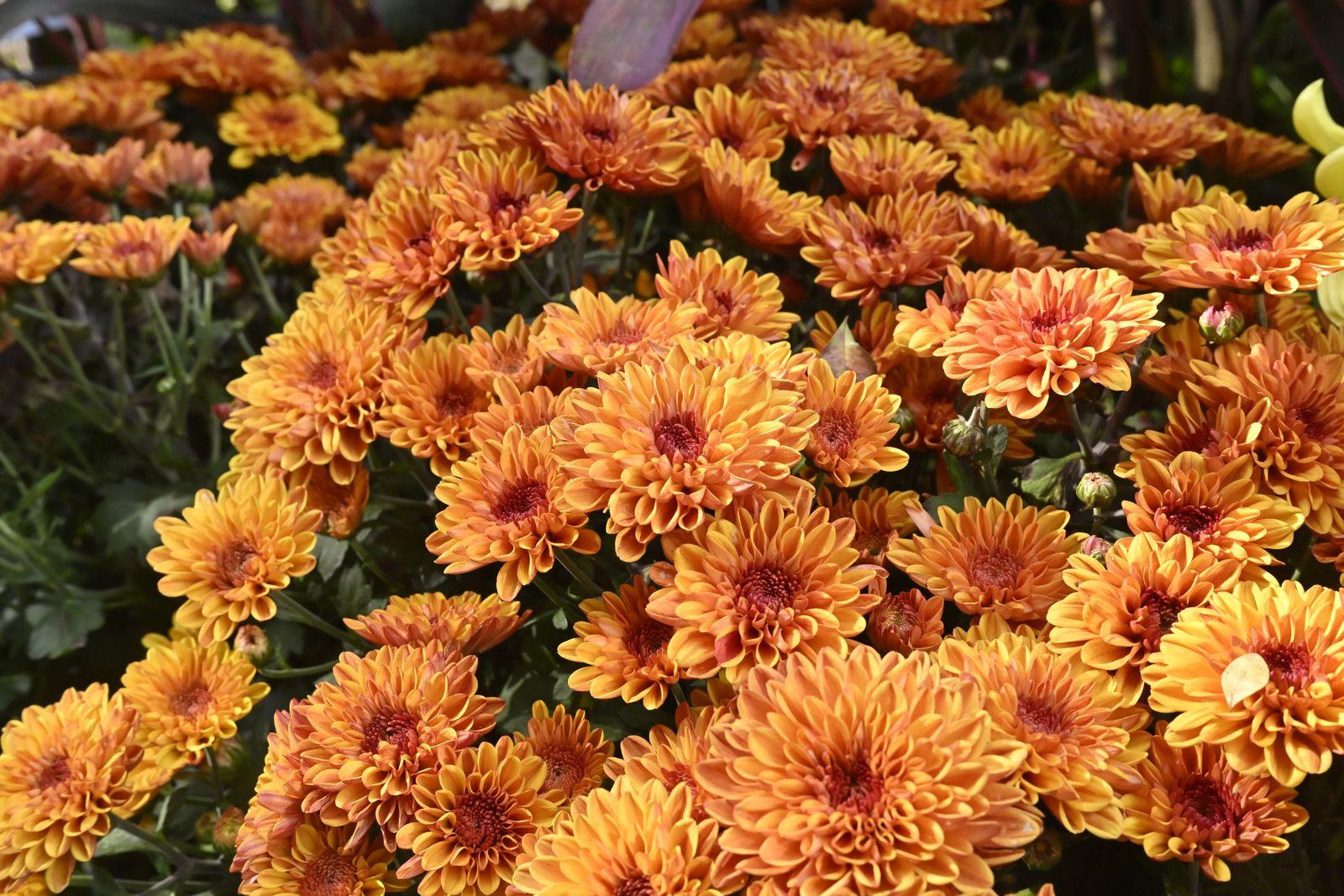
November's birth flower is the chrysanthemum, and it holds a distinction none of the other eleven months can claim. On the Old Farmer's Almanac's birth-month table, every month but one lists two flowers, a primary and a secondary. November lists one. The column where its partner bloom should sit is a dash. That single detail changes how the month's meaning of friendship, loyalty and honesty should be read, and it settles the peony question people keep asking. For the birthday itself, Cindy's Flowers hand-ties chrysanthemum arrangements in our Toronto studio for same-day delivery across the GTA.
Why is November the only month with one birth flower?
There is no botanical reason for it, only editorial choice. Run down the Almanac's table and the pattern is obvious. January takes the carnation and the snowdrop. February, the violet and the primrose. April pairs the daisy with the sweet pea, June the rose with honeysuckle, September the aster with morning glory, December the narcissus with holly. Eleven months, eleven pairs. November's secondary column is empty.
Readers noticed, and asked why. Answering that question under the table itself, the Almanac's editors replied: "We're just selecting the most popular flower; there may be others if you Google around." For a reference work, that is a candid thing to say, and it is the key to the whole custom. Birth flowers are convention, not registry.
Penn State Extension's Master Gardener program puts it in plainer language. It traces the tradition to the language of flowers found in "ancient Greek mythology, ancient Roman, Egyptian and Chinese texts, and folklore from European and Asian cultures", notes that the language of flowers was "especially popular in the Victorian era", and is blunt about what the meanings rest on: "The meanings are not based on scientific study but on folklore and tradition passed on through generations." Our complete guide to birth flowers by month sets out all twelve if you want the rest of the year.
Why do some lists give November two birth flowers?
Because plenty of modern charts have quietly added the peony. Search the phrase and you will find gardening sites, florist blogs and Google's own AI summary offering the peony as November's secondary or alternative bloom. It is not in the Almanac's table, which leaves that column blank, and it is not in Penn State Extension's November post either.
The honest framing is that the pairing is recent, not wrong. Lists like this drift, they always have, and nobody was ever the custodian of the official version. If the peony means something to the person you are buying for, that matters more than which chart it came from; note that the ASPCA lists peony as toxic to dogs, cats and horses, the same as the chrysanthemum. Just know where the claim starts before you repeat it as tradition.
There is a practical catch as well. Peonies are a late-May-into-June flower in Ontario, as our guide to peony season explains, so a peony in a November bouquet has flown in from the other side of the world. The chrysanthemum, for all the argument about what it means, is genuinely a flower of the northern autumn.
Friendship, loyalty and honesty belong to the mum alone
Here is where the one-flower status starts to pay off. The Almanac's table gives each month a meaning, and for eleven months that meaning covers a pair. Its own per-month pages split them back apart: hope belongs to January's snowdrop, remembrance to August's poppy and gladiolus together, protection to December's holly. Hand the whole phrase to the primary flower and you have credited it with its partner's half.
November has no partner. "Friendship, loyalty, honesty" is the chrysanthemum's entire reading, unshared, which makes it one of the few birth flowers you can quote without a footnote. It is also a notably unromantic set of words. The mum suits a long friendship, a sibling, a parent or a colleague far better than it suits a new relationship, and it is a natural fit for a just-because bouquet sent for no reason beyond keeping in touch.
The flower's wider symbolism, colour by colour and culture by culture, is a much bigger subject than the birth-flower chart. Our chrysanthemum meaning guide covers that ground.
November's birth flower is out of season in November
The Almanac notes that the bloom assigned to each month "is usually tied to the season when it blooms". For November in this part of the world, the link is off by a few weeks.
UMass Extension's scheduling fact sheet for commercial growers puts natural garden mum flowering for a Massachusetts fall crop at roughly September 10 to October 10, depending on cultivar. The Old Farmer's Almanac puts Toronto's first fall frost at around October 13, a one-in-three-years-early date rather than an average. Line those dates up and the outdoor mum display across southern Ontario begins mid-September to mid-October and tapers after the first hard frost, which often means it runs into early November. By the later November birthdays, the porch pots are usually done and the garden has little left to give.
None of that is a problem for a gift. Chrysanthemums flower in response to day length, and commercial growers control it, so the mums a florist cuts are greenhouse crops rather than garden survivors. They are available in November, in February, and in any other week you need them. What shifts month to month is what sits alongside them, which is the real reason to browse the current bouquets rather than order from a photograph taken last autumn.
The Almanac still gives the flower its due for the season it does own, calling the mum "the flower most associated with the fall season, providing the last pop of color in the garden."
How to send a November birth flower gift
A few things I would tell a friend before they ordered:
- Mix them, do not mass them. A bunch of white mums on their own reads as a funeral flower in East Asia, and across much of Europe it is the chrysanthemum itself, whatever the colour, that belongs on a grave. Folded into an autumn mixed bouquet with roses and seasonal foliage, that association falls away.
- Know the two forms. Spray mums carry several smaller blooms per stem and give a bouquet volume. Disbudded mums are grown to one large flower per stem and give it a focal point. Ask for whichever suits the arrangement you are picturing.
- Check for pets before you order. The ASPCA lists the chrysanthemum as toxic to dogs, cats and horses. If the birthday person shares a home with any of them, roses, alstroemeria, gerbera daisies or sunflowers are the stems to ask for instead.
- Wear gloves if you are arranging them yourself. Chrysanthemum foliage contains sesquiterpene lactones, and repeated handling is behind the contact dermatitis long documented among florists who work with them daily.
- Order before the cutoff. Cindy's Flowers delivers same-day across Toronto and the GTA on orders placed before 3 PM, Monday to Saturday, and our birthday flower delivery arrangements are built around stems that still look right a week after the candles.
November sits in the flattest stretch of the Toronto year. The leaves are down, the snow has not arrived, and little outside is flowering. A birth flower whose whole meaning is friendship, loyalty and honesty could hardly have landed in a better month.