A carnation traditionally means love, fascination and distinction, and the colour does the fine-tuning: light red for admiration, dark red for deep love, white for pure love and remembrance, pink for a mother's love, purple for capriciousness, yellow for disappointment, striped for regret. These readings are convention rather than botany, and the sources behind them disagree more often than most florist blogs admit. Cindy's Flowers hand-ties carnations into bouquets in our Toronto studio and delivers them same-day across the GTA, so if you want to send one of those messages this week, here is what each shade actually says and where it came from.
What do carnations symbolize?
Love, fascination and distinction, roughly in that order of frequency. Iowa State University Extension's language-of-flowers list records the carnation as "Fascination, women love", which is the shortest honest summary of a very long tradition. Distinction is the reading that gets dropped most often, and it fits how the flower is actually used: pinned to a lapel at graduations and civic ceremonies far more than handed over as a romantic gesture.
The old tradition also gave carnations a job no other bloom had. In that same Iowa State list, a solid-colour carnation means "Yes" and a striped one means "No, refusal, sorry I can't be with you". The refusal half is genuinely Victorian, in Greenaway's 1884 list; the solid-colour "Yes" is Iowa State's modern pairing, so only the striped carnation let a Victorian deliver a verdict before the card was opened. Few entries in the language of flowers are that literal, though Greenaway has a handful, from four-leaved clover for "Be mine" to wild tansy for "I declare war against you".
That precision is why carnation symbolism survived when so much of the Victorian code faded. Most flowers carry one broad mood. This one carries a vocabulary, and it changes completely with colour.
Carnation colours, one by one
The colour outranks the flower here, which is unusual. The Old Farmer's Almanac publishes the fullest modern table, while Iowa State's list and Kate Greenaway's *Language of Flowers* (1884) supply the older, blunter readings:
- Light red is admiration, dark red is deep love. The Almanac splits the shade in two. Iowa State compresses both into "My heart aches for you, admiration", and Greenaway's Victorian entry for deep red is far more theatrical: "Alas! for my poor heart."
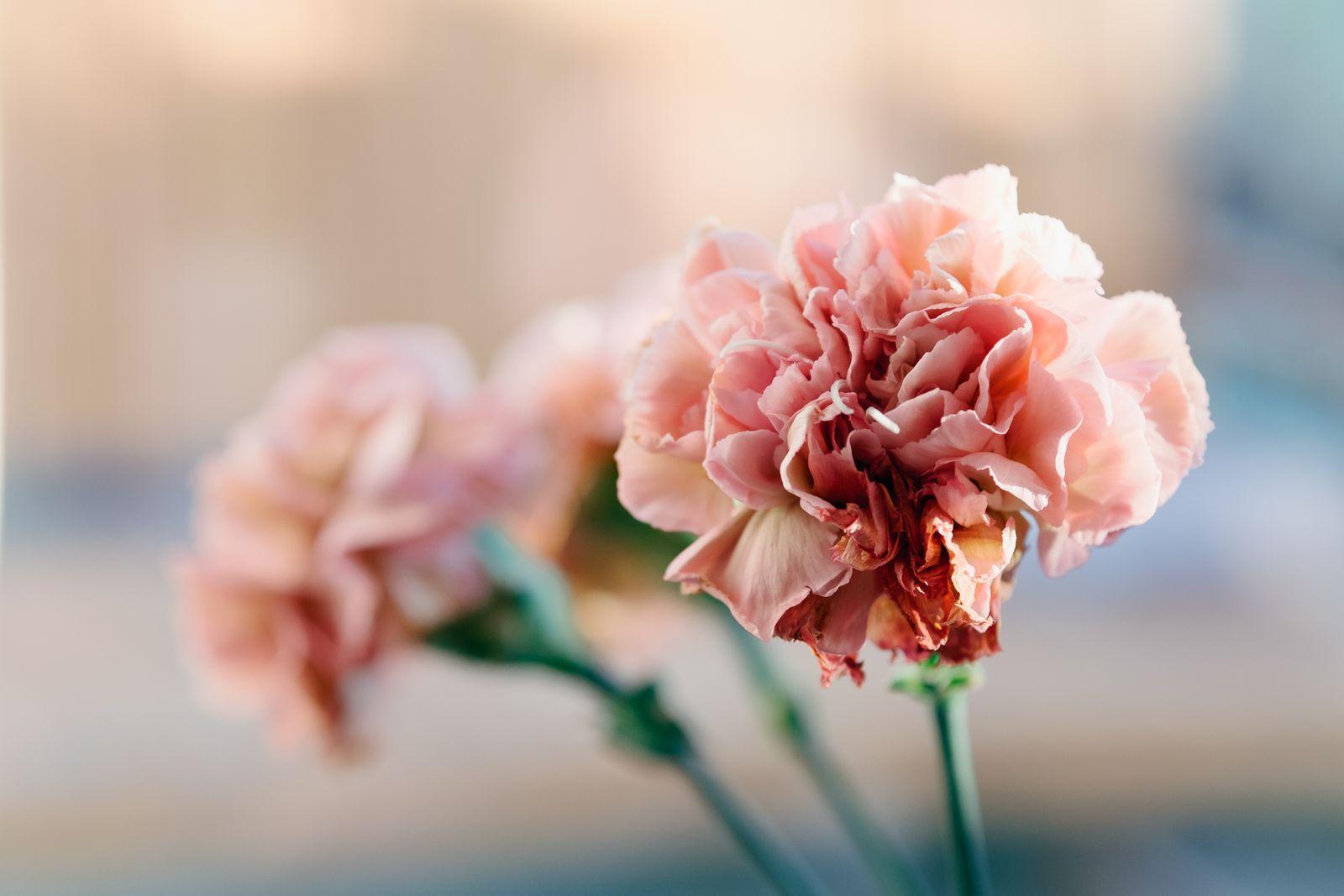
- Pink is affection and a mother's love (Almanac). Iowa State gives pink the line people search for most, "I'll never forget you", and Greenaway lists the carnation itself, filed among the pinks as "Pink, Carnation", under a woman's love. It is the least ambiguous carnation you can send.
- White is innocence, pure love and remembrance (Almanac). Iowa State adds "woman's good luck gift", which is a warmer reading than the memorial one white carnations picked up later.
- Purple is capriciousness in both lists, unusually consistent across a century. In France, carnations are also a traditional condolence flower.
- Yellow is disappointment and rejection (Almanac); Greenaway gives it as "Disdain." Precision matters here, because the internet is careless with it: Iowa State's list contains no yellow carnation entry at all. The "No, refusal" line belongs to the striped ones.
- Striped is regret (Almanac), and refusal in both Iowa State and Greenaway. Hand someone a variegated carnation in 1884 and you had turned them down.
- Green is a bred cultivar colour and, more often, a dye job, most visible around St Patrick's Day. It has no entry in any of the historic dictionaries.
The same colour logic runs across the rest of the flower world, if with less precision; our guide to what flower colours mean covers that wider palette. With carnations, though, the shade is the whole message, which is worth deciding on deliberately when you order carnations for delivery instead of leaving it to whatever the bucket holds.
One colour you cannot buy honestly: blue. No carnation cultivar produces a true blue flower. A blue carnation in a bouquet has been dyed, with engineered exceptions, Florigene's mauve Moondust and violet Moonshadow, both launched in the late 1990s (Florigene's own history dates both to 1996; a journal record puts Moonshadow at 1998), with eleven further Moon series varieties since. The wild plant's own colour is a bright pinkish-purple. Every red, white, yellow and green in the shop was bred into it afterwards.
Why is the carnation called the flower of the gods?
Because of the genus name, not the English one. *Dianthus* is usually credited to the Greek botanist Theophrastus and built from the Greek words for divine and flower. The Old Farmer's Almanac states it plainly: translated from Greek, carnation is often referred to as "flower of the gods."
The English word is a messier story, and nearly everyone tells it with confidence nobody has earned. Three derivations compete:
- Corona, Latin for wreath, garland or crown, since carnations were among the flowers used in Greek and Roman ceremonial crowns.
- Caro (genitive *carnis*), Latin for flesh, describing the flower's natural colour.
- Incarnatio, the Christian term for God taking human form.
The coronation story is the one that gets presented as settled fact across page one of Google and inside AI answers. It is one candidate of three, and the honest position is that the origin is disputed.
The species name is easier to pin down. *Dianthus caryophyllus* is also called the clove pink, after a spicy, clove-like scent that the older varieties carry strongly. Put your nose in one before you write the flower off.
The carnation's reputation problem
Because they are cheap and everywhere, which is a verdict on the supply chain rather than on the plant. Sit with the botany for a minute and the snobbery gets harder to defend.
NC State Extension describes *Dianthus caryophyllus* as a herbaceous perennial reaching 1 to 4 feet, flowering 1 to 3 inches across through the summer, hardy in USDA zones 6a to 9b and happiest in cooler summers with gritty, well-drained soil. The flowers are edible for people when grown unsprayed for the kitchen, though the same NC State page grades the plant low-severity poisonous to humans (mild stomach upset, mild dermatitis), and petals off a delivered bouquet are an ornamental crop, not food. The plant shrugs off deer and rabbits, and it is pollinated by moths and butterflies. A taller type, 3 to 4 feet, is grown specifically for the florist trade, which is where those long stems come from.
Then there is the endurance, which is the part that matters once the bouquet is on a kitchen table. Carnations hold 14 to 21 days in clean water according to the Old Farmer's Almanac, putting them at the head of our roundup of the longest-lasting cut flowers. Cindy's Flowers works them into mixed bouquets for exactly that reason: they are still upright a fortnight later, long after the showier stems around them have collapsed.
The flower's own history argues the same case. Ceremonial crowns, not clearance buckets.
Which carnation should you send?
Match the colour to the message, then say the message on the card anyway. A few pairings that hold up:
- Mother's Day. The carnation is the holiday's traditional flower, and the convention runs pink for a mother who is living, white in memory of one who has died, red for love and admiration. The carnation itself traces to Anna Jarvis in 1908, who handed out white ones for every mother; the pink-for-living, white-for-deceased split was a florists' invention that came later; our Mother's Day guide tells that story properly, and Mother's Day arrangements go out across the GTA.
- Remembrance. White, for the reasons above, and it reads gently rather than mournfully.
- Romance or long admiration. Dark red, in enough quantity that the shade reads as a decision.
- A get-well or thank-you note. Pink, which carries warmth without asking for anything back.
- Yellow or striped. Send them because the colour is beautiful, not because you are fluent in Victorian. Anyone who is fluent will read disappointment or refusal.
Two practical notes before you order. The ASPCA lists carnations, as *Dianthus*, toxic to dogs, cats and horses, so mention any animals in the house when you send flowers; roses, alstroemeria, sunflowers and snapdragons sit on the ASPCA's non-toxic list and cover a lot of colour between them. And carnations arrive year-round from greenhouse growers, so unlike Ontario peonies there is no season to wait for. The full bouquet lineup is online, hand-tied in our Toronto studio and out for same-day delivery when the order lands before 3 PM, Monday through Saturday.