Lisianthus is Eustoma grandiflorum (also called E. russellianum), a gentian-family wildflower from the Great Plains of the United States, south into Mexico, that Japanese breeders turned into the closest thing to a rose that isn't one. Its double forms carry soft, layered petals, but each stem branches into several flowers and buds, with no prickles. By modern florist convention it means appreciation. The care habit that matters most is pinching off each spent flower so the buds behind it can open. The ASPCA doesn't list lisianthus, so treat its pet safety as unverified. To see the resemblance in person, Cindy's Flowers hand-ties lisianthus into mixed bouquets in our Toronto studio.
Where does lisianthus grow wild?
On open grassland, and farther north than most people guess. The Lady Bird Johnson Wildflower Center gives the florist's lisianthus a native range from Nebraska and southeastern Wyoming south through Texas into Mexico, in moist spots in fields and prairies, especially near streams. It flowers there from June to September and goes by Texas bluebell, showy prairie gentian or plain prairie gentian.
Its botanical name is messier than the bouquet. The Wildflower Center files the plant as Eustoma exaltatum ssp. russellianum, while the Royal Horticultural Society lists Eustoma grandiflorum, gives E. russellianum as a synonym and marks the name unresolved. Either way, it sits in a genus of just two or three species in the gentian family, Gentianaceae.
One myth needs correcting: lisianthus isn't native to Japan. Japan is where it was bred into the flower florists know. The Wildflower Center notes that Japanese breeders have worked on Texas bluebells for more than 70 years, developing pink, white and deep purple-blue forms in single and double petals, and that the plant still goes by its old genus name, Lisianthus, in Japan.
Those looks have cost the wild plant. According to the Wildflower Center, Texas bluebells are scarcer than they once were because people picked so many that wild stands couldn't reseed. Admire them where they grow.
What do the names mean?
Eustoma joins the Greek eu-, good or well, to stoma, mouth: a pleasing mouth, which the Wildflower Center takes as a reference to the wide opening into the flower's throat. Lisianthus, the obsolete name the trade never let go of, comes from lissos, smooth, and anthos, flower. You'll also see "dissolving flower", from the Greek lysis, offered online as its meaning, but that reading circulates on florist sites without a cited source.
Even that old name was shared around. Dr. Lena Struwe's Gentian Research Network at Rutgers University counts three different gentian groups once called Lisianthus. A separate genus first described from the Caribbean, spelled Lisianthius, holds the name under botanical rules today. Eustoma is the one called lisianthus in English.
The rose look-alike, up close
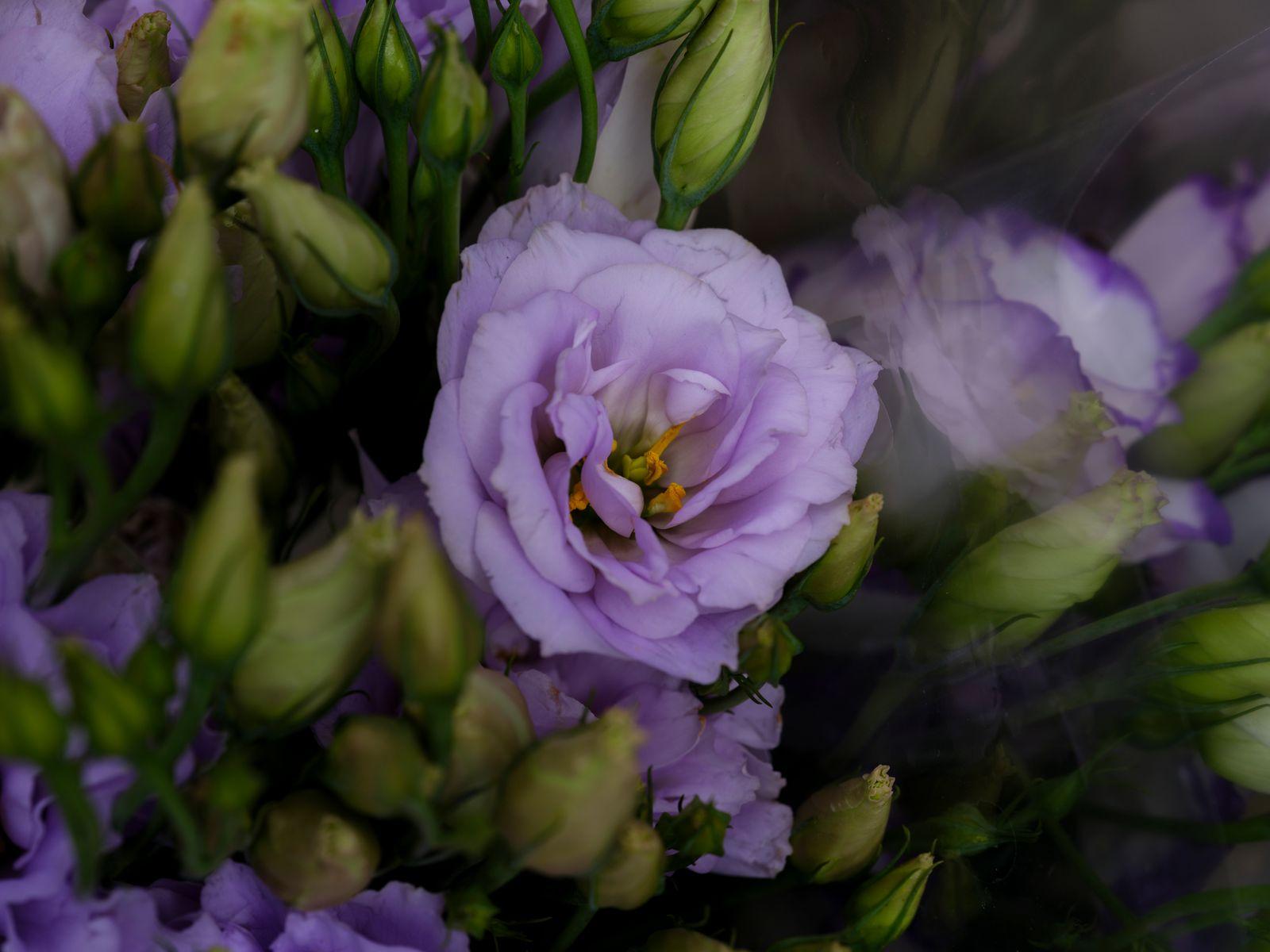
Lisianthus earns the comparison twice, in bud and fully open. The Pick Ontario profile from Flowers Canada Growers says the closed buds "look like rose buds", and Plants and Flowers Foundation Holland says the most popular of the hundreds of E. grandiflorum cultivars are double-flowered and closely resemble roses. So how do you tell them apart? Four details give it away.
- Several flowers to a stem. A lisianthus stem branches, carrying open flowers and buds together. A standard long-stemmed rose carries a single head, though spray roses break that rule.
- Nothing sharp. A rose technically has prickles rather than thorns, as our guide to the types of flowers explains. Lisianthus has neither, so there's nothing to strip.
- A finer stem. Slimmer stems give the whole flower a lighter, airier look in the vase.
- A looser bloom. Fully open, the flowers take on what the Pick Ontario profile calls "the loose-petal form of a poppy or a tulip". That softness is the quickest tell.
Colour is the other giveaway. Cornell University's high-tunnel cut-flower guide lists lisianthus in white, cream, green, pink, blue and purple, some with darker picotee edges or darker centres, and notes that ruffled edges make a flower look fuller with fewer petals. The purple-blue end is where lisianthus beats the rose outright, since no rose makes a natural blue.
What does lisianthus mean?
By modern florist convention it means appreciation and gratitude, with charisma sometimes added. Kate Greenaway's Language of Flowers, published in 1884, has 713 entries and none for lisianthus, so treat any Victorian pedigree claimed for it with suspicion.
I find that freeing rather than disappointing. A flower with no inherited code says what you write on the card, and our post on the Victorian language of flowers argues that was always the more dependable method anyway. Lisianthus has no colour code of its own either, so a purple or white stem simply borrows the general colour conventions.
In practice, appreciation suits a thank-you, and the rose-like shape suits romance without the formality of a dozen red roses. That's why lisianthus slips so easily into an anniversary bouquet, especially for a couple who've already had the red roses many times over.
Why growers put up with a slow crop
Each branched stem does the work of several, and Canadian growers produce it in volume. Statistics Canada counted 13.9 million greenhouse lisianthus stems in 2024, 3.3 per cent of the country's greenhouse cut flowers and nearly four times the 3.6 million roses cut under Canadian glass, figures Agriculture and Agri-Food Canada republishes.
That's a count of what Canada grows, not what it buys. Canada imports more cut flowers than it exports.
It isn't an easy plant. Cornell's guide describes a tiny seed that is "very slow to reach transplant stage": sown in a greenhouse in late January, seedlings are ready to plant out in early May, and flowering takes another 60 to 75 days. Seedlings grown above 72°F (22°C) can rosette, meaning the stem stops lengthening. Run those dates forward and a winter sowing isn't cut until midsummer.
The Royal Horticultural Society calls it "an excellent cut flower", and it's a regular in our mixed bouquets for that reason: a few branched stems bring rose-like softness and a run of buds without the weight of a full rose bouquet.
Between first frost and midsummer, any lisianthus in a Toronto vase was grown under glass or somewhere warmer.
What does the ASPCA say about lisianthus?
Nothing, and that's the honest answer. The ASPCA's plant lists don't include lisianthus in either direction, toxic or non-toxic. Absent from the list means unproven, not safe, so treat its pet safety as unverified and don't assume a chewed stem is harmless.
Uncertainty grows once lisianthus is part of a mix. Its companions in a mixed bouquet change with the market, and several common ones are ASPCA-listed as toxic to dogs, cats and horses, so a mixed arrangement isn't the gift for a home with a cat or dog.
For that home, our pick is a potted moth orchid. The white and pink Phalaenopsis orchids are plants the ASPCA lists as non-toxic to dogs and cats.
How long does lisianthus last, and how do you care for it?
Expect anywhere from about five days to more than two weeks, and the cultivar matters as much as the handling. In North Carolina State University's 2006 postharvest trials, 'ABC Lavender' lasted longest, 12 days, with a hydrating solution plus a holding solution, and shortest in plain water, where its weakest stems gave out after five days. 'ABC White', in the same trials, lasted 14 to 16 days whatever it was treated with, so treat any single number loosely.
The same NC State program summed up eight years of these trials in HortTechnology in 2010 (Clark, Dole and colleagues). Across 16 lisianthus cultivars, a holding preservative, the flower food in the sachet, made no difference to 11, added 1.5 to 6.5 days for three and cost two of them up to 2.3 days. Their firmer advice concerned the hydrating pretreatment: "a hydrator should not be used with lisianthus". Our comparison of grocery-store and florist flowers covers what the study found across all 121 cultivars.
In short, the response depends on the cultivar, so the authors say individual cultivars should be tested, and that 'ABC Lavender' result rests on just eight stems per treatment. The four industry guides the paper compares, Armitage and Laushman's Specialty Cut Flowers among them, all recommend a holding preservative for lisianthus, and Cornell's guide says commercial vase solutions "stimulate bud development and aid vase life", so use the sachet if your flowers came with one. You won't know which cultivar is in your vase, so put the rest of the effort into habits that don't depend on it:
- Pinch off each flower as it fades. The buds behind it keep opening from the bottom of the stem up, as the Old Farmer's Almanac describes, and Plants and Flowers Foundation Holland credits that gradual opening with stretching a lisianthus bouquet further.
- Judge the stem by its buds. Our mixed-bouquets page expects lisianthus to fade first in a mix, but unopened buds mean it isn't finished.
- Keep the basics tight. The recut, the leaves below the waterline and the fruit bowl are all covered in our guide to making cut flowers last longer, while our rundown of the longest-lasting cut flowers names the varieties built to last longest.
Give it a few days before you judge it, because a lisianthus that looks half-finished on day one is usually just getting started. Cindy's Flowers hand-ties it into bouquets in our Toronto studio and delivers across Toronto and the GTA Monday to Saturday, the same day on orders placed before 3 PM.