The anemone flower is the windflower, a member of the buttercup family whose name is conventionally traced to the Greek anemos, wind. Its myth belongs to Adonis: Ovid has it rising from his blood, an earlier Greek poet from Aphrodite's tears. By modern florist convention an anemone usually stands for anticipation, though the Society of American Florists gives fragile and older flower dictionaries forsaken. The one in a bouquet is Anemone coronaria, the poppy anemone, a cool-season stem at its best from late fall into spring, short-lived in water and happiest kept cold. If you'd like to give some, Cindy's Flowers hand-ties seasonal bouquets in our Toronto studio and can tell you when good anemone stems are in, though every part of the plant is poisonous, so skip them for a home with pets.
Was the anemone born from Adonis's blood or Aphrodite's tears?
It depends which poet you trust. In Book X of Ovid's Metamorphoses, Venus finds Adonis killed by a boar and sprinkles his blood with nectar; within an hour a blood-coloured flower springs up, "such as pomegranates carry," in A. S. Kline's translation. Bion's Lament for Adonis, an earlier Greek poem, divides the grief differently, in J. M. Edmonds's translation: "Of the blood comes the rose, and of the tears the windflower."
So for Ovid the anemone is Adonis himself, and for Bion it's Aphrodite's mourning. The version repeated across flower-meaning sites, where her tears mix with his blood to make one flower, stitches the two poems together. Neither poet tells it that way. If the story is going on a gift card, pick a version and credit the poet.
Ovid also explains the flower's mood better than any dictionary does. The bloom doesn't last: the winds shake its petals loose, he says, and those same winds give it its name. A love cut short, then a flower that falls apart in a breeze. It's a good deal darker than most bouquet copy admits.
One botanical snag: Adonis (pheasant's eye) is a separate genus named for the same hero, so "the Adonis flower" can point a reader to the wrong plant.
Did the wind really name the anemone?
Probably, though not for the reason the ancients gave. The Online Etymology Dictionary dates the English word to the 1550s, from the Greek anemone, "wind flower," literally "daughter of the wind," built on anemos, wind. Pliny the Elder supplied the explanation in his Natural History, in the Bostock and Riley translation: "The flower never opens, except while the wind is blowing, a circumstance to which it owes its name."
Pliny had the mechanism wrong. The Society of American Florists notes that anemone blooms close in cold and dark and reopen in light, and Floralife ties the opening to warmth and daylight. Wind plays no part. The Old Farmer's Almanac records a kinder explanation from Irish and English folk tales: when the petals folded shut at night, fairies were believed to be sleeping inside.
Is the wind even the right story? The same dictionary notes a suggested Hebrew origin, and a related theory derives the word from Na'aman, a Phoenician epithet of Adonis. If that holds, "windflower" is a Greek folk explanation laid over a borrowed word, and the flower's name and its myth were one story all along. Treat the wind as the conventional derivation, not a settled one. However you trace it, say it uh-NEM-uh-nee.
The florist's anemone is not a poppy
The anemone in a florist's cooler is Anemone coronaria, the poppy anemone, a tuberous perennial native to the Mediterranean. It belongs to the buttercup family, Ranunculaceae, and "poppy" only describes its resemblance to the corn poppy. What look like petals are coloured sepals: Wikipedia counts five to eight, NC State Extension seven to nine. Most anemone species have no true petals at all.
The two cultivar groups you'll meet most often:
- De Caen anemones carry single flowers. They descend from hybrids cultivated around Caen and Bayeux in Normandy in the 18th century, and the white one is called 'The Bride'.
- St Brigid anemones are semi-double or double, and take their name from Ireland's saint.
The genus itself is a moving target. Kew's Plants of the World Online now accepts 106 species, with the Japanese anemones moved to Eriocapitella and the Canada anemone to Anemonastrum. So the tall pink and white Japanese anemones that flower in Toronto gardens at the end of summer are, strictly, no longer anemones, though NC State Extension rates them as poisonous too. Botanists redraw lines. Gardeners keep the name.
The white anemone with the black eye
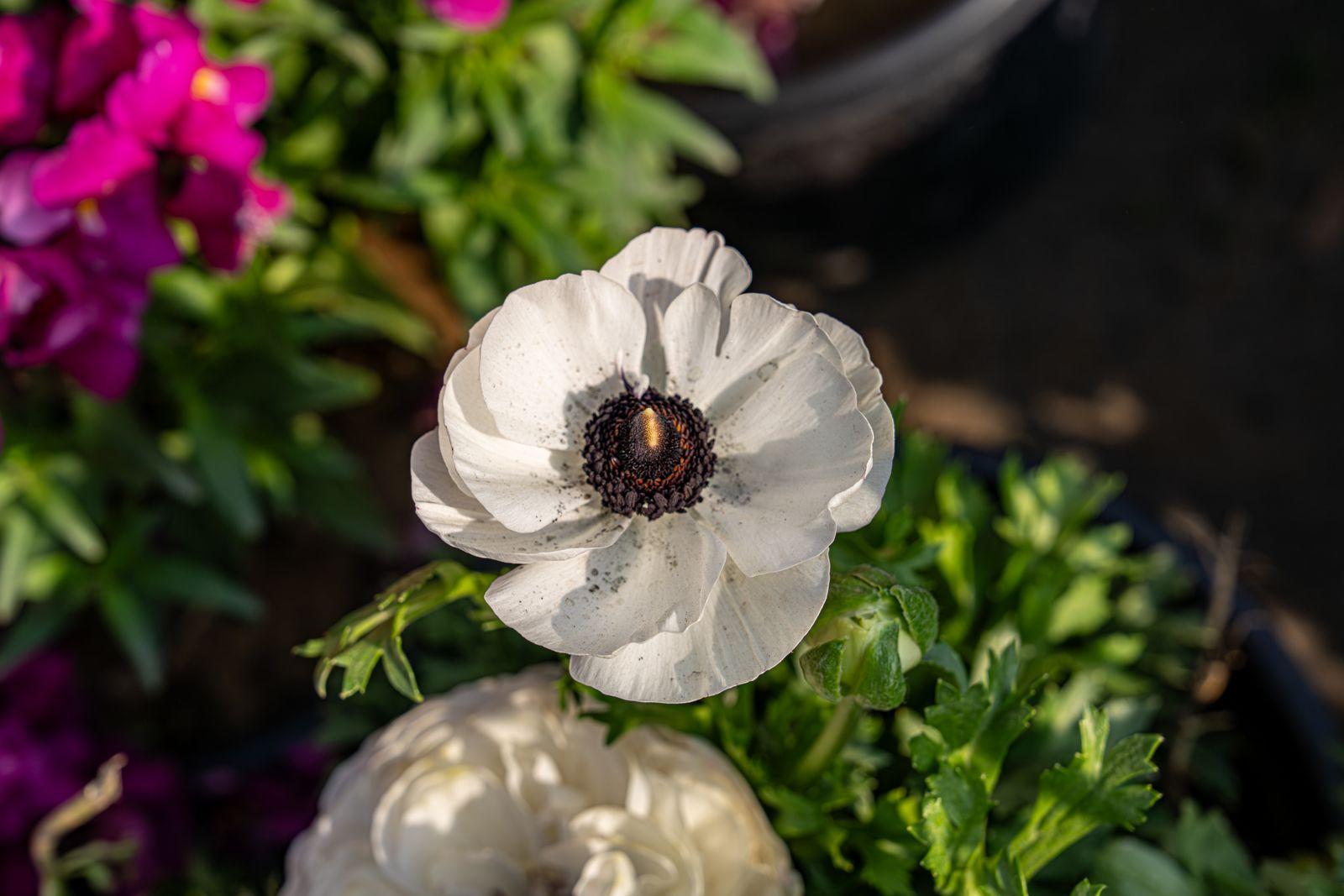
The classic look is pure white around a dark centre. That centre is a mound of tightly packed pistils ringed by a crown-like circle of stamens. Coronaria comes from the Latin for crown or garland, perhaps for that ring, perhaps for the flower's use in garlands. Some white varieties have a pale green centre instead, so the black eye is a variety choice.
Bulb growers sell the black-eyed form under names such as 'Bianco Centro Nero', from the Italian Mistral series, and some nickname it the panda anemone. The palette runs well past white. Cultivated anemones come in bluish violet, pink, red and violet-pink, though Wikipedia is blunt that there are "no truly blue anemones." What's sold as blue is blue-violet.
When are anemone flowers in season in Toronto?
From late fall into spring, through the cut-flower market rather than local gardens. Anemone coronaria is a cool-season crop: Utah State University Extension puts its ideal temperatures for growth and flowering at 12 to 18°C by day and 5 to 10°C at night, and above about 27°C flower production declines as the plant goes dormant. Summer heat shuts it down.
That makes the anemone one of the more honest winter flowers. Much of a Canadian winter vase is forced, flown in or grown under glass, and our guide to winter flowers in season maps each of those routes. By mid-November, with Toronto gardens finished for the year, they're coming into their stride.
Ranunculus runs on the same clock. It's the anemone's buttercup-family cousin and a cool-season crop too. If you love the papery texture but want petals stacked in layers, ranunculus bouquets are the closest relative; the ASPCA lists ranunculus, under its buttercup entry, as toxic to dogs, cats and horses.
Anemones in the vase: short, restless and cold-loving
Plan on a short run: 3 to 8 days, say the Society of American Florists and Floralife. As our mixed-bouquet care guide puts it, the shortest-lived stem sets the pace, and in a mixed bouquet that is usually the anemone. Pull it when it goes and the rest carries on. Inside that window, three habits catch people off guard.
- The stems keep growing. Anemones keep lengthening after they're cut, so a flower that sat level on day one can stand proud of the arrangement by day three. Trim that one stem rather than rebuilding the vase.
- The blooms close at night. A shut anemone at breakfast isn't wilting; a bright room opens it again.
- They want it cold. Use cool water and the coolest room you have, well away from radiators and floor vents. The general routine of recutting, a clean vase and fresh water belongs to our guide to making cut flowers last longer.
One handling note: NC State Extension warns of inflammation and blistering on contact with fresh sap, so wash your hands after recutting, or wear gloves if your skin reacts easily.
Anemones and pets
Treat anemones, Japanese ones included, as toxic to dogs, cats and horses alike. The ASPCA doesn't list the anemone, but the Old Farmer's Almanac calls its protoanemonin moderately toxic to animals and humans, and the ASPCA lists its cousin ranunculus as toxic to all three animals. Where a cat or dog lives, send a potted white Phalaenopsis orchid instead; the ASPCA lists moth orchids as non-toxic to dogs, cats and horses.
What does an anemone flower mean in a bouquet today?
By modern florist convention, anticipation, and the plant's own habits suggest why. The Old Farmer's Almanac notes that the petals close at night and reopen in the morning, so an anemone spends part of every day looking as if it's waiting for something. Here's how the layers stack up:
- Anticipation is the usual modern reading and the one to lean on for a gift, though the Society of American Florists says fragile and Floralife relaxation.
- Forsaken is how nineteenth-century flower dictionaries tended to read the garden anemone, and some lists add sickness or expectation. That last word sits close to anticipation, so the modern meaning may be older than it looks.
- Love cut short is the meaning the Adonis poems actually support.
- Red carries the myth most directly, since Ovid's flower was the colour of blood. White takes the broader white message of purity and new beginnings, which our guide to flower colour meanings covers shade by shade.
An anemone is wasted on a formal occasion and perfect for no occasion at all. It fades fast and looks slightly strange, that dark eye staring out of the bouquet, which suits flowers sent just because far better than an anniversary that wants a rose.
Cindy's Flowers hand-ties bouquets for those no-reason days in our Toronto studio, delivered across the GTA Monday to Saturday, same day on orders placed before 3 PM. Ask about anemones while the cool-season supply lasts, and for a home with a cat or dog, the orchid is the better call.