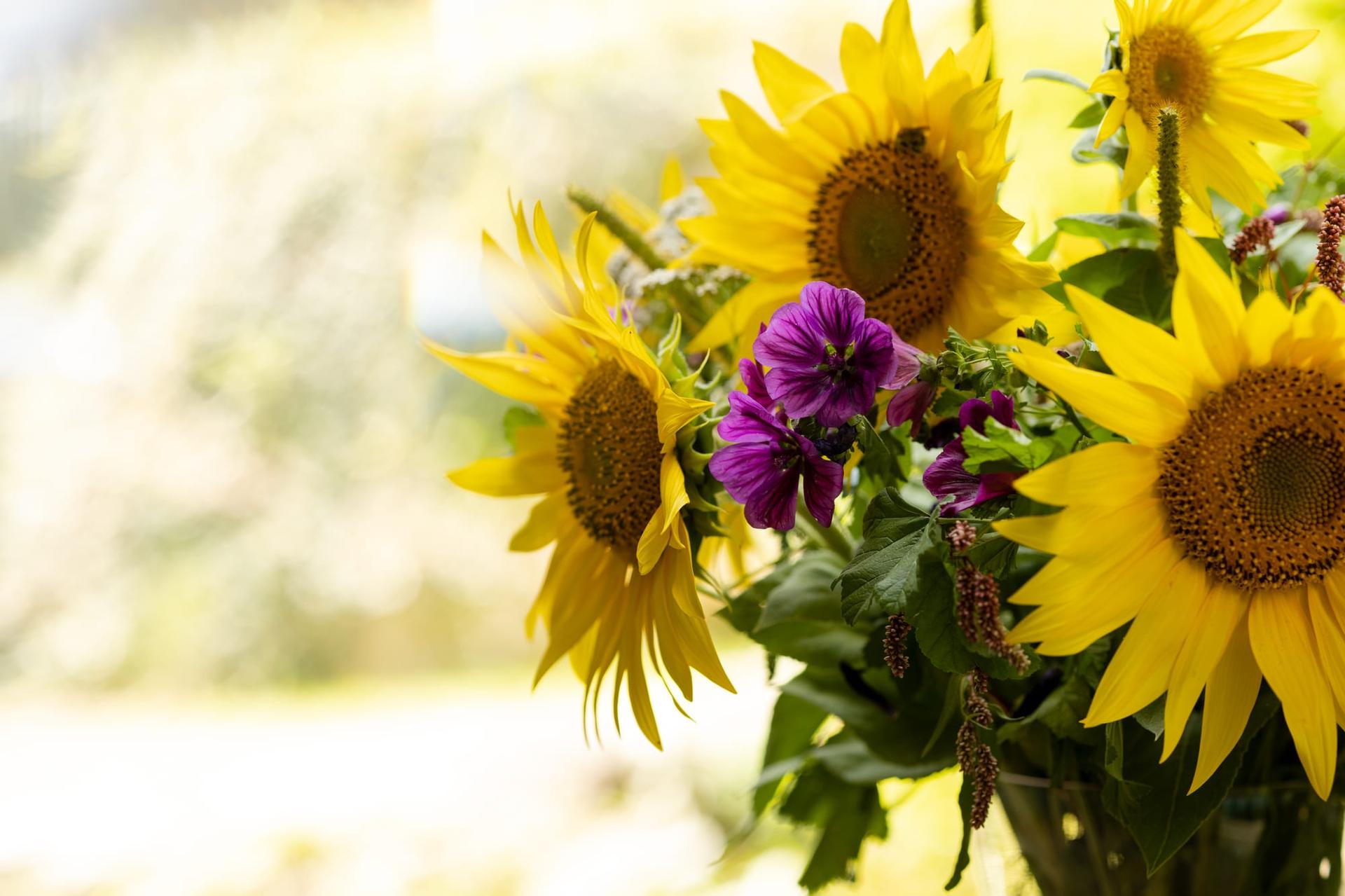
A sunflower means adoration, loyalty, and lasting happiness. That reading is convention handed down by florists and gift-givers rather than old floriography, and it is why a bunch of them reads instantly as a lift rather than a heavy, formal gesture. That same golden colour ties the flower to friendship and hope, a meaning strengthened by its modern role as Ukraine's national flower. As a Toronto florist, I'll walk through what sunflowers symbolize, what giving them says, a few facts that surprise people, when they bloom in Ontario, and how to keep cut stems fresh for a week or two. Vase life starts long before the water goes in, which is why Cindy's Flowers hand-ties bunches fresh in our Toronto studio and delivers them same-day across the GTA when you order before 3 PM.
What do sunflowers symbolize?
By florist convention, sunflowers stand for adoration, loyalty, longevity, and happiness, with warm cross-cultural ties to faith, vitality, and good fortune. It is worth being straight about where that comes from: it is a convention handed down by florists and gift-givers, not a Victorian inheritance. The Victorian dictionaries actually split the flower by size, and they were far less flattering about the tall one. Kate Greenaway's Language of Flowers (1884) gives the dwarf sunflower as adoration, but the tall sunflower, which is the type you buy as a cut stem, as haughtiness. The longevity part is easy to see in the plant itself: it grows tall, holds its bloom for weeks, then hands off a head full of seeds, so it reads as endurance as much as cheer.
The devotion theme is usually given an old root. It gets traced to the Greek myth of Clytie, a water nymph who pined for the sun god and was turned into a flower that followed him across the sky. Here is the nuance most retellings skip: that sun-chasing flower was almost certainly heliotrope, not the sunflower. True sunflowers are native to the Americas and were unknown to the ancient Greeks, so the plant we picture never actually appears in the myth.
Colour shifts the message, again by convention:
- Yellow, the classic shade, leans toward friendship, warmth, and vitality.
- Red and orange cultivars are read as strength and optimism.
Two cultural moments cemented the flower's modern meaning. Vincent van Gogh's 1888 Sunflowers series helped fix the bloom as shorthand for gratitude and warmth. And as the national flower of Ukraine, the sunflower has become, since the 2022 invasion, a widely recognized symbol of solidarity, resistance, and hope. It is the state flower of Kansas too, the original Sunflower State.
What does giving someone sunflowers mean?
Handing someone sunflowers is generally read as "I admire you" and "you brighten my day." Their upbeat symbolism, loyalty, warmth, and cheer, makes them a natural pick when you want to lift a mood rather than send a romantic signal. In the language of love they lean platonic and steadfast: devoted friendship and long-loyal partnership more than first-date passion. A single tall stem can carry the same message on its own, a small "you are my sunshine" rather than a grand statement.
A few related questions cluster here. Spiritually, sunflowers are widely associated with positivity, faith, and turning toward the light, a metaphor many find comforting even though the flower has no scripture behind it. As a tattoo, a sunflower usually carries the same ideas its blooms do: happiness, resilience, and devotion.
By florist convention, and these lists are informal rather than official, the sunflower is also tied to the third wedding anniversary. Because the whole message skews so sunny, it makes an easy just-because gift when the only reason is wanting to brighten someone's week.
Sunflower facts that surprise people
Here is the one that reliably gets a reaction: a fully open sunflower does not follow the sun across the sky. Only young buds do that. Researchers reported in the journal Science in 2016 that immature plants track the sun east to west by day and swing back east overnight on an internal clock. Once the head matures and opens, it stops tracking and settles facing east, which is why a field of open sunflowers all seems to stare in one direction. Facing east is not random, either: the morning sun warms those blooms faster, and warmer flowers draw more pollinators, part of the same 2016 research.
A few more worth knowing:
- The botanical name is Helianthus annuus, from the Greek helios (sun) and anthos (flower), plus the Latin annuus, meaning annual. It belongs to the daisy family, Asteraceae.
- Sunflowers are North American natives, domesticated by Indigenous peoples of the Americas more than 4,000 years ago.
- What reads as one flower is really a head packed with hundreds of tiny florets, all of them true flowers. The outer "petals" are ray florets, which are sterile and do the advertising; the fertile disk florets at the centre are the ones that set seed, arranged in interlocking Fibonacci spirals at the golden angle of about 137.5 degrees for the tightest packing.
- Beyond the vase, the sunflower is a major food crop, grown worldwide for its seeds and oil, and it is even studied for pulling heavy metals out of contaminated soil, a process called phytoremediation.
When do sunflowers bloom in Ontario?
In Ontario, field-grown sunflowers run from roughly late July through August, with the biggest show from the last week of July into early August. They are a warm-season annual: seeds go in only after the last spring frost, once the soil reaches at least 10 C (50 F), and most cut varieties bloom about 55 to 75 days later. The 70-to-95-day figure you often see quoted is days to full maturity, when the seed is ready, not days to first bloom. That timing is why the sunflower festivals on farms northwest of the city, around Caledon, open their fields in late July, a favourite midsummer day trip out of Toronto.
One honest caveat: locally grown Ontario sunflowers are a high-summer treat, not a year-round crop. When the fields are producing, those local stems are about as fresh as cut flowers get, which is worth asking about in late July and August. Outside that window, the sunflowers at florists are greenhouse-grown or imported, which is normal and how most cut flowers reach us off-season. And despite the timing, the sunflower is not an official birth flower; August's two recognized birth blooms are the gladiolus and the poppy, both of which are toxic to cats and dogs, the gladiolus to horses as well. The sunflower itself is on the ASPCA's non-toxic list.
Sunflowers pair so easily with other stems that they show up often in a seasonal mixed bouquet, where their height and open faces anchor everything around them.
How do you care for cut sunflowers?
With good care, cut sunflowers last about one to two weeks. The Old Farmer's Almanac says to expect at least a week, and well-kept stems in ordinary home conditions often run 10 to 14 days. The best predictor of a long vase life happens before you buy: choose stems whose central disk is still greenish and not yet shedding pollen. A head that is already dropping pollen has done most of its opening and will fade faster.
After that, the routine is simple:
- Recut each stem on an angle, taking off about 2 cm, and strip any leaves that would sit below the waterline.
- Use a clean, tall vase. Sunflower heads are heavy and thirsty, so they need both support and plenty of water.
- If you have flower food, stir it in. It feeds the stems and slows the bacteria that clog them.
- Keep the vase cool, out of direct sun, and away from ripening fruit, which gives off ethylene gas that ages flowers early.
- Refresh the water every couple of days and recut the stems each time.
Two small quirks help. Cut sunflowers stay a little alive and will lean toward the brightest window, so rotate the vase daily if you want the faces straight. And the pollen can stain fabric or skin, so lift any stray powder off with sticky tape rather than rubbing it in.
Sunflowers drink fast, so check the level daily and top it up. In or out of the field season, you can see what is fresh right now and have Cindy's Flowers hand-tie a bunch and deliver it same-day across Toronto and the GTA, Monday to Saturday, when you order before 3 PM.