Safe pesticide use starts before you buy. The University of California's Statewide IPM Program (UC IPM) advises using a pesticide only when non-chemical methods have failed and pests have reached intolerable levels. In practice:
- Confirm that a pest is really causing the damage.
- Try non-chemical fixes first.
- If you treat, choose the least-toxic product labelled for that pest and plant.
- Read and follow the whole label.
- Apply at the right time, in the right weather.
- Protect yourself, children, pets and pollinators.
- Store leftovers securely and dispose of them properly.
Start with integrated pest management
Integrated pest management (IPM) means looking before acting. UC IPM notes that damage blamed on insects can come from incorrect watering, poor drainage, herbicide injury or physical damage, and that beneficial insects are sometimes mistaken for pests.
Then decide if the damage matters. One or two caterpillars may not justify a pesticide, UC IPM says, and most established plants tolerate aphid feeding and outgrow it. If action is needed, start here:
- Hand-picking. Penn State Extension suggests a morning and evening walk, dropping pests into a bottle of water. Wear gloves: some caterpillars sting and some beetles blister skin, extension services warn.
- A strong spray of water knocks aphids off sturdy plants (UC IPM).
- Pruning. Cut out curled, infested leaves, where contact sprays can't reach the aphids inside (UC IPM).
- Natural enemies. Lady beetles, lacewings and syrphid (hover) fly larvae eat aphids, and parasitic wasps lay their eggs in them; University of Minnesota Extension counts all four as natural enemies, so avoid broad-spectrum sprays that kill them too.
What does a pesticide label tell you?
In the US, every label states that using the product "in a manner inconsistent with its labeling" violates federal law, which the Environmental Protection Agency (EPA) sums up as "the label is the law." Look for:
- The signal word (US labels). CAUTION, WARNING and DANGER rank acute toxicity from a single exposure (EPA), but say nothing about long-term effects or harm to wildlife and beneficial insects (UC IPM).
- The active ingredient, protective equipment and re-entry directions (how long people and pets must stay off).
- The pre-harvest interval (PHI): the wait between the last application and harvesting an edible crop.
- Bee-hazard statements. University of Minnesota Extension explains that on US labels, often under "Environmental Hazards", "foraging" or "visiting" wording means the product stays toxic to pollinators for over eight hours and "actively foraging" for under eight. EU and UK labels use a standard phrase against applying to crops in flower. Whatever the wording, keep sprays off open flowers.
"Natural" or "organic" doesn't mean harmless. As the US National Pesticide Information Center (NPIC) points out, snake venom and arsenic are natural too.
Rules vary by country, state, province and town, so check yours. In France, home gardeners have been limited since January 2019 to biocontrol, low-risk and organic-approved products. In the UK, garden products must be authorised, and the Health and Safety Executive (HSE) keeps a database of those still legal to use.
Lower-toxicity options and their limits
UC IPM names insecticidal soaps, horticultural oils and Bt as least-toxic examples, but none is risk-free.
- Insecticidal soap kills soft-bodied pests such as aphids and spider mites, but only those it wets, and leaves no residual effect, says Clemson University's Home & Garden Information Center. It can injure sensitive plants, so avoid full sun, temperatures above 32 °C (90 °F) and water-stressed plants, and test a small area 24 hours ahead.
- Horticultural oil also kills by contact and can affect any insect it hits. University of Maryland Extension advises against spraying above 29 °C (85 °F), on drought-stressed plants or on open blossoms, and says not to mix it with other pesticides, including sulfur or some copper fungicides, unless the label allows.
- Neem oil is practically non-toxic to mammals and birds and slightly toxic to fish, NPIC says. NPIC calls neem oil practically non-toxic to bees, but the Xerces Society, an invertebrate-conservation charity, rates its bee toxicity medium, notes that mixing it with soap raises it, and says it harms many insects' larvae. NPIC also records cats that trembled or convulsed after neem flea treatments; some died.
- Bt. The common garden strain, Bacillus thuringiensis subsp. kurstaki (Btk), controls the caterpillars of butterflies as well as moths (NPIC), so treat only the plant under attack. Subsp. aizawai also kills caterpillars and Xerces rates it more toxic to bees, so check the strain on the label; see our butterfly garden guide.
- Spinosad is low in toxicity to people and other mammals, NPIC says, but very highly toxic to bees, and the Xerces Society says never to spray it on, or let it drift onto, flowering plants.
- Pyrethrins and pyrethroids. Pyrethrins, found naturally in some chrysanthemum flowers, are highly toxic to honey bees and highly to very highly toxic to fish (NPIC). Synthetic pyrethroids such as bifenthrin and permethrin are highly toxic to bees and persist longer (Xerces Society). Cats are more sensitive to permethrin than dogs or people, NPIC adds; accidental exposure to concentrated products (45–65% permethrin) can cause seizures and death in cats.
For slugs and snails, NPIC rates iron phosphate bait much less toxic to dogs than metaldehyde, yet cautions that baits called "pet safe" can still be toxic. Our eco-friendly gardening guide covers slug control.
Why homemade sprays aren't automatically safer
NPIC notes that home remedies often lack a label, so nothing tells you the dose or the risks, and even a low-toxicity ingredient can harm when overused. Clemson warns that homemade soap sprays carry a substantially higher risk of plant injury than commercial insecticidal soap.
Never mix household chemicals. Poison Control, run by the US National Capital Poison Center, warns that bleach and ammonia together create poisonous chloramine gas.
How do you spray without harming pollinators?
University of Minnesota Extension advises never spraying flowers in bloom, treating just the patches where pests are active, and working at dusk or in the evening, when fewer bees are out. The Xerces Society says not to let even insecticidal soap, horticultural oil or neem reach flowering plants. UC IPM advises spraying in calm weather, with wind below 8 km/h (5 mph) and no rain forecast for the next 24 hours.
Systemic neonicotinoids are taken up by the plant and can be in its pollen and nectar, the Xerces Society says, harming pollinators even when applied months before bloom. Our bee-friendly garden guide covers what to ask when buying nursery plants.
Mixing, applying and keeping pets and children safe
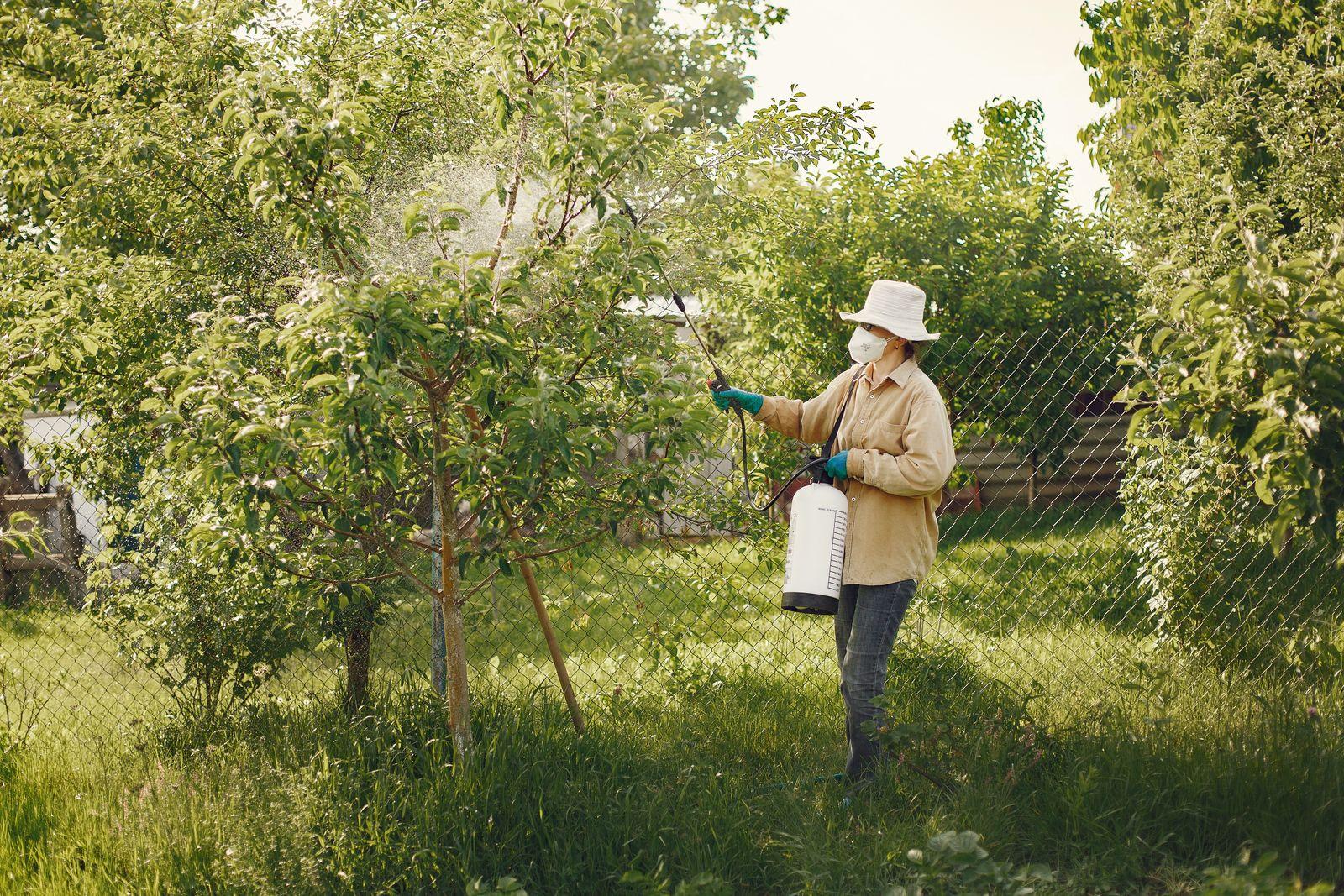
Wear what the label lists. UC IPM's minimum, even for least-toxic products, is chemical-resistant gloves, eye protection, a long-sleeved shirt, long trousers and closed shoes; cotton gloves soak up spray.
- Mix outdoors or in a well-ventilated area, and only as much as you need right away (EPA).
- Measure exactly, with tools kept only for pesticides, and never exceed the label rate.
- Keep a separate sprayer for weedkiller; UC IPM warns that herbicide residue can injure plants.
- Keep children and pets away while you work (NPIC).
- Don't eat, drink or smoke until you've washed; shower and wash work clothes separately.
How long after spraying pesticides is it safe for pets? Keep them off for the label's stated time or until the spray dries completely, whichever is longer, NPIC says; granular products can mean 24 hours or more, and even then stop pets chewing treated plants, since residues can remain.
If someone swallows a pesticide or is splashed
For a splash, start rinsing straight away and call for help during or after; if something was swallowed, call at once and don't make the person vomit. Keep the label at hand and follow its First Aid section. Poison Control advises taking off contaminated clothing first, then rinsing skin under running water for at least 15 minutes; for eyes, remove contact lenses and rinse for at least 15 to 20 minutes; if spray was breathed in, move to fresh air. Call emergency services (911 in North America, 999 in the UK, 000 in Australia, 112 in the EU) if someone collapses, can't be woken, has a seizure or struggles to breathe. Otherwise:
- US: the Poison Help line, 1-800-222-1222 (24 hours).
- Canada: 1-844-764-7669 (1-844-POISON-X); in Québec, the Centre antipoison du Québec, 1-800-463-5060.
- UK: the NHS advises 999 or A&E if someone may have swallowed, touched or breathed in something harmful, and NHS 111 if you're unsure.
- Australia: Poisons Information Centre, 13 11 26.
- Elsewhere: the WHO keeps a world directory of poisons centres.
- Pets: call your veterinarian or, in the US, the ASPCA Animal Poison Control Center on (888) 426-4435; a consultation fee may apply.
Storage, disposal and harvest
The US EPA advises keeping pesticides in their original, labelled containers, locked away somewhere well ventilated, away from food, animal feed and medical supplies and anywhere that might flood; the UK's HSE adds that sheds and greenhouses aren't ideal because they get very hot or cold. Never decant them into drink bottles: Poison Control describes an eight-year-old boy who died weeks after drinking a weedkiller he mistook for a soft drink.
Never pour leftovers down a sink, toilet or street drain (UC IPM). Use them up as the label directs, or take them to a household hazardous waste or chemical collection point, following local rules. For empty containers, follow the label's disposal instructions (the "Storage and Disposal" section on US labels), apply rinse water only as the label allows, and never reuse the container (NPIC).
On edible crops, use only products labelled for food plants, never ornamental-only ones (UC IPM), and wait out the pre-harvest interval.