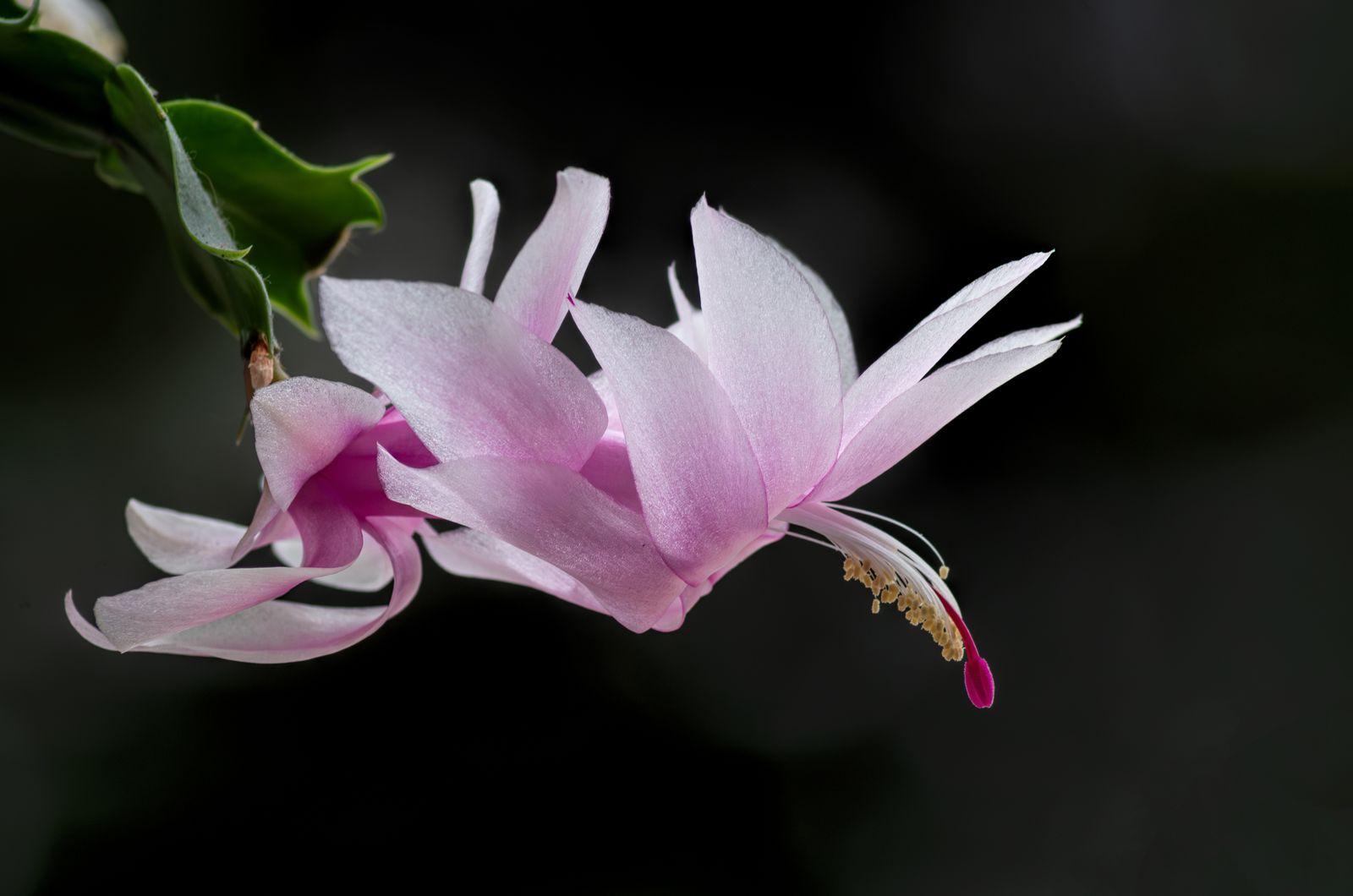
Two things make a Christmas cactus bloom: long uninterrupted nights and cool air. Clemson Cooperative Extension puts the requirement at 14 or more hours of continuous darkness each day, started around the middle of September and held for at least six continuous weeks, and warns that as little as two hours of interrupted lighting will inhibit flower bud set. Buds are normally visible in three to four weeks. Cool nights can do the same job on their own. Miss the window and you keep a healthy green plant with nothing on it, which is a fine reason to let Cindy's Flowers cover December instead: we deliver plants and fresh flowers across Toronto and the GTA.
Is the plant on your windowsill actually a Christmas cactus?
Probably not, and the difference moves your calendar by about a month. Clemson Cooperative Extension separates Thanksgiving cactus (Schlumbergera truncata) from Christmas cactus (Schlumbergera x buckleyi), describing both as fall- and winter-flowering houseplants native to Brazil that "grow as epiphytes among tree branches in shady rain forests." Clemson also notes that Thanksgiving cacti normally flower near Thanksgiving, roughly a month before Christmas cacti bloom, which is exactly why the Thanksgiving type dominates the shops during the winter holidays.
Three tests sort them out:
- Count the teeth. Clemson describes two to four saw-toothed serrations along each segment margin on a Thanksgiving cactus. On a Christmas cactus, the margins are more rounded.
- Look at the anthers. Thanksgiving cactus anthers are yellow. Christmas cactus anthers are purplish brown.
- Watch how the flower hangs. Growers split the two cultivar groups the same way: the Truncata Group holds its flowers at or above the horizontal and carries yellow pollen, while the Buckleyi Group lets its flowers hang below the horizontal on pink pollen.
Neither plant has a single true leaf. Clemson is explicit about that, and calls the flattened green segments phylloclades: they are stems, and they do all of the photosynthesis. Schlumbergera is a small genus of six to nine species from the coastal mountains of southeastern Brazil, growing on trees and rocks in habitat that is generally cool, shaded and humid. Nothing about it is a desert plant.
The naming is a Canadian habit as much as a botanical one. "Christmas cactus" is the name used in Canada regardless of which group the plant belongs to, while American nurseries propagate the same cultivars in large numbers for sale ahead of American Thanksgiving.
The two levers that set buds
Darkness and temperature, and only the cold one works on its own: cool nights of 50 to 59°F set buds regardless of day length, but long nights cannot do it while the room stays above 65°F. Clemson's instruction is unambiguous: "Fourteen hours or more of continuous darkness each day is required before flower bud set will occur," starting about the middle of September and continuing for at least six continuous weeks for complete bud set. Two hours of interrupted lighting is enough to inhibit it. Once the buds are set, Clemson notes the photoperiod stops mattering.
Temperature is the second lever, and it is the one most Toronto apartments get wrong. University of Minnesota Extension calls holiday cacti short-day plants and asks for daytime temperatures of 65 to 70°F (18 to 21°C) with evenings of 55 to 65°F (13 to 18°C). At night temperatures near 55°F (13°C), Minnesota says plants bloom in about five to six weeks, sometimes regardless of day length. At 60 to 65°F (16 to 18°C) nights, they need at least 12 hours of complete darkness every night for about six weeks. Above 65°F (18°C) at night, blooming is unlikely.
Clemson's numbers run in the same direction: fall growing temperatures of 60 to 68°F (16 to 20°C), as close to 68°F as possible for maximum flower production, with night temperatures between 50 and 59°F (10 to 15°C) setting buds regardless of day length, though growth slows and bud drop may occur at 50°F (10°C).
The two extension services do not agree on the exact hours of darkness. Clemson says 14 or more; Minnesota says at least 12 when nights sit between 60 and 65°F. Aim for 14 and the disagreement stops costing you anything.
The routine, in order:
- Start in mid-September, not in November when the tree goes up.
- Give it 14 hours of true dark. A spare room with the door shut, a closet, or a box over the pot from roughly 6 PM to 8 AM.
- Keep the days bright and around 65 to 68°F (18 to 20°C).
- Let the nights get cold. Keep the plant off the radiator wall and Toronto's shoulder season does most of this for free.
- Stop once buds appear, and leave the plant where it is.
The failure almost nobody catches is the light leak. A hallway lamp, a phone screen, a streetlight through an uncovered pane: two hours is the whole margin. If late November arrives with no buds, the plant has told you it wants another year, and that is the moment to order Christmas flowers rather than keep negotiating with a cardboard box.
How should you water and light it the rest of the year?
Treat it as a forest plant, because that is what it is. Bright indirect light suits it, an east-facing window most of all, and it will scorch in a south window in July. Water when the top of the mix has dried, soak it properly, then let it drain and empty the saucer.
That is the same logic that governs the moth orchids in our plants and orchids collection: epiphytes want air at the roots and steady moisture, never a full saucer. We've found the two plants fail for identical reasons in Toronto condos, which is overwatering in winter dressed up as devotion. The rest of the indoor lineup follows similar rules, and our guide to the best indoor plants covers the low-light end of it.
Ease off slightly during the six dark weeks, but do not dry the plant to the point where the segments go soft. Once buds appear, keep the watering steady and stop moving the pot around. Sudden drought at bud stage is one of the standard ways people lose the flowers they just spent six weeks earning, alongside a draft, a temperature swing and moving the pot.
Why isn't it blooming, and why are the segments limp?
Run through this list before assuming the plant is defective:
- Light got in. Clemson's two-hour threshold makes a hallway light a real cause, not a technicality.
- The nights were too warm. Above 65°F (18°C), Minnesota says blooming is unlikely, no matter how dark the room was.
- You started too late. Six weeks from mid-September lands the buds in time; six weeks from Halloween does not.
- Buds formed, then dropped. Clemson notes bud drop at 50°F (10°C), so an unheated porch can overshoot. Relocating the pot and letting it dry out do the same damage.
- The segments went limp. That is a root problem, and it reads the same whether the mix has been soggy for weeks or bone dry for weeks. Tip the plant out and look. Worth remembering that those are not leaves at all: they are stem segments, so a limp one is reporting on the roots.
Pruning, and how to make more plants
Prune right after flowering finishes, which is the same job as propagating. Hold a segment and twist it off at the joint rather than cutting through the middle of one; the plant branches from the wound and gives you more flowering tips next season, and each removed piece is a free plant.
To root the pieces:
- Take cuttings of two or three joined segments.
- Leave them on a dry counter for a few days until the cut end calluses over.
- Set them upright and shallow in barely moist, fast-draining mix.
- Keep them in bright indirect light and let the surface dry between waterings.
Roots come in a few weeks, and a rooted cutting in a small pot is one of the better housewarming presents going, for the reasons set out in our housewarming flowers and plants guide. When the date arrives faster than the roots do, housewarming flowers and plants cover the gap.
Is a Christmas cactus safe to keep around cats and dogs?
The ASPCA lists Christmas cactus (Schlumbergera bridgesii) as non-toxic to dogs, cats and horses, and Clemson Extension's pet-safe houseplant list extends that to the whole holiday-cactus group, Thanksgiving cactus included, which is one reason it earns its windowsill in households where other holiday plants cannot. A non-toxic listing is not an invitation, mind: a determined cat chewing any houseplant can still end up vomiting, and the plant will look terrible afterwards.
The species that rule themselves out of a cat's home outright are true lilies (Lilium) and daylilies (Hemerocallis), which cause fatal kidney failure in cats. The December plants a reader is likelier to bring home are on the ASPCA's toxic list too: amaryllis, American holly, cyclamen and poinsettia are all listed as toxic to dogs and cats. The pollen and the vase water carry the hazard, so a high shelf or plucked anthers fix nothing, as our piece on lilies and cats explains. Alstroemeria is the substitution we make when someone wants that look and has a cat.
For the weeks when the cactus is just green, Cindy's Flowers hand-ties bouquets in our Toronto studio and delivers them the same day across Toronto and the GTA when the order lands before 3 PM, Monday to Saturday. The current bouquets carry live prices.