A butterfly garden works when it feeds both halves of a butterfly's life: host plants that caterpillars eat and nectar flowers for the adults. Give it a sunny, sheltered spot, a shallow damp patch and a few flat stones for basking. Plant natives first, choose flowers that bloom from spring into fall, skip pesticides, and leave stems and leaves standing until spring. In North America, add milkweed for monarchs, whose caterpillars eat nothing else. One caution: the ASPCA lists milkweed as toxic to dogs, cats and horses.
Monarchs and milkweed (North America)
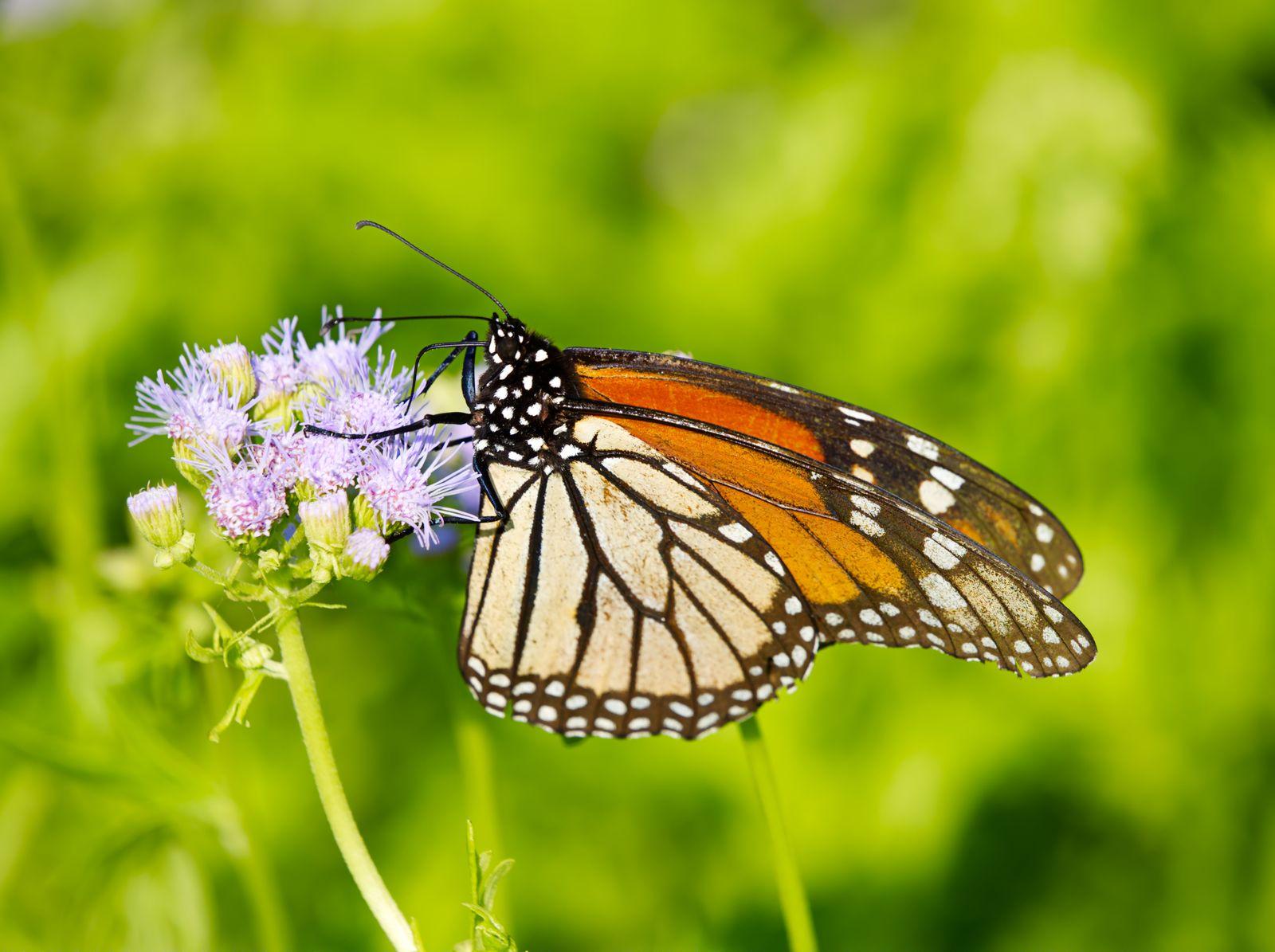
The US Fish and Wildlife Service says females lay their eggs on milkweed because it is the only food the caterpillars can eat, while adults nectar on many kinds of flowers through breeding, migration and winter. The Monarch Joint Venture adds that a female usually lays a single egg on a plant, often on the underside of a leaf near the top, and that a full-grown caterpillar generally crawls off its milkweed to find a secure place for its chrysalis.
The Fish and Wildlife Service says most breeding adults live about two to five weeks, while overwintering adults in reproductive diapause can live six to nine months. Most eastern monarchs spend the winter in oyamel fir forests in the mountains of central Mexico; western monarchs mostly winter in groves along the California coast.
The monarch's conservation status, as of September 2026:
- IUCN Red List: the migratory monarch subspecies was listed as endangered in 2022, then moved to vulnerable in December 2023 after a petition review; the species as a whole is rated least concern.
- United States: the Fish and Wildlife Service proposed listing the monarch as threatened under the Endangered Species Act in December 2024. No final rule had been published by September 2026.
- Canada: listed as endangered under the Species at Risk Act in December 2023.
Which milkweed should you plant?
In North America, where milkweeds are native, plant a species native to your region. Elsewhere, check local rules first: common milkweed (Asclepias syriaca) is on the EU's list of invasive alien species of Union concern, so it may not be grown or sold there. In the US and Canada, the Xerces Society says tropical milkweed (Asclepias curassavica), native from Mexico south, and other evergreen, non-native milkweeds can lead to a build-up of OE, a protozoan parasite of monarchs, and interrupt migration, especially in mild-winter areas. It advises replacing them with native species.
Three widespread species of eastern and central North America show the range:
- Common milkweed (A. syriaca). Grows 90–150 cm (3–5 ft) tall in full sun and tolerates poor, dry soil (NC State Extension). It spreads by underground rhizomes, so Monarch Watch suggests planting it where you can limit the spread, for instance by mowing around the patch.
- Swamp milkweed (A. incarnata). A clump-former of wet sites with pink to white flowers from summer into fall, 90–150 cm (3–5 ft) tall, for full sun to partial shade in moist or occasionally wet soil (NC State Extension).
- Butterfly weed (A. tuberosa). Orange flowers on clumps 30–90 cm (1–3 ft) tall, for full sun in dry to medium, well-drained soil. Its deep taproot means it doesn't transplant well (NC State Extension), and Clemson Cooperative Extension notes it is slow to emerge in spring, so mark its spot.
The ASPCA lists milkweed (Asclepias species) as toxic to dogs, cats and horses, with signs ranging from vomiting and weakness to seizures, breathing trouble and death. ASPCA Poison Control advises keeping pets out of any bed where it grows.
Wear gloves when you cut it back, too. Common and swamp milkweed have milky sap and butterfly weed's is clear, but NC State Extension says the sap of all three can cause contact dermatitis and eye irritation. Wash your hands afterwards and don't rub your eyes; if sap gets in an eye, rinse it with plenty of water and see a doctor. NC State also rates all three as poisonous to people if eaten in quantity, causing vomiting, weakness and confusion, so keep an eye on small children and call a poison centre if a child eats some.
What should bloom from spring to fall?
University of Wisconsin–Madison Extension advises planting species with different flowering times, so nectar lasts from spring to fall. Butterflies must land to feed, it notes, so they favour clusters of short tubular flowers or large, flat petals; most prefer pink, purple, orange, yellow or red, and large masses of one colour beat mixed plantings. University of Illinois Extension adds that flowers with double petals often have less nectar, zinnias being an exception, and that many modern hybrids are bred for showy flowers rather than nectar.
Spring
The Xerces Society notes that mourning cloaks, which overwinter as adults, emerge quite early in spring. UW–Madison Extension counts dandelions among the weeds that make good butterfly plants, so leave a few in the lawn.
Summer
In eastern North America, wild bergamot (Monarda fistulosa), Joe-Pye weed (Eutrochium) and the milkweeds carry a garden through midsummer. NC State Extension lists both bergamot and Joe-Pye weed as summer-to-fall bloomers that attract butterflies. Joe-Pye weed grows 1.5–2.1 m (5–7 ft) tall in moist soil, so give it the back of the bed. Zinnias, an annual, fill the gaps.
Fall
New England aster (Symphyotrichum novae-angliae) is both a nectar source and a caterpillar host for the pearl crescent (NC State Extension), and goldenrod (Solidago) is a late-season standby there. In Europe, though, the European and Mediterranean Plant Protection Organization lists Canada goldenrod (S. canadensis) as an invasive alien plant, so pick a local species.
A pet check: the ASPCA names zinnias non-toxic to dogs, cats and horses. ASPCA Poison Control's article on native plants for wildlife names asters and Joe-Pye weed (Eutrochium) non-toxic to dogs and cats; horses aren't covered, and the ASPCA's plant database has no entry for Joe-Pye weed or New England aster. Wild bergamot (Monarda), goldenrod (Solidago) and dandelion aren't on its lists at all (its "Bergamot" is bergamot orange, and its "Rayless Goldenrod" is a different plant, toxic to horses), so treat those three as unverified rather than safe.
Host plants for swallowtails and other caterpillars
Host plants depend on which butterflies live near you; ask a native-plant society. Three eastern North American examples:
- Black swallowtail. Its caterpillars eat carrot-family plants; in gardens, UW–Madison Extension names dill, parsley, fennel, celery, caraway and carrot. The ASPCA lists dill, fennel and carrot as non-toxic to dogs, cats and horses, but parsley and caraway as toxic to all three, and it doesn't list celery, so treat that one as unverified. Two of the butterfly's wild hosts, poison hemlock and wild parsnip, should never be planted: NC State Extension says poison hemlock is highly toxic and can be fatal to people and livestock, and that wild parsnip sap makes skin sensitive to sunlight, leading to severe burns and blisters. If you have to remove either, wear gloves, long sleeves and long trousers, wash afterwards and keep pets away; the ASPCA lists poison hemlock as toxic to dogs, cats and horses.
- Eastern tiger swallowtail. The University of Florida's Featured Creatures profile says its caterpillars use trees and shrubs from at least seven families, tulip tree and black cherry among them. The ASPCA lists black cherry as toxic to dogs, cats and horses, and tulip tree as non-toxic; in Europe, black cherry is on EPPO's invasive plant list.
- Baltimore checkerspot. NC State Extension lists white turtlehead (Chelone glabra), a plant of stream banks and marshes, as a host; it suits the same damp corner as swamp milkweed. The ASPCA doesn't list turtlehead, so its pet safety is unverified.
Setting up the garden: sun, puddles and shelter
Start with sun. UW–Madison Extension says most butterfly plants need full sun and butterflies need sun to warm their bodies for flight. Choose a sunny spot sheltered from harsh wind, and add flat rocks or other surfaces for basking. Then add:
- Water. A shallow puddle or damp patch of soil. University of Illinois Extension says butterflies prefer shallow puddles to deep water and take minerals from them as well as moisture; refresh standing water every few days so mosquitoes can't breed.
- Shelter. Butterflies rest under leaves, in bark crevices and in brush or log piles (University of Illinois Extension).
Why skip pesticides and the fall cleanup?
Products that kill pest insects kill butterflies too, and UW–Madison Extension reminds gardeners that "natural" or "organic" does not mean non-toxic. It also rules out Btk (Bacillus thuringiensis ssp. kurstaki), a bacterial caterpillar control, wherever you want caterpillars, because that strain kills them. If a problem truly needs treating, it suggests a less toxic or very specific product, spot-applied, following the label. Pesticide rules vary by place, and a permitted product isn't necessarily harmless to caterpillars.
Then do less in the fall. The Xerces Society says most butterflies and moths don't migrate; they winter in the landscape as eggs, caterpillars, chrysalises or adults, sheltering in leaf litter. So:
- leave leaves on the beds, or rake them there, and keep them whole; Xerces advises against shredding them with a mower; keep them off paths, lawn edges and play areas, since the US CDC advises removing leaf litter to reduce ticks;
- leave perennial stems standing until spring is well under way;
- let one corner go wild.
Before letting any wild plant spread, check it against your regional invasive-species list. For the rest of a lower-impact yard, see our eco-friendly gardening tips, and for bees, our guide to a bee-friendly garden.