An iris carries a message. That is the reading with the longest paper trail: Kate Greenaway's *Language of Flowers* (1884) gives the entry a single word, "Message", which fits a bloom named for the Greek goddess who carried word from the gods to mortals. Modern florists read it differently, usually as faith, valour and wisdom, one virtue for each of the three upright petals. Colour shifts it again, from purple for wisdom to yellow for passion. If you want that read delivered rather than merely understood, Cindy's Flowers hand-ties bouquets in our Toronto studio for same-day delivery across the GTA.
Why is the iris named for a rainbow?
Because the flower turns up in nearly every colour there is. UC Davis's postharvest sheet states it plainly: "Iris is Greek for 'rainbow' in reference to the range of flower colors." Missouri Botanical Garden takes the other half of the same story, noting that the genus is "named for the Greek goddess of the rainbow." Both readings hold at once, and each reinforces the other.
The goddess is the more interesting half. Iris travelled the rainbow carrying messages from the gods down to mortals, serving alongside Hermes and often as Hera's personal courier. Hesiod's *Theogony* makes her a daughter of Thaumas and the Oceanid Electra, and a sister of the Harpies. Her name covered two things in ancient Greek: the rainbow, and the halo around the moon.
The colour claim is not poetic licence either. Iris is the largest genus in the family Iridaceae, and Plants of the World Online listed 310 accepted species as of 2022. Most are perennials growing from creeping rhizomes; in drier climates they grow from bulbs instead. Very few plant families hand a florist that much of the spectrum inside one genus.
What each iris colour means
Colour does most of the work in iris symbolism, and every reading below is modern florist convention rather than botany or anything Victorian. Use them the way you'd use shorthand: useful if the recipient reads it, harmless if they don't.
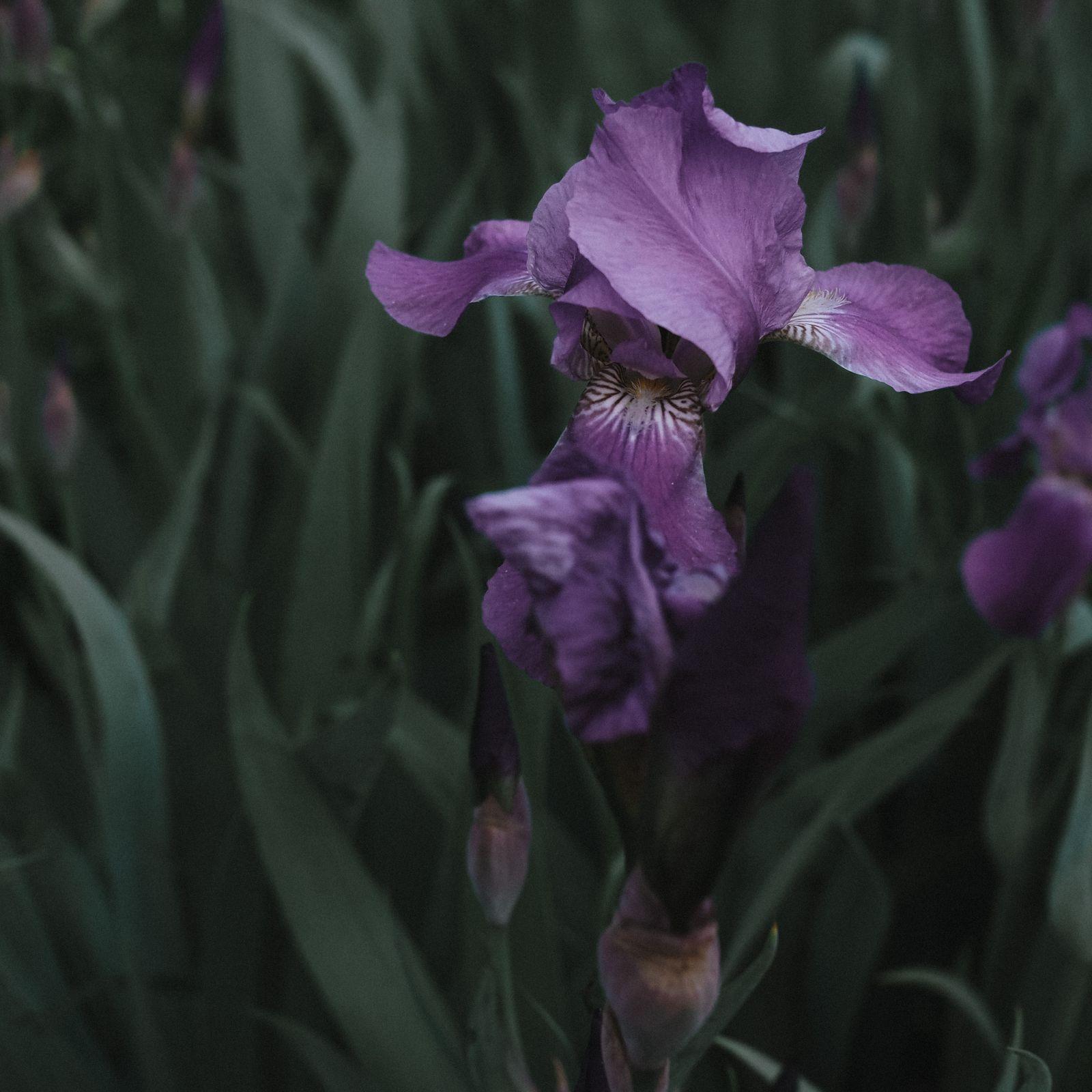
- Purple. Wisdom and respect, and a compliment paid without gushing. The deep blue-violet most people picture when they hear the word "iris" sits right here.
- Blue. Hope and faith. It is the shade that carries best on a get-well card or a thinking-of-you note.
- White. Purity, and by extension remembrance.
- Yellow. Passion and drive, a louder reading than the rest of the genus tends to get.
Put several colours in one vase and you are back where the name started. That is part of why an iris sits so comfortably in a mixed bouquet, where its vertical line does something no round-headed flower can. If you want to see how the season's colours are actually running, our current bouquets tell you more than a symbolism chart will. For colour readings across the rest of the flower shop, we keep a guide to what flower colours mean.
The Victorian iris meaning was one word: message
Look the flower up in Kate Greenaway's *Language of Flowers*, the 1884 book most "Victorian meaning" lists are quietly copied from, and the entry is startlingly short. It reads *Iris*, then one word: *Message*. The reverse index lists "Message" against the iris, and also files it under "Flame" beside the fleur-de-lis. Two other entries add heat rather than virtue: the German iris is given as "Flame", and *Fleur-de-Lis* as "Flame. I burn." None of faith, valour or wisdom is assigned to the iris anywhere in the book.
That gap matters if you're writing a card. The modern three-petal reading, one virtue per standard, is florist convention assembled fairly recently, and it is a decent convention. But "message" is the version with a paper trail, and it agrees with the goddess the flower was named after. An iris is the stem for saying something specific to one person, which makes it a better fit for a just-because delivery than for a milestone that already comes with a script. Send irises when you have a sentence in mind. Send roses when the occasion supplies the sentence for you.
Is the fleur-de-lis really an iris?
Possibly, and nobody has proved it. The name argues the other way: *fleur-de-lis* is French for "lily flower", tracing back through Latin *lilium* to the Greek *leírion*. Treat the iris origin as a long-standing hypothesis rather than a settled fact, because that is exactly what it is.
The case for the iris is old and reasonable. In the 18th century the naturalist Pierre-Augustin Boissier de Sauvages argued that the old fleurs-de-lis "have a lot less in common with ordinary lilies than the flowers called flambas, or irises". The heraldist François Velde points instead to the yellow flag iris, *Iris pseudacorus*, a plant of marshes and wet ditches, and notes how neatly it explains the azure field behind the charge: blue for water.
What is documented is the politics. The fleur-de-lis has been attached to France since Louis VII adopted it in the 12th century, appearing in its modern use as the emblem of the House of Capet. Legend pushes it back much further, to Clovis, the first Christian king of the Franks, said to have taken the flower as his personal emblem at his baptism. The Government of Canada dates that legend to 496.
Why is Quebec's flower a wild iris?
Because the province traded a garden flower for a native one. The blue flag, *Iris versicolor*, became Quebec's floral emblem when An Act respecting the flag and emblems of Québec came into force on 5 November 1999. The Government of Canada describes it as an indigenous spring flower, growing on more than half of Quebec's territory, from the St. Lawrence Valley to the shores of James Bay. From 1963 until 1999 the title had belonged to the white garden lily.
The flag came first. Quebec's Fleurdelisé was adopted in 1948 and confirmed by the legislature in 1950, and heraldists had been arguing over whether a fleur-de-lis depicts a lily or an iris for centuries before that. The 1999 Act settled the living half of the question, at any rate. Blue flag grows in Ontario too, in marshes and along wet shoreline edges, so it is a genuinely local wildflower for anyone reading this in the GTA rather than a Quebec exclusive.
Does an iris work as a gift, or only as a symbol?
It works, with two caveats worth knowing first. Start with the shape, because it explains the appeal. An iris flower carries six lobes in two sets of three: three sepals that spread or droop downward, called falls, and three petals standing upright behind them, called standards. Bearded types add a row of fuzzy hairs at the base of each fall, which gives a pollinator a landing place and a route to the nectar. That architecture is why an iris reads as structure beside a rose, and why it wants room in a vase instead of being packed tight.
Caveat one is pets. The ASPCA lists iris as toxic to dogs, cats and horses, so it is the wrong stem for a household with animals. Lilies are a separate and far more serious problem, because pollen and vase water are the hazard for cats; our guide to lilies and cats covers what that actually means in practice. When you need flowers that don't appear on the ASPCA's toxic list, roses, alstroemeria, gerbera daisies and sunflowers are the dependable substitutes.
Caveat two is the calendar. Iris holds no month on the standard birth-flower table; the month-by-month list gives February to the violet and primrose, the latter ASPCA-listed toxic to dogs, cats and horses. On the traditional anniversary list it owns the 25th year, which is the milestone it genuinely fits. For a birthday delivery it plays a supporting part rather than the headline, and there is nothing wrong with that. If the message matters more to you than the stem count, Cindy's Flowers is the Toronto florist to hand it to: we hand-tie bouquets in our own studio and deliver same-day across Toronto and the GTA on orders placed before 3 PM, Monday to Saturday.