A hydrangea means gratitude and heartfelt emotion by modern florist convention, with abundance close behind, and the reading comes straight from the flower's structure: one head holds dozens of small blooms, so it lands as plenty rather than as a single declaration. Colour tunes it. Blue leans toward apology and calm, pink toward affection, white toward sincerity, purple toward abundance and understanding. Japan reads the same flower differently again, giving ajisai pride and a changeable heart. Victorian lists were harsher still. To send that meaning rather than only read about it, Cindy's Flowers hand-ties hydrangeas in our Toronto studio.
What is the meaning of a hydrangea?
Gratitude, heartfelt emotion and abundance, by modern florist convention. All three trace back to one botanical fact that most symbolism guides skip: a hydrangea head is not a flower. It is a crowd.
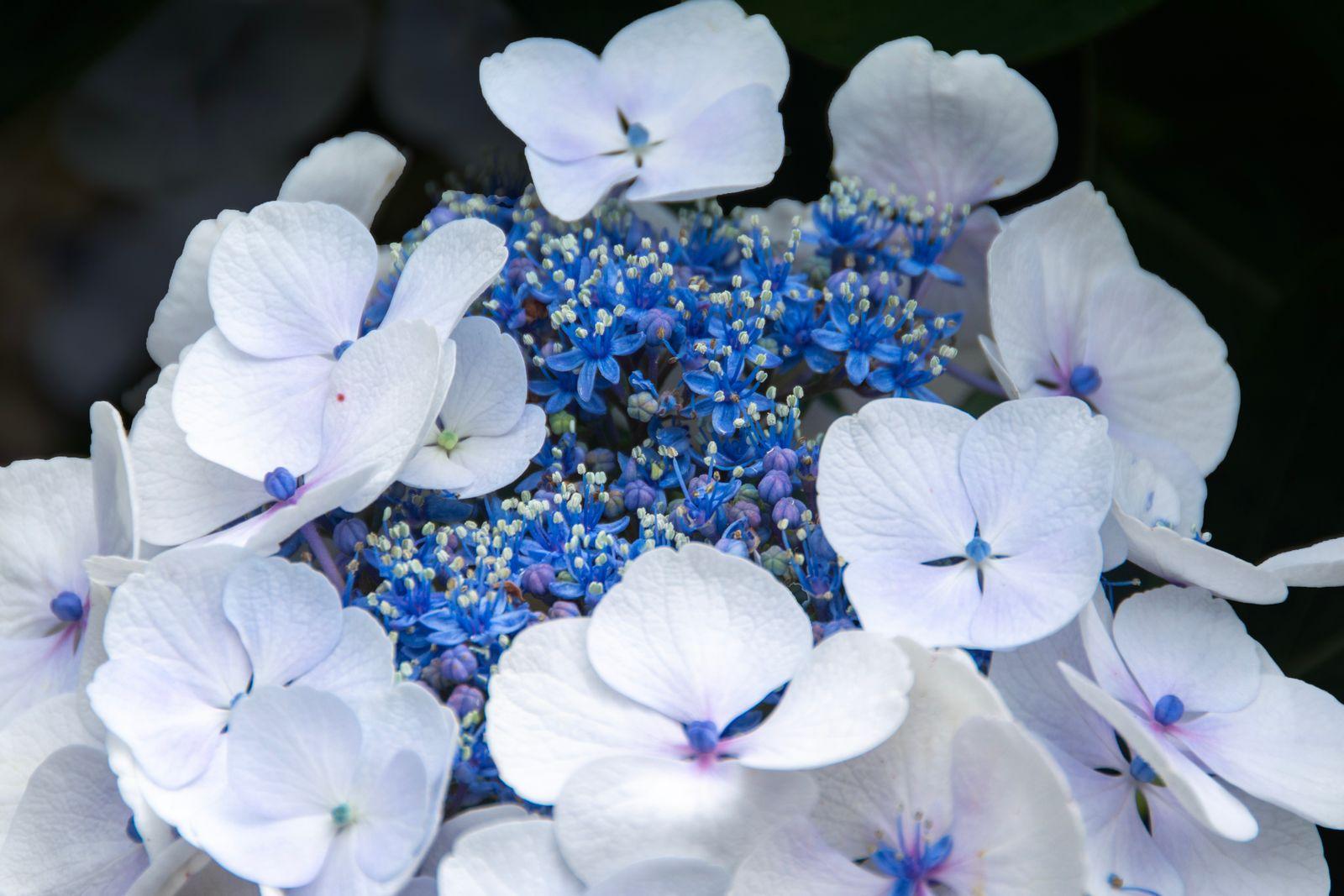
Look closely and there are two kinds of bloom in the same head. Small, plain, fertile flowers sit in the centre or the interior, and large sterile ones ring them, their colour carried by enlarged sepals rather than by petals. Mophead cultivars have been bred until nearly the whole head is the showy sterile kind. So the part everyone calls a petal is a sepal, and the thing everyone calls a flower is a bouquet in miniature. Daisies pull a version of the same trick, which our guide to daisy meaning and symbolism unpacks.
That structure is the whole argument for the modern reading. Dozens of blooms arriving as one gesture is what abundance looks like, and it is why a hydrangea so often carries a thank-you that a single stem could not.
In love, the convention puts it in a supporting role. A hydrangea reads as settled, generous understanding rather than the first flush a red rose announces. It is a long-marriage flower, not a first-date one.
While we are correcting things, the name has nothing to do with thirst. Hydrangea comes from the Greek hydor, water, and angos, vessel, and it describes the shape of the seed capsules. The plant does drink hard and the mnemonic is genuinely useful. The etymology is still about seed pods.
Hydrangea colours, one by one
By modern florist convention:
- Blue: apology, calm, forgiveness. The colour to send when the message is "I'm sorry" rather than "well done".
- Pink: affection and romance, dialled down. Warmer than white, quieter than red.
- White: sincerity and grace. The default for weddings and for sympathy.
- Purple: abundance, pride, deep understanding. The closest the flower gets to a royal reading.
- Green: renewal and good luck, and in practice the neutral that lets everything else in the vase speak.
Now the part most colour guides get wrong. Soil pH does not paint the flower. What pH does is govern whether aluminium is available for the roots to take up, and the aluminium is what pulls the pigment blue.
The Royal Horticultural Society is precise about which plants do this at all: mophead and lacecap cultivars of Hydrangea macrophylla, along with H. serrata and H. involucrata, change colour with soil acidity because acidity affects aluminium availability. They run blue in acid soils where aluminium is plentiful, mauve in lightly acid to neutral conditions, and pink in alkaline ones. White-, red- and green-flowered cultivars keep their colour regardless of pH. Missouri Botanical Garden gives the same rule for the bigleaf group and names the levers: aluminum sulfate for bluer, lime for pinker. The thresholds usually quoted are pH 5.5 or lower for blue, 6.5 or higher for pink, and purple in the band between.
The chemistry is tidier than the folklore. A single anthocyanin, delphinidin 3-glucoside, produces the whole pink-to-blue range depending on whether aluminium is there to bind it: with aluminium the pigment forms a blue complex, and without it the same pigment reads pink. Same dye, aluminium or no aluminium. That is also why a white hydrangea will never turn blue no matter what goes into the soil: no pigment, nothing for aluminium to bind to. And on very alkaline or chalky ground, the Royal Horticultural Society notes, blueing compounds will not work either. Blue is scarce across the whole plant kingdom for related reasons, which our guide to flower colour meanings gets into.
Two footnotes worth having. White heads usually age to shades of pink on their own, which is ageing rather than soil, and it is exactly what those antique-rose panicle hydrangeas on Toronto porches are doing by late September. And no soil trick has a vase equivalent: aluminium or pH additives will not shift the colour of a cut stem, though florists do tint white blooms by letting them drink a floral absorption dye. Our hydrangea care guide covers the garden side properly, and if you would rather skip the chemistry entirely, our hydrangea bouquets are sorted for colour at the bench.
What does ajisai mean in Japan?
Utsurigi, a changeable heart, is the hanakotoba entry most often recorded for ajisai, with pride recorded alongside it.
The flower has a real claim on the country. Hydrangea macrophylla, the bigleaf that supplies most florist stems, is native and endemic to Japan, growing in coastal habitats from Honshu southwards. Its Japanese name survives inside the botanical record: Siebold published the plant as Hydrangea azisai, which is ajisai written the way a nineteenth-century European ear heard it. The genus as a whole runs to more than 70 species across Asia and the Americas, and although it was first described from Virginia, the great concentration of species sits in China, Korea and Japan.
The fickleness reading is not hard to explain. A plant that opens pale, goes blue, drifts mauve and finishes rose across a single season makes a fair emblem for somebody who keeps changing their mind. Japanese gardens plant it heavily for the June rains, when it is one of the few things doing anything at all, so the flower is bound up with wet weather and shifting moods.
Modern lists soften all of that, adding readings like family togetherness, taken from the way so many small flowers cluster into one head. Which is a reminder that flower meanings are conventions, and conventions get renegotiated.
The negative reading Victorians gave it
There is, and it is older than the friendly one. Kate Greenaway's Language of Flowers of 1884 pairs the hydrangea with boastfulness and heartlessness, about as unflattering as her list gets.
The logic is those sterile florets again. A head that large, that loud and that close to seedless reads as display without substance, though that is the explanation usually offered today; Greenaway recorded the meaning and not the reason. It is a useful case study, because the modern gratitude reading is not a descendant of the Victorian one. It replaced it.
Does any of it matter now? Almost never. Nobody outside a symbolism footnote reads a hydrangea as an accusation, and between the Japanese changeable-heart entry and the Victorian boaster, this flower has already been called worse things than anyone is likely to say over a vase. If the recipient is the sort of person who knows the old list, put the meaning you intend on the card and let that settle it.
When are hydrangeas the right flower to send?
When the message is thanks, congratulations on the house, or anything a single stem cannot say loudly enough. Hydrangea is a volume flower: one head does the visual work of a dozen small blooms, so five stems read as a far bigger arrangement than five stems of almost anything else.
Where the symbolism and the shape agree:
- Thank you. Gratitude is the meaning and abundance is the shape, a rare case of both pulling the same way. Blue or white reads sincere, pink reads warm. Thank-you flowers are built on that pairing.
- Apology. Blue, by convention, and a gentler message than red roses, which say something else entirely.
- Housewarming. Generous, substantial and not romantic, which is usually the brief.
- Sympathy. White, for sincerity, at a scale that fills a space without looking celebratory.
- Mixed arrangements. Hydrangea is the one bulk flower that never reads as filler. It gives a mixed bouquet its spine.
Two practical notes before you order. Hydrangea appears on the ASPCA's list of plants toxic to dogs, cats and horses, so if there is an animal at the delivery address, mention it and ask for roses, alstroemeria or gerbera daisies instead, all of which the ASPCA lists as non-toxic to dogs and cats. And hydrangeas drink hard once cut, so tell the recipient to top the water up daily rather than weekly.
Cindy's Flowers hand-ties every hydrangea bunch in our Toronto studio, with same-day delivery across Toronto and the GTA Monday to Saturday on orders placed before 3 PM. See what is fresh right now and match the colour to the meaning you actually want to send.