A daisy means innocence, purity, loyal love and new beginnings, at least by the floral conventions we've inherited. The name isn't decorative either: "daisy" comes from the Old English dæges eage, or "day's eye", because the whole flower head closes at dusk and opens again with the morning light. That nightly reset is where the fresh-start reading comes from. The daisy is also April's birth flower. Here's what the symbolism actually rests on, why a daisy isn't really one flower, and how to tell four common daisies apart. Only one of the four reaches a vase, the gerbera, and Cindy's Flowers hand-ties it into mixed bouquets for same-day delivery across Toronto and the GTA on orders placed before 3 PM.
What does a daisy symbolize?
By long floral convention, the daisy stands for innocence, purity, cheerfulness and loyal love, with a strong secondary reading of new beginnings. Victorian flower dictionaries added a quieter meaning: a daisy could say "I'll never tell", a promise to keep a confidence. None of that is botany. It's a gift language built up over centuries by florists, poets and letter-writers, and it still works because enough people can read it.
The loyal-love thread is the one people ask about most, and it survives in a game nearly everyone has played. Pull the white petals off one at a time: he loves me, he loves me not. The French call it effeuiller la marguerite, and marguerite happens to be one of the common names Ontario's own weed identification guide lists for the ox-eye daisy along our summer roadsides. The fortune-telling flower and the ditch flower are the same plant.
Innocence is the reading that stuck hardest, helped along by daisy chains, schoolyards and the flower's plain white-and-yellow honesty. There's no hidden agenda in a daisy. That's exactly why it works as a flower sent for no reason at all, where something more loaded might land like an apology.
Why is a daisy called a day's eye?
Because it behaves like one. Merriam-Webster traces "daisy" straight back to the Old English dægeseage, literally "day's eye", a name earned by the head's habit of shutting at night and reopening in the morning. Geoffrey Chaucer, writing in the fourteenth century, called it the "eye of the day", which is about as good as English plant-naming gets.
The flower keeps working through the day, too. Common daisy heads show heliotropism, turning to follow the sun across the sky. Anyone who has watched a lawn full of them go blank at dusk has seen the etymology in action.
Two side-effects of that habit are still in the language. "Fresh as a daisy" describes someone who looks well rested, a phrase usually explained by the flower's nightly close and morning reopening. Merriam-Webster also records an informal sense of daisy meaning a first-rate person or thing, as in "that catch was a daisy".
Is a daisy one flower, or many?
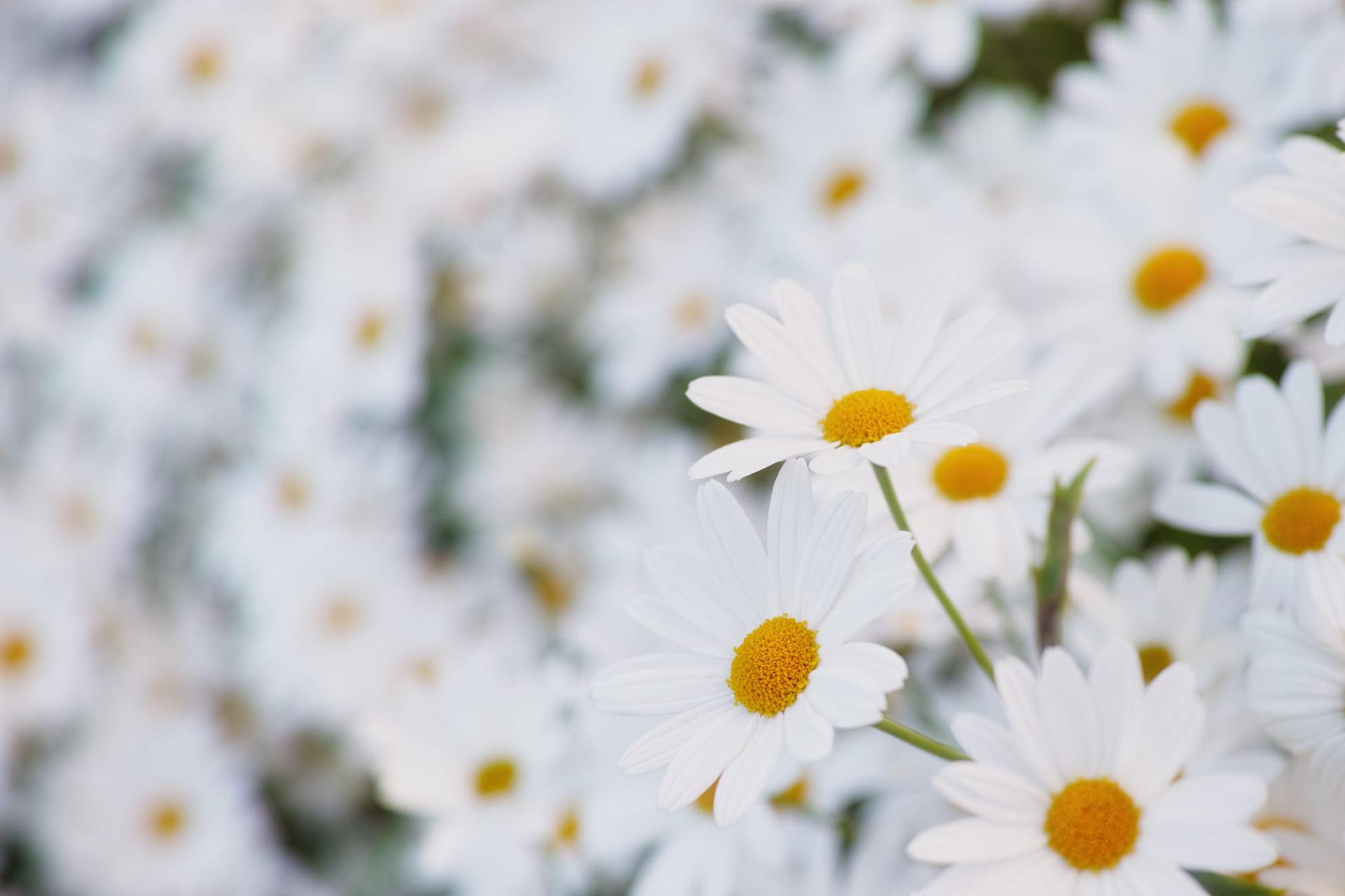
Many. What reads as a single bloom is a pseudanthium, a false flower: one head, properly a capitulum, packed with dozens of tiny individual florets. The white "petals" around the outside are ray florets, each a flower in its own right, often tipped with red underneath in the common daisy. The yellow button in the middle is a dense crowd of disc florets.
So the florist's line about a daisy meaning true love because it's "two flowers living as one" is charming and slightly wrong. It isn't two flowers. It's a whole committee of them, arranged so convincingly that most people never notice.
That construction is the signature of Asteraceae, and it has been wildly successful: over 32,000 known species across more than 1,900 genera, rivalled in size only by the orchids. Sunflowers, asters, marigolds, chrysanthemums and gerberas all sit inside it. So does lettuce.
One correction worth making, because page-one articles repeat it constantly: daisies are not "members of the chrysanthemum family". Chrysanthemums are members of the daisy family, along with everything else above. The confusion does have a real root. Leucanthemum, the genus holding ox-eye and Shasta daisies, was once filed inside Chrysanthemum before being split out. A reclassification got garbled into a fake family tree.
Which daisy is which?
Four plants carry the name around here, and only one of them is likely to arrive in a bouquet.
- Common daisy (Bellis perennis), also called English or lawn daisy. A low European perennial about 20 cm tall, heads 2 to 3 cm across, blooming March to September. It naturalised across the Americas and colonises lawns, shrugging off the mower, which is why it's so hard to be rid of. It is not native to Canada.
- Ox-eye daisy (Leucanthemum vulgare), the roadside one: field daisy, whiteweed, poorland flower, marguerite. Heads 2.5 to 5 cm with 20 to 30 white rays around a yellow centre, spreading by seed and by underground rhizomes.
- Shasta daisy (Leucanthemum × superbum), the garden one. Two to three feet tall, blooming July to September, hardy in USDA zones 5 to 9, which covers southern Ontario comfortably. Missouri Botanical Garden rates it showy and good for cutting.
- Gerbera (Gerbera × hybrida), the florist's daisy. Big flat faces in saturated coral, hot pink, orange and cream, on a stem long enough to arrange.
Two of those have origin stories worth a sentence. The Shasta is a deliberate human invention: American plant breeder Luther Burbank spent the 1890s crossing a European ox-eye, a Pyrenean species, a Portuguese field daisy and a Japanese one, then named the result for Mount Shasta, because the petals matched the mountain's snow. Three continents in a single garden perennial.
The gerbera came from tropical Africa. Its genus honours Traugott Gerber, an eighteenth-century German botanist and physician who was a friend of Linnaeus, and the species behind most florist stems, Gerbera jamesonii, was described from South Africa in 1889. Crossed with G. viridifolia, it produced the hybrid that now ranks as the fifth most used cut flower in the world. When gerberas turn up in a mixed bouquet, they're doing the job the lawn daisy never could.
About the ox-eye, one detail gets misreported constantly. Canada's Weed Seeds Order classifies it federally as a noxious weed seed, and it now grows in every province and territory after arriving in the late 1700s as an ornamental and a seed contaminant. It is not, however, on Ontario's provincial list. Regulation 1096 under the Weed Control Act names 25 noxious weeds, and no daisy is among them.
Is the daisy a birth flower?
It is. The daisy is April's birth flower, sharing the month with the sweet pea, and the pairing is almost too tidy: the flower of new beginnings assigned to the month Toronto gardens actually restart. Gerberas fall under the same heading, which is the answer to what birth month a gerbera daisy belongs to.
April reinforces everything else the flower carries. Innocence, a clean page, the eye that opens each morning. That's why daisies read so naturally for a new baby or a first apartment, and why they feel slightly underpowered as a grand romantic declaration. A daisy is warmth, not a proclamation.
When are daisies the right flower to send?
Send daisies when the message is light and genuinely happy. They suit:
- New babies and new homes, where the fresh-start reading is the whole point.
- Get-well and thinking-of-you notes, where roses would sit too heavy.
- Congratulations for someone young, or for a first anything.
- No occasion whatsoever.
Timing matters less than people expect. Garden daisies are a summer show in Ontario, ox-eye from June into September, Shasta from July into September, while greenhouse gerberas run year-round. That's why the daisy you receive in February is nearly always a gerbera. Give them a clean vase, a fresh angled cut and a spot away from the fruit bowl, and they hold beautifully; gerbera stems in particular prefer shallow water and something that supports those heavy heads.
If you'd rather leave the choosing to us, the full bouquet lineup is online, hand-tied by Cindy's Flowers in our Toronto studio and out for delivery the same day when the order lands before 3 PM, Monday through Saturday.