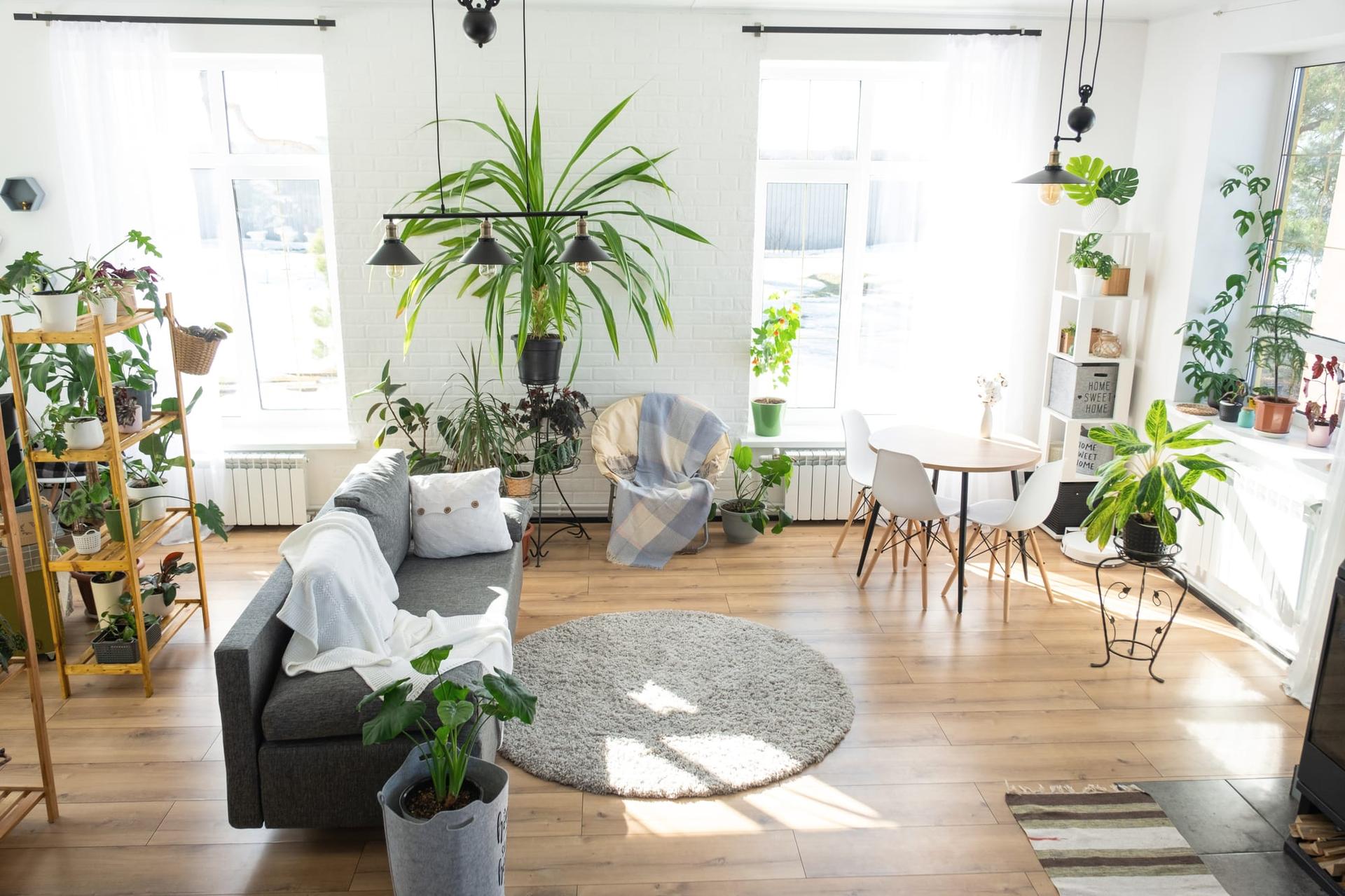
The best indoor plants for a Canadian home are the ones that match the light you actually have, not the light you wish you had. For a dim north-facing room: snake plant, cast-iron plant, heart-leaf philodendron. For an east window: moth orchid, African violet, Boston fern. For a bright south or west exposure: weeping fig, schefflera, English ivy. Then water less than instinct tells you to. University of Maryland Extension is blunt about the reason people fail: overwatering is the number one cause of dead houseplants. Nearly everything else is detail. Once your window has told you which list you're shopping from, Cindy's Flowers delivers orchids and indoor plants same-day across Toronto and the GTA on orders placed before 3 PM.
Which indoor plants suit which room?
Sort by window first, looks second. Clemson Cooperative Extension groups foliage plants into light classes and says plainly where each belongs. High-light plants like weeping fig, English ivy and schefflera want a western or southern exposure. Medium-light plants like African violet, Boston fern and dumb cane do well within a few feet of those windows, or in an eastern one. Low-light plants like peace lily, heart-leaf philodendron and the cast-iron plant sit several feet back from an east window, or in a north-facing room.
University of Minnesota Extension puts the ceiling simply: an unobstructed south-facing window gives plants the highest level of natural light available indoors. A north window or a genuinely dark corner is low-light territory, and only a short list of species will be content there.
Why does that short list exist at all? Because low-light houseplants are understory species. In their native habitats they grow underneath the branches of larger plants, so shade is their normal condition rather than a hardship they endure. It also explains why dragging one into a blazing south window scorches it.
Flowering plants ask for more. Moth orchids and African violets fall in the medium band, which in a Toronto apartment usually means an east-facing sill: soft morning sun, no punishing afternoon glare. Most of the orchids and indoor plants we deliver are happiest in exactly that spot.
How much light does that window actually give?
Less than it looks, by roughly an order of magnitude. Light for plants is measured in foot-candles, and Clemson sets low-light plants at a minimum of about 100 ft-c, medium at 100 to 150, high at 150 to 1,000. Then comes the humbling line: "the interior of a well-lighted home is often less than 100 ft-c, while outdoor light intensity on a clear sunny day may exceed 10,000 ft-c."
Your eyes are no help, because they adapt. A hallway that reads as pleasantly bright can sit below the threshold that merely keeps a plant alive. A free light-meter app on your phone settles the argument in about ten seconds, and I've watched it change more minds than any amount of advice.
Light in one spot also moves through the year. Clemson notes it varies with the sun's angle and the length of the day, with whatever shades the window from outside, and with curtains and wall colour. A pale wall bounces usable light back onto a plant; a charcoal feature wall swallows it. The pothos that thrived on your sill in July may be quietly starving in the same place come January.
Why overwatering kills more houseplants than neglect
Because drowned roots look exactly like thirsty ones. University of Maryland Extension names the culprit directly: "The number one reason for dying plants is usually overwatering." The same guidance takes apart the habit behind it, warning that "too many people assume that watering once a week is the right interval between waterings."
The mechanism is worth understanding, since it explains the trap. Excess water drives oxygen out of the soil, fine roots die off, and a plant with damaged roots can't absorb water even while it stands in a puddle of it. Leaves wilt. Lower and inner leaves yellow. The owner reads wilt as thirst and pours in more. Root rot and drought produce the same sad droop.
Two checks beat any schedule:
- Lift the pot. Learn its weight right after a thorough watering, then compare. Light means dry.
- Push a wooden dowel down to the bottom of the pot and pull it out. Where the moisture stops tells you what's happening below the surface.
Winter has its own target. Maryland's advice is to let most of the potting soil dry down until it feels "like a freshly wrung out dish towel. Not bone dry, but not too moist." If you overshoot and the pot goes bone dry, with water running straight through and out the bottom, half-submerge the whole pot in warm water for an hour or two to rewet the root ball properly.
Toronto loses six and a half hours of daylight by December
That single fact should reshape your care routine twice a year. On 21 June 2026 the sun is up over Toronto for 15 hours 27 minutes, rising at 5:36 am and setting at 9:02 pm. On 21 December it manages 8 hours 56 minutes, rising at 7:47 am and setting at 4:43 pm, and sunset stays before 4:45 pm from around 25 November right through to 23 December. Cloud, snow and the building across the street take their cut on top of that.
Less light means slower growth, which means less water used and no reason to feed. Clemson supplies the numbers: around 100 ft-c for 12 hours a day is needed simply to maintain a plant's quality over a year, and at least 200 ft-c for 12 hours before a foliage plant shows any benefit from fertilizer at all. Below that, feeding a plant in a dark January room is effort spent on growth it can't produce.
If you want to push back against the dark, add light rather than nutrients. University of Minnesota Extension recommends a daily total of 12 to 14 hours for foliage houseplants and 14 to 16 hours for flowering ones, run off a timer so it stays consistent. Shift plants closer to the glass for the winter, then ease them back in spring as the sun climbs again.
Which indoor plants are safe around cats?
Fewer than most people hope, so check before you buy. The ASPCA lists both the snake plant and golden pothos, the two plants beginners get pointed toward most often, as toxic to cats and dogs. Peace lilies and philodendrons carry calcium oxalate crystals that irritate a pet's mouth and throat and bring on drooling.
True lilies are the hard line, not a judgment call. Lilium species and daylilies (Hemerocallis) are highly toxic to cats: a nibbled petal, pollen groomed off fur, or a drink of vase water can cause fatal kidney failure. If a cat lives in the home, no lilies, in any room, ever.
The reassuring list is real, though:
- Spider plant (Chlorophytum comosum)
- Boston fern (Nephrolepis exaltata)
- Parlour palm (Chamaedorea elegans)
- Moth orchid (Phalaenopsis)
All four appear on the ASPCA's non-toxic list, and all four live comfortably in the low-to-medium light a Canadian apartment tends to offer. Our orchid care guide covers watering and reblooming if you take that route.
Choosing a plant for someone else
Give the plant that fits their window and their attention span, not the one that photographs well. For someone who forgets things, the snake plant is the safest bet going. Its accepted botanical name is Dracaena trifasciata, known as Sansevieria trifasciata until 2017. It tolerates low light and irregular watering, and through winter it needs watering only about once a month — the New York Botanical Garden advises no more often than every two weeks from October through February. It runs crassulacean acid metabolism, opening its stomata at night to limit water loss, which is the real source of that drought tolerance. It also rots easily if you overwater it. Keep it clear of cats.
For someone who wants flowers rather than foliage, a moth orchid on an east sill is the answer. A living plant also makes a good housewarming gift for the practical reason that it outlasts the unpacking by months.
Cindy's Flowers hand-ties every bouquet in our Toronto studio, and orders placed before 3 PM go out same-day across Toronto and the GTA, Monday through Saturday. Deciding between a bouquet and something living? Our full collection shows both side by side. Whatever you send, pass along the one habit that saves the most plants: check the soil, not the calendar.