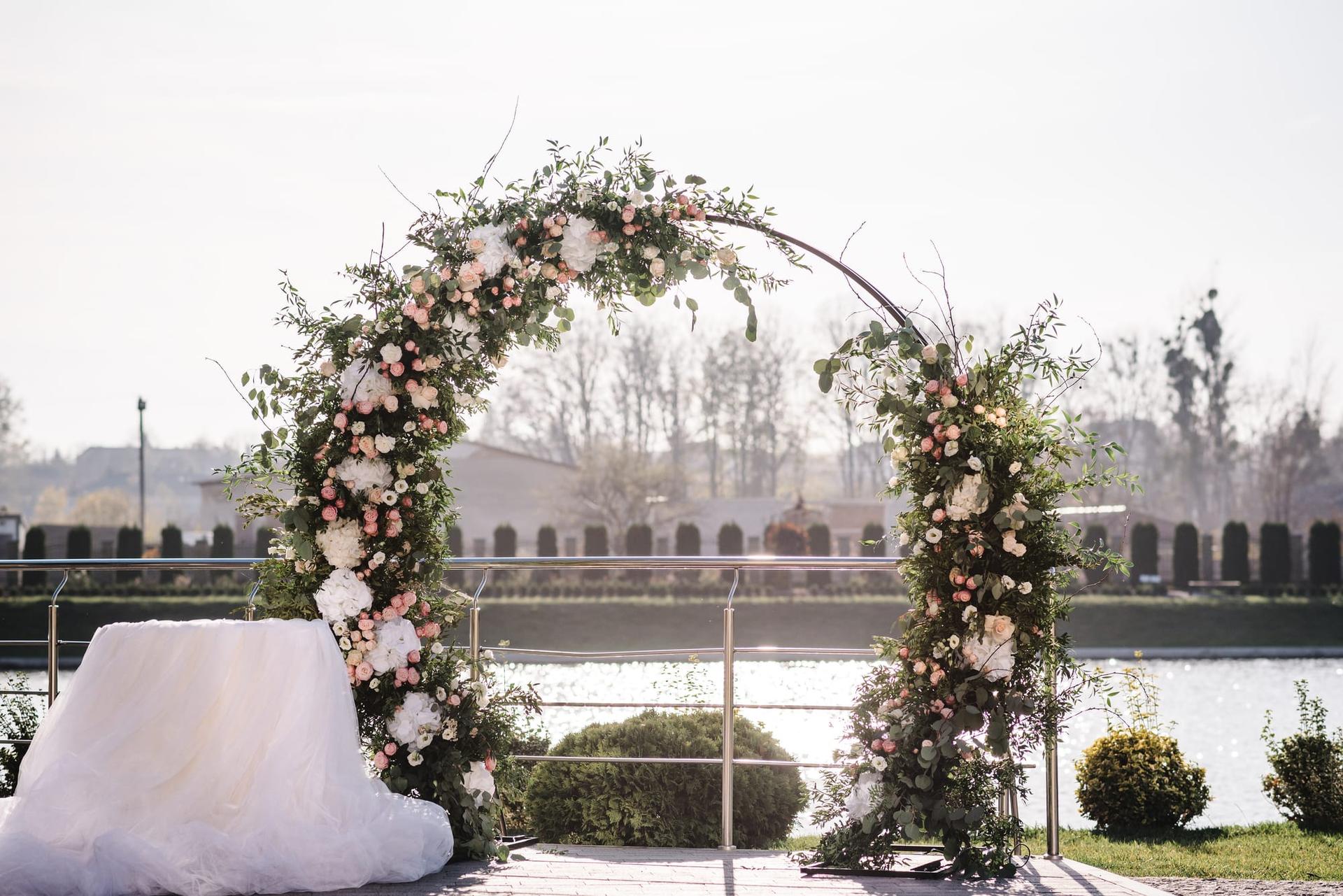
A wedding arch costs more than your bouquet because it is a construction project, and a bouquet is an arrangement. A full floral arch carries 200 to 400+ stems on a standard 8-foot frame, takes one to three hours to install at the venue, and relies on hidden mechanics to keep every bloom alive without a vase. The gap is measurable: in our 2026 Wedding Flower Price Study, arch, chuppah or mandap florals average US$1,682 in the United States, while a bridal bouquet averages US$248. Nearly seven times the price, for reasons you can count. Every one of those reasons is priced on the page at Cindy's Flowers, arch florals included, and a written line-by-line quote comes back within one business day.
How Much More Does an Arch Cost Than a Bouquet?
The 2026 Wedding Flower Price Study is an observational census of the prices florists publish on their own websites: 2,231 florists examined across two countries, 968 of them publishing prices, and 9,534 prices recorded. These are list prices rather than invoices, and they put arch florals at the very top of the ceremony bill.
- United States: arch, chuppah or mandap florals average US$1,682 across 66 published prices. The priciest tenth start at US$3,625, and the full range runs from US$159 to US$9,250.
- Canada: the same category averages CA$851 across 48 published prices, with the top tenth at CA$1,750 or more and a range of CA$150 to CA$4,237.
- Bridal bouquets, for contrast: US$248 on average in the United States and CA$246 in Canada.
- Ceremony or altar florals, the smaller pedestal and urn pieces, land in between: CA$464 on average in Canada and US$954 in the United States.
The full tables live in the United States edition of the price study and its Canadian edition. One note on the category name: the study reports arches, chuppahs and mandaps together because the job is the same. A chuppah is the canopy a Jewish couple stands beneath during the ceremony; a mandap is the pavilion raised for a Hindu wedding. All three are large temporary structures dressed in flowers, and all three obey the same cost logic.
The Scale: 200 to 400 Stems Before the Greenery Goes On
Stem count is the first half of the answer. Poppy, a US wedding-flower company with one of the few published stem-count references, puts a fully covered arch on a standard 8-foot frame at 200 to 400+ stems, plus substantial greenery. A corner cluster uses roughly 30 to 60 stems and a half arch 100 to 200, so full coverage swallows three to five times the flowers of a corner design.
A bridal bouquet, meanwhile, is whatever one hand can comfortably hold. Every additional foot of covered frame is another armload of roses, and the cost of goods climbs in step with it. This is why Cindy's Flowers publishes ceremony arch florals from $250 with each option priced on the page: watching the number move with coverage is the fastest way to understand where arch money actually goes.
Why Do Arch Flowers Need Special Engineering?
A bouquet rides to the ceremony in water. An arch flower is cut off from water the moment it is wired into the frame, and biology is unforgiving about that. Oklahoma State University Extension's cut-flower guide explains that air bubbles drawn into a stem at harvest restrict the upward movement of water, which is why florists recut an inch off every stem under water before use. A stem only drinks while those channels stay clear.
Heat compounds the problem. The same guide notes that respiration and water loss rise with temperature and wilting follows, and that cut flowers held at 5°C (41°F) may deteriorate up to four times faster than flowers held at 0°C (32°F). A July ceremony on a sun-baked Toronto patio is close to the hardest environment a cut flower can face, the same biology behind our guide to keeping flowers fresh through summer heat.
For decades the workaround was floral foam. The industry is walking away from it: a 2019 RMIT University study found that aquatic animals ingest floral-foam microplastics, and that the chemicals leaching from foam were more toxic to aquatic invertebrates than the leachates of the other plastics tested. The Royal Horticultural Society banned foam from its own events, including the Chelsea Flower Show, from 2021. Foam-free mechanics take over instead: chicken wire, moss and concealed water tubes. They keep an arch drinking all day, and they take meaningfully longer to build. That build time is labour, and labour is the second half of the price.
What Does Full-Service Installation Actually Involve?
The same stem-count guide budgets one to three hours of on-site labour for an arch install, and that comes after the studio work: conditioning stems, pre-building the mechanics, packing hundreds of flowers so they survive the drive. On the day, a crew arrives well before the ceremony, secures the frame, places stem after stem, and steps back to check the sight lines your photographer will shoot through.
This is why our ceremony installations are full-service only. Bouquets and boutonnieres can travel on the delivery-only tier; a structure that has to stand through your vows cannot. Full service adds 15 to 45 percent of the floral subtotal, depending on the venue and how much is built on site, and we install at venues up to three hours' drive from Toronto. There is no consultation fee, and every price sits on the page before you ever write to us. That is rarer than it should be: only about 47% of florists publish any wedding pricing at all, our corrected estimate in both countries, a gap we measured in our count of who actually publishes wedding prices.
Smart Ways to Get the Arch Look for Less
The same guide that counts stems also prices the shortcuts: corner clusters run about US$300 to US$600 in flowers and asymmetrical designs US$500 to US$1,200, against US$1,500 to US$2,500+ for a fully flowered arch. By long-standing design convention, ceremony photos frame the densest section of the structure, so a generous corner reads surprisingly close to full coverage in the pictures you keep.
- Choose corner or asymmetric coverage. It uses a third to a fifth of the stems of a full arch and photographs like far more.
- Move it after the ceremony. A well-built corner piece can often be relocated behind the head table, so one budget dresses two rooms.
- Dress a frame you already have. If the venue owns an arch, put the budget into stems instead of a structure.
- Pin the coverage down in writing. Published arch prices run from US$159 to US$9,250 in the US study data, and most of that spread is coverage. "An arch" is not a specification.
- Pressure-test the whole ceremony budget. Our wedding flower calculator starts every line from the study's published averages, so you can add a full arch, shrink it to a corner, and watch the total move before you talk to anyone.
An arch earns its price. It is the largest, most laboured, most engineered piece of flowers most people will ever order, and, unlike a wedding florist's minimum spend, every one of its moving parts is visible and adjustable. Decide how much frame you want covered, and the number will follow.