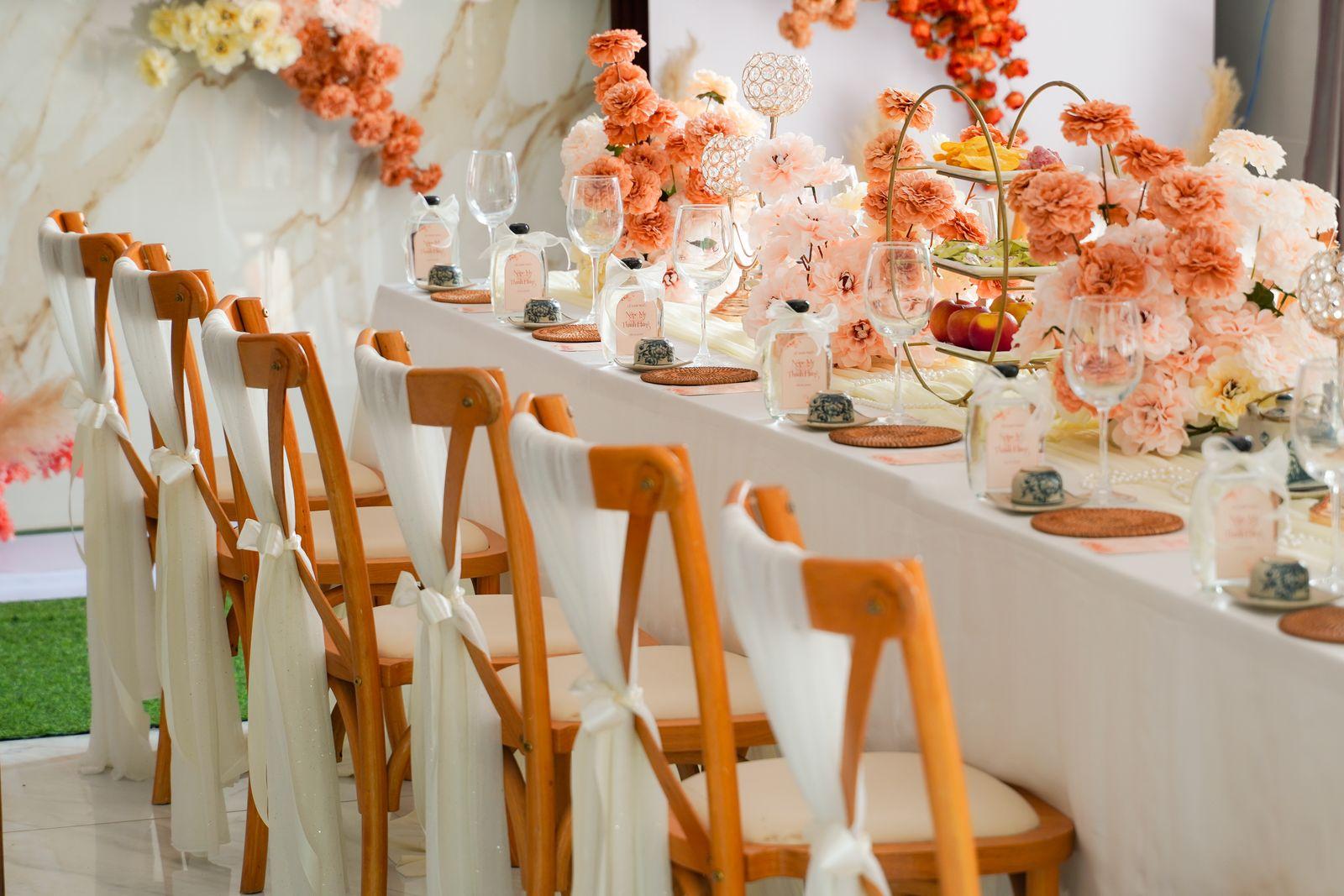
A centrepiece works on a real table when it stays out of the sightline between two people. Keep low arrangements at or under about 12 inches, or lift the flowers high enough on a stand that guests look underneath them. Standard rental tables are 30 inches tall, and seated eye level sits roughly 13 to 23 inches above that surface, so the blocked zone is narrow and very easy to land in by accident. Cindy's Flowers builds Toronto centrepieces to the table you have actually booked, not to a stock photo.
How tall should a centrepiece be before it blocks a conversation?
Two measurements settle the argument. US accessibility rules (the 2010 ADA Standards, section 902.3) require accessible dining surfaces to fall between 28 and 34 inches above the finished floor, and the round rental tables most venues stock are 30 inches. Adult seated eye height runs roughly 42.6 to 52.6 inches off the floor across the 5th to 95th percentile, per the BIFMA Ergonomics Guidelines table reproduced in *Ergonomics and Design: A Reference Guide*. Subtract one from the other and, by our own arithmetic, seated eye level lands about 13 to 23 inches above the tabletop.
That band is the whole problem. An 18-inch arrangement photographs beautifully and ruins the table it stands on, because it clears nobody's sightline and blocks everybody's. The two workable zones sit on either side of it. By convention, low pieces are kept at about 12 inches or under, which puts the top of the flowers beneath even the shortest seated guest's eyeline. Tall pieces go the other way: the stand carries the florals up past 30 inches from the tabletop, so guests talk underneath the arrangement instead of around it.
Both shapes sit on our wedding centrepieces page, and choosing between them is not a decorative call. It decides whether the couple across from each other spend dinner leaning sideways.
Before you approve a design, run this test:
- Sit at a table the same height as the venue's, ideally the venue's own.
- Hold your hand flat where the top of the flowers will be.
- If your hand crosses the face of the person opposite, the piece is in the band. Take it down, or take it up.
Count tables, not guests
The question everyone asks is how many centrepieces 100 guests need. The answer comes off the floor plan, not the guest list. A 60-inch round seats eight to ten, so 100 guests is ten to thirteen rounds before anything else is counted. Then come the tables nobody photographs: sweetheart or head table, gift table, escort cards, cake, sign-in book, the bar tops. That is routinely three to five extra pieces.
One piece per table, plus three to five for the non-dining tables, is a fair first pass, and it is how our wedding flower calculator scales the count as guest numbers move. Almost nothing else in a wedding order scales the same way. The bride carries one bouquet whatever happens and the ceremony gets decorated once, while the wedding party grows only loosely, because a 250-guest wedding does not have five times the bridesmaids of a 50-guest one. Centrepieces are the one line that tracks the guest count directly, which is why they grow faster than anything else on a quote when the list creeps from 90 to 130.
What changes when the tables are long?
Rectangles behave nothing like rounds. A 6-foot banquet table seats six to eight, an 8-foot seats eight to ten, and the eye reads the full length as a single line, so one arrangement stranded in the middle of a 72-inch table looks like an afterthought. Runs read better than solos.
- Round tables: one focal piece, because every seat looks at the same centre point.
- Six-foot rectangles: two or three low pieces spaced roughly every 24 to 30 inches, leaving room for plates, glassware and menus.
- Long farm tables: a low greenery run with bud vases and enclosed votives filling the gaps.
- Mixed rooms: alternate low and elevated pieces table to table, so the room gets rhythm and no single group of guests is stuck behind the tall one all night.
A greenery run is also the least expensive way to make a long table look finished, which is the case our guide to eucalyptus and greenery makes in more detail.
Can you use real candles? Ontario's fire code answers first
Venue coordinators take the blame for candle rules they did not write. In Ontario the baseline is the Fire Code, O. Reg. 213/07 under the Fire Protection and Prevention Act, 1997. Division B, Article 2.4.4.1(1) states: "In a building used for a public assembly, open flames shall not be used in such quantity or manner as to create a fire hazard unless the use has been approved."
Article 2.4.4.1(3) is the sentence that shapes what actually lands on your table. It says decorative and lighting devices with open flames "shall not be used unless they are (a) securely supported in noncombustible holders and located and protected so that combustible materials will not come into contact with or be ignited by the flame, or (b) approved." Article 2.4.4.3 repeats the point for open flames generally: they "shall be securely supported in noncombustible holders and located or protected so as to prevent accidental contact of the flame with combustible materials."
Two practical consequences follow. Glass hurricanes and enclosed votives satisfy the holder requirement in a way a bare taper beside a paper menu does not, and dried grasses, loose petals and fabric runners are precisely the combustible materials the article has in mind. The second consequence is a definition: in the code, "approved" means approved by the Chief Fire Official, not by the person answering the venue's email. Ask your venue for its written candle policy early, then design to whatever it says.
The vessel is a real line on your quote
Flowers get the attention, and glass gets the invoice. Twelve elevated stands and twelve bud vases serve the same guest count and are wildly different purchases, yet the vessel is the part of a centrepiece almost nobody budgets for. At Cindy's Flowers, vessels are sold with the order and never lent, so the cost appears once, in writing, and the glass leaves with you at the end of the night.
Our centrepieces start at $75 for a bud vase trio. You can assemble the whole list yourself in our wedding package builder, where every piece carries its published price, and a written line-by-line quote comes back within one business day. There is no consultation fee and no fixed packages, so a room of low bud vases with one elevated piece on the head table is an ordinary order rather than a special request. Vessels are only one of the costs couples do not see coming; the rest are in our list of wedding flower price surprises.
What happens to the flowers at the end of the night?
Someone takes them home, and that deserves a moment of planning, because a centrepiece that is charming on a banquet table can be a real hazard in a guest's kitchen. True lilies and daylilies cause fatal kidney failure in cats, and both the pollen and the vase water are hazards, so those stems should not go into a home with a cat at all. Our post on lilies and cats explains why the usual workarounds do not help. The ASPCA also lists hydrangea, eucalyptus, carnations, tulips and ranunculus as toxic to dogs, cats and horses, while roses, alstroemeria, gerbera daisies and sunflowers appear on its non-toxic list for dogs and cats. That makes the second group the straightforward pick when arrangements are going home with guests.
Who moves the pieces is a service question, not a design one. Cindy's Flowers works two ways: delivery only, where the boxes arrive and your team places them, or full service, where we arrive, install and style, priced at 15 to 45 percent of the floral subtotal depending on the venue and how much is built on site. Wedding delivery runs up to three hours from Toronto, and the full range of pieces sits on our Toronto wedding flowers page.
Get the height right, count the tables rather than the heads, and check the candle policy in writing. Everything after that is taste, and taste is the easy part. For guests who want their centrepiece to last another week, our guide to making cut flowers last longer is worth passing along with the vase.