Here's the trick in one line: raise the greenery share, and your wedding flowers look fuller while costing less. Foliage builds most of an arrangement's visible volume, so a bouquet that is one third eucalyptus reads just as generous as an all-bloom design with far fewer premium stems. The Knot calls eucalyptus a budget-friendly stem that adds, on average, between $10 and $40 to a bouquet that averages $150 to $300 (both figures American, in USD). It works for a Toronto wedding in January as well as July, and this guide shows exactly where to use it. Cindy's Flowers publishes a price for every wedding piece, greenery included, so you can price the greens-heavy version against the all-bloom one before you commit to either.
How the greenery trick works
Focal blooms carry the cost of a wedding arrangement. Premium stems are priced individually, and a dense, all-bloom dome needs a lot of them. Greens like eucalyptus and Italian ruscus occupy space beautifully at a fraction of the price per stem, so shifting the recipe toward foliage drops the flower count without shrinking the piece.
There's a style bonus, too. A loose, eucalyptus-laced hand-tie moves and photographs with more life than a tight dome, and that silvery blue-green flatters white dresses, blush palettes and deep autumn tones alike. Florists have leaned on foliage this way for years; the trick is simply asking for it on purpose.
Two honest limits. First, greenery-forward is a look: airy and garden-like rather than lush and packed, so a couple set on a solid wall of roses won't get there on foliage. Second, the saving multiplies where quantities do. One bouquet saves a little; fourteen guest tables save a lot, which is why the biggest wins come further down this page.
Which eucalyptus goes in a wedding bouquet?
There are hundreds of eucalyptus varieties, which is why The Knot's answer to "when is eucalyptus in season?" is, in short: always. Some variety is available to florists every week of the year. A few show up in wedding work constantly:
- Silver dollar. The rounded, silvery-blue "coins" florists sell are the juvenile leaves of Eucalyptus cinerea, an Australian species nicknamed the silver dollar tree. It's the variety most couples picture when they say eucalyptus, and the one that photographs best in a eucalyptus wedding bouquet.
- Seeded. Stems studded with clusters of seed pods, wonderful for texture. One planning note from The Knot: for a short period between April and June the seeds have gone to flower and lose their expected look, so seeded stems show best outside that window.
- Baby blue. Small, stiff, coin-like leaves from Eucalyptus pulverulenta. This is the variety Kansas State University researchers chose for their preservation trials, which says something about how well it keeps.
That fresh, faintly medicinal scent comes from eucalyptol, the plant's essential oil, and the same compound is the reason for a caveat that belongs right here: the ASPCA lists eucalyptus as toxic to dogs, cats and horses, with signs of ingestion including salivation, vomiting, diarrhea, depression and weakness. If arrangements will go home with guests who have pets, tell us. We'll design bloom-forward take-home pieces around stems like roses and alstroemeria instead.
What about Italian ruscus and olive?
Italian ruscus is the other workhorse green, and it hides a lovely piece of botany. Ruscus is a small genus, six species of evergreen perennials known as butcher's-broom, native to western and southern Europe and neighbouring regions. Those glossy "leaves" along the stem aren't leaves at all: they're cladodes, flattened stem tissue doing a leaf's job, while the true leaves are tiny scales. Ruscus hypophyllum is the species grown for the floral trade, and its deep green, arching stems give an arrangement structure that softer foliage can't.
Olive earns its place differently: soft, grey-green and Mediterranean, beautiful against terracotta, rust and cream.
On pets, I'd rather be precise than reassuring. Neither ruscus nor olive appears in the ASPCA's plant database at all, in either the toxic or the non-toxic list, so we don't call them pet-safe. If pets will reach the arrangement, ask us to swap the greens and we will.
Where does greenery save the most?
Centrepieces, without question. They're the one wedding item that multiplies with your guest list, one piece per table, so a per-piece saving repeats twelve or twenty times over. For scale: the 87 Canadian florists who publish a wedding centrepiece price average $176 CAD, per our 2026 Wedding Flower Price Study.
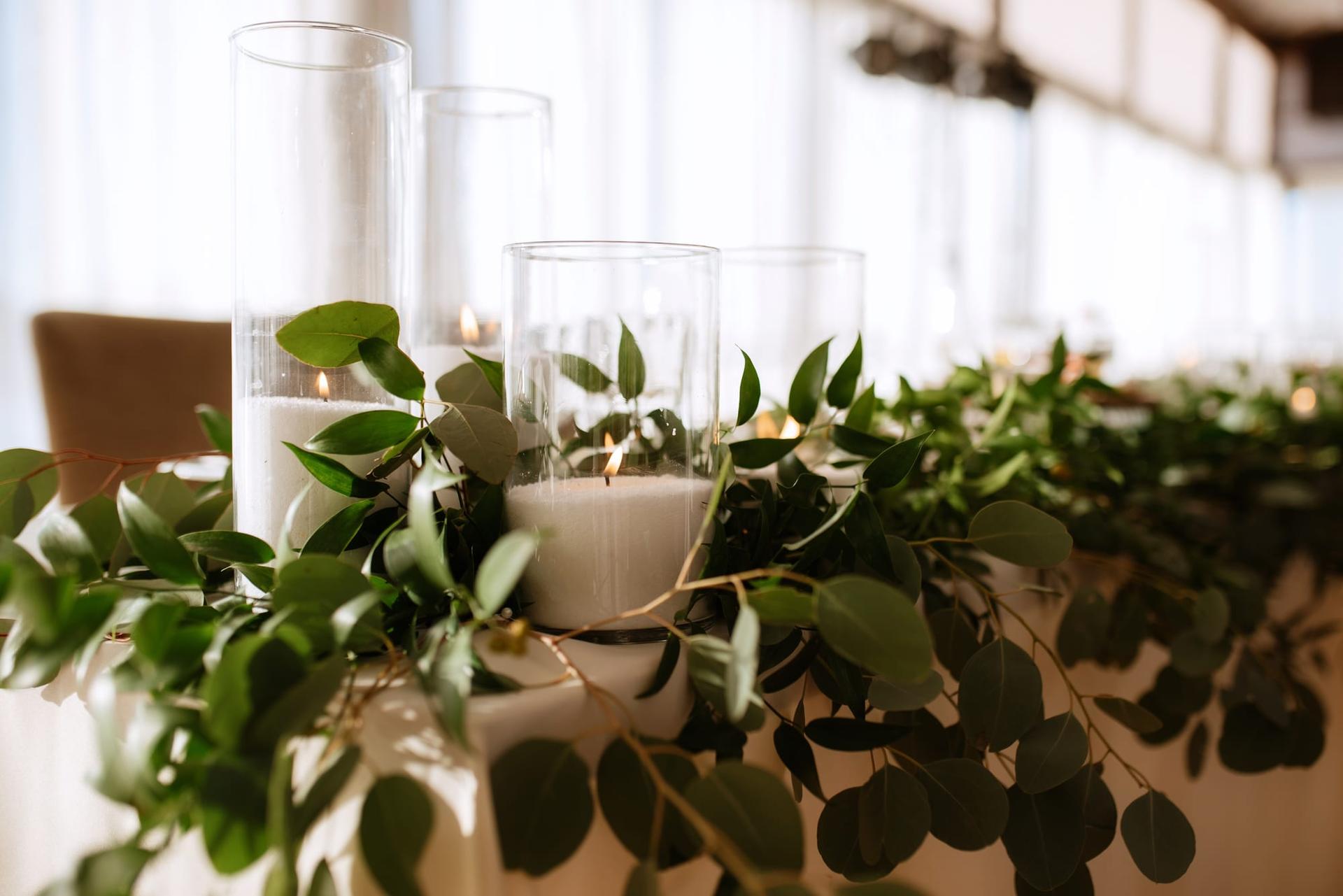
Greenery-forward tables come in two reliable shapes. One is a eucalyptus garland run down the table as a living runner, dotted with tea lights and a few focal blooms. The other is clusters of small vases, each holding a stem or two, which give a full-looking table on the fewest flowers of any format. Our bud vase trio centrepiece starts at $75, and the rest of our wedding centrepieces are priced openly on the same pages.
Two footnotes before you commit. If you're tempted to build DIY garlands the day before, wear gloves: NC State Extension grades eucalyptus as high severity for people because handling the leaves and bark can cause skin redness, irritation and burning. And if you're eyeing a ceremony arch, greenery bulk is a large part of why arches are priced the way they are.
The Toronto catch: every stem is imported
No eucalyptus grows through an Ontario winter. NC State Extension puts its hardiness at USDA zones 7b to 10b and notes that in zones 7a and lower the plants are prone to dying back to the ground. Toronto sits colder still, so every cut stem a Toronto florist sells is imported or greenhouse-grown, and any "locally grown eucalyptus" claim deserves a raised eyebrow.
Oddly, that's good news for planning. Imported foliage has no local season to hit or miss, so a February wedding gets the same silver dollar as an August one. Compare that with Ontario-grown peonies and their tight late-spring window, which we've mapped in our guide to peony season in Ontario.
Can you keep a eucalyptus bouquet after the wedding?
Yes, and it keeps better than almost any flower in it. Eucalyptus preserves so well that there's real research on the method: a Kansas State University study, published in HortTechnology and funded in part by the American Floral Endowment, tested 'Baby Blue' eucalyptus and recommends standing fresh stems in a 25 percent glycerin solution, 1 part glycerin to 3 parts water, for about two weeks. Glycerin-treated stems stay flexible after drying instead of shattering, though the leaves surrender some of their green from around day six. Mississippi State University Extension adds that glycerin suits foliage far better than flowers, and that preserved leaves take on a soft, leathery feel.
For the blooms themselves, the methods are different; our guide to drying and preserving flowers covers the whole bouquet. One note for the mantelpiece: dried or fresh, the ASPCA lists eucalyptus as toxic to dogs, cats and horses, so give the keepsake a spot pets can't chew.
If the greenery trick sounds like your kind of arithmetic, run the numbers yourself. Every piece Cindy's Flowers makes is priced up front, so you can build your wedding package greens-heavy and watch the total drop. There's no consultation fee, a written line-by-line quote comes back within one business day, and we deliver wedding flowers up to three hours from Toronto.