August carries two birth flowers: the gladiolus, its primary bloom, and the poppy, its secondary one. The gladiolus draws its name from *gladiolus*, the Latin diminutive of *gladius* — literally "little sword," and stands for strength, honour and remembrance. The poppy speaks to rest, peace, and, for Canadians especially, wartime remembrance. Only one of the pair actually flowers in Ontario gardens by August, and there's a genuinely good story behind why both earned the month. Here's what each bloom means, where the traditions come from, and how to give them well for a late-summer birthday. For an August birthday that actually matches the season, Cindy's Flowers builds bouquets around gladioli and other late-summer stems, hand-tied in our Toronto studio for same-day delivery across Toronto and the GTA.
Why does August have two birth flowers?
Most months carry a primary birth flower and a secondary one, and August is no exception. Its lead bloom is the gladiolus; its companion is the poppy. The two-flower setup comes from different floral traditions landing on the same month rather than a single official rulebook, which is why you'll sometimes see one listed without the other.
Think of the gladiolus as the headline and the poppy as the supporting act. The gladiolus earns top billing partly because it genuinely peaks in late summer, while the poppy holds its place on symbolism and history rather than the calendar. August straddles two star signs, Leo and then Virgo, but the birth flowers belong to the whole month rather than one sign. Both suit a late-summer birthday anyway. Courage, sincerity, and remembering the people who matter run through the pair.
The gladiolus: August's "little sword"
The gladiolus is a genus of perennial plants in the iris family, Iridaceae, and it grows from underground corms rather than true bulbs. The name is the Latin diminutive of gladius, or "sword," a nod to the tall, blade-shaped leaves, which is also why it's nicknamed the sword lily. Despite that name, it is not a true lily: true lilies belong to the genus Lilium, while the gladiolus sits in the iris family entirely. That distinction matters for cats, because true lilies and daylilies cause fatal kidney failure in them. It does not make the gladiolus pet-safe, though — the ASPCA lists gladiolus as toxic to dogs, cats and horses, with the highest concentration of toxin in the corms, so keep corms away from pets when you plant or lift them. There are close to 300 species in the genus.
Most garden gladioli trace back to the wild species of South Africa's Cape region, the plant's centre of diversity, with others native to the Mediterranean, Asia and tropical Africa. Each flower blooms in mid- to late summer on a tall spike, its trumpet-shaped florets opening from the bottom upward in white, pink, red, purple and yellow. That vertical drama is the whole appeal. A single stem reads like a small firework paused mid-burst.
The sword theme runs deeper than the leaves. In ancient Rome the flower was linked to gladiators, who were said to wear the blooms into the arena, and crowds reportedly showered victorious fighters with them. Strength written into a plant's name: it doesn't get more literal than that.
What does the gladiolus symbolize?
By floral tradition the gladiolus stands for strength, integrity, honour and remembrance. The Victorian language of flowers added a romantic layer on top: infatuation, faithfulness, and love at first sight, as if the tall spike had pierced the giver's heart. In short, it carries a lot of meaning for one stem:
- Strength and integrity, drawn from its upright, sword-like form
- Honour and remembrance, the reason it turns up in tributes
- Infatuation and faithfulness, the Victorian romantic reading
- Love at first sight, the image of a heart pierced clean through
That range explains a common mix-up. You'll spot gladioli in sympathy and tribute arrangements, which leads people to file them as funeral flowers. The height and the remembrance symbolism do make them a natural fit for solemn settings, but the gladiolus is not a funeral flower by definition.
It suits a bright, celebratory bouquet just as well, which is what makes it a strong pick for an August birthday delivery when you want a little ceremony in the gift. Tradition also names it the flower of the 40th, or ruby, wedding anniversary, so its reach runs from milestone marriages to Leo-season gifts.
The poppy: rest, remembrance, and a Canadian story
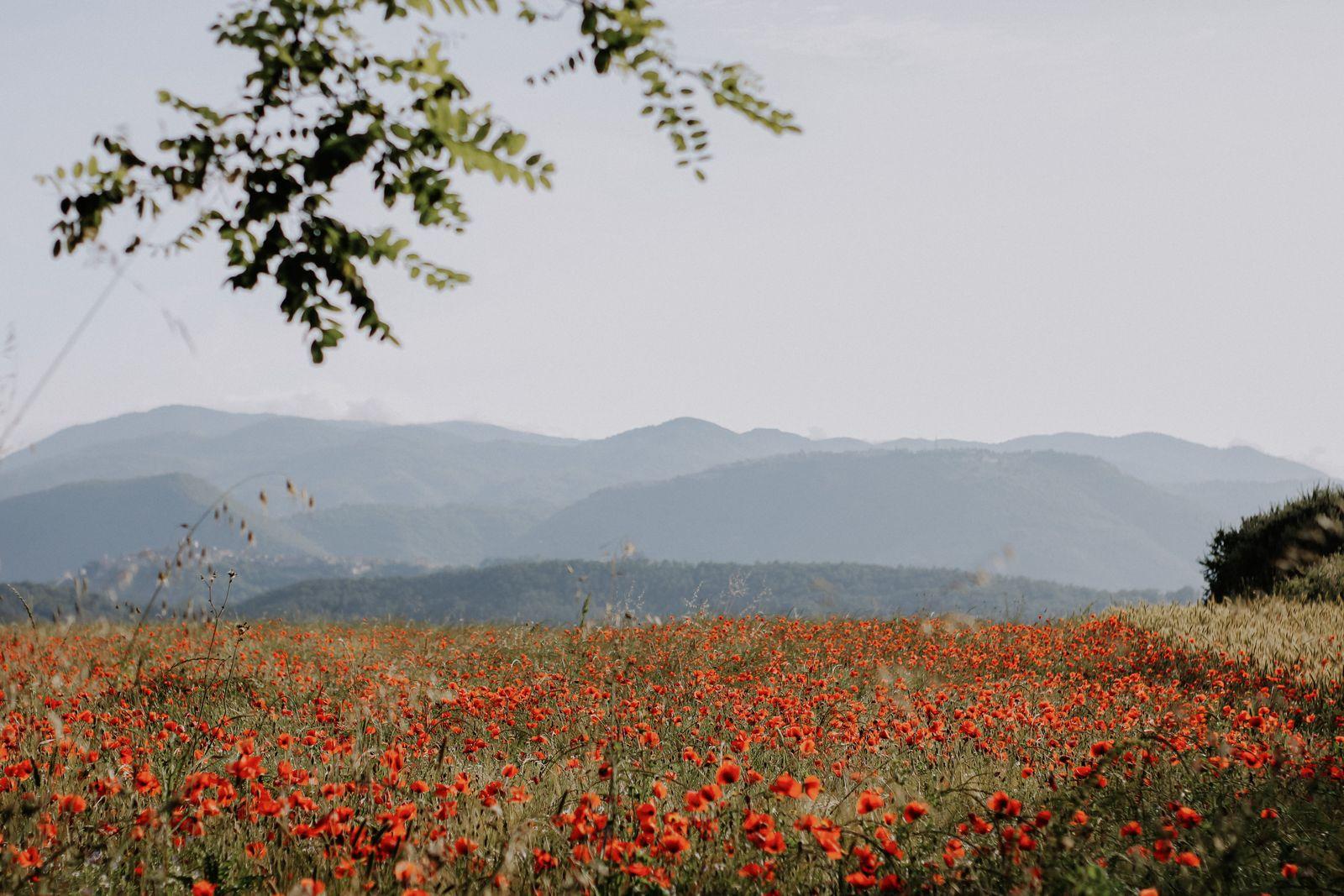
The poppy is August's secondary birth flower, and for Canadians it carries unusual weight. Poppies are herbaceous plants of the genus Papaver, and most species leak a milky sap when the stem is cut. That sap is the most potent part of a plant that is itself toxic to cats and dogs, so keep cut poppies and their stems away from curious pets. The red field poppy, Papaver rhoeas, became the emblem of wartime remembrance, a symbol that runs especially deep across Canada and the Commonwealth.
That association traces to "In Flanders Fields," the poem written in 1915 by John McCrae, a Canadian surgeon and soldier. It's why the remembrance poppy is worn each year around Remembrance Day on 11 November. Long before the World Wars, though, the poppy already meant sleep, peace and death in Greco-Roman myth. The sedative opium poppy stood for rest; the blood-red petals stood for eternal sleep. Poppies were left as offerings for the dead, and they also came to signify resurrection and the remembering of departed loved ones. For a birthday flower, that's a surprisingly deep well to draw from.
Are August's birth flowers actually in season in Ontario?
One of them is, and one isn't. That's the honest answer. Gladiolus corms, planted here after the last spring frost around mid-May and on into late June, flower from mid- to late summer, so they are genuinely in season for August birthdays in Ontario gardens. In our winters the corms aren't hardy, so local growers lift them after the first fall frost and store them somewhere frost-free until spring.
Poppies are a different story. Most Ontario garden poppies, the Oriental poppy included, bloom in June and July and are past their peak by August. The poppy's birth-flower status is symbolic and traditional, not a promise that it's blooming outdoors in late summer. Any florist who tells you otherwise is stretching the truth.
Poppies vary widely as cut flowers. Breadseed and Shirley types last only a few days and weep that milky sap, so growers sear the cut end with a flame to slow the bleed; Iceland poppies, by contrast, are a mainstay specialty cut crop and hold up to a week when cut at the right stage. Gladioli, by contrast, are prized in the vase. Cut the spike when the lowest floret is just showing colour, get it into water quickly, and it will keep opening for days. If you would rather skip the garden altogether, you can browse what's fresh right now and let the season make the call.
How do you give August birth flowers as a gift?
Lead with the gladiolus. It's the seasonal, symbol-rich choice for an August birthday, and its tall spikes bring instant structure to an arrangement, especially next to softer summer blooms. Treat the poppy as the sentimental footnote rather than the headline, since most garden poppies won't be in local bloom by then, though Iceland poppies do cut well if you can find them.
A gladiolus-forward bouquet reaches well beyond the birthday itself. That same strength-and-sincerity symbolism fits a congratulations, a thank-you, or a no-occasion "thinking of you" gesture dropped into an ordinary Toronto August. Cindy's Flowers hand-ties every arrangement in our Toronto studio and delivers same-day across the GTA when the order comes in before 3 PM, Monday through Saturday. Add a single line about what the flower means, strength, honour, love at first sight, and a nice bouquet becomes one the recipient actually remembers.