Two flowers share October. Marigold is the primary birth flower and cosmos the second, per the Old Farmer's Almanac, whose birth-flower table gives the pair a combined meaning of creativity, passion and joy. That meaning belongs to both blooms together, not to marigold alone: the Almanac's own October page gives marigolds death and grief alongside optimism, joy and strong emotions, and gives cosmos order, balance, peace and innocence. If someone in your life has an October birthday, Cindy's Flowers builds that autumn palette into hand-tied bouquets and delivers them across Toronto and the GTA.
Marigold leads, cosmos follows
The Old Farmer's Almanac puts it in one line: "Marigolds and cosmos are the birth flowers for October." Its month-by-month table gives each row a primary flower, a secondary flower where there is one, and a single meaning. October's row reads marigold, cosmos, "Creativity, passion, joy." September's is built identically: aster, morning glory, "Patience, love, affection."
Read that column carefully. It describes the pair, not the headline bloom, and gift guides routinely hand the whole phrase to the marigold on its own. The Almanac's per-flower pages split it very differently, and that split is the version worth quoting.
Why do some months carry two? Because birth-flower lists are custom rather than botany. No botanical authority governs them, references disagree at the margins, and several months ended up with a primary and a secondary bloom. Our month-by-month guide to birth flowers sets out all twelve pairings, and the September pairing of aster and morning glory shows the same structure one month earlier. Tattoo artists work from these lists too, which is why an October design can carry both blooms instead of one; our guide to birth-month flower tattoos covers how the twelve get drawn.
What do marigolds actually symbolize?
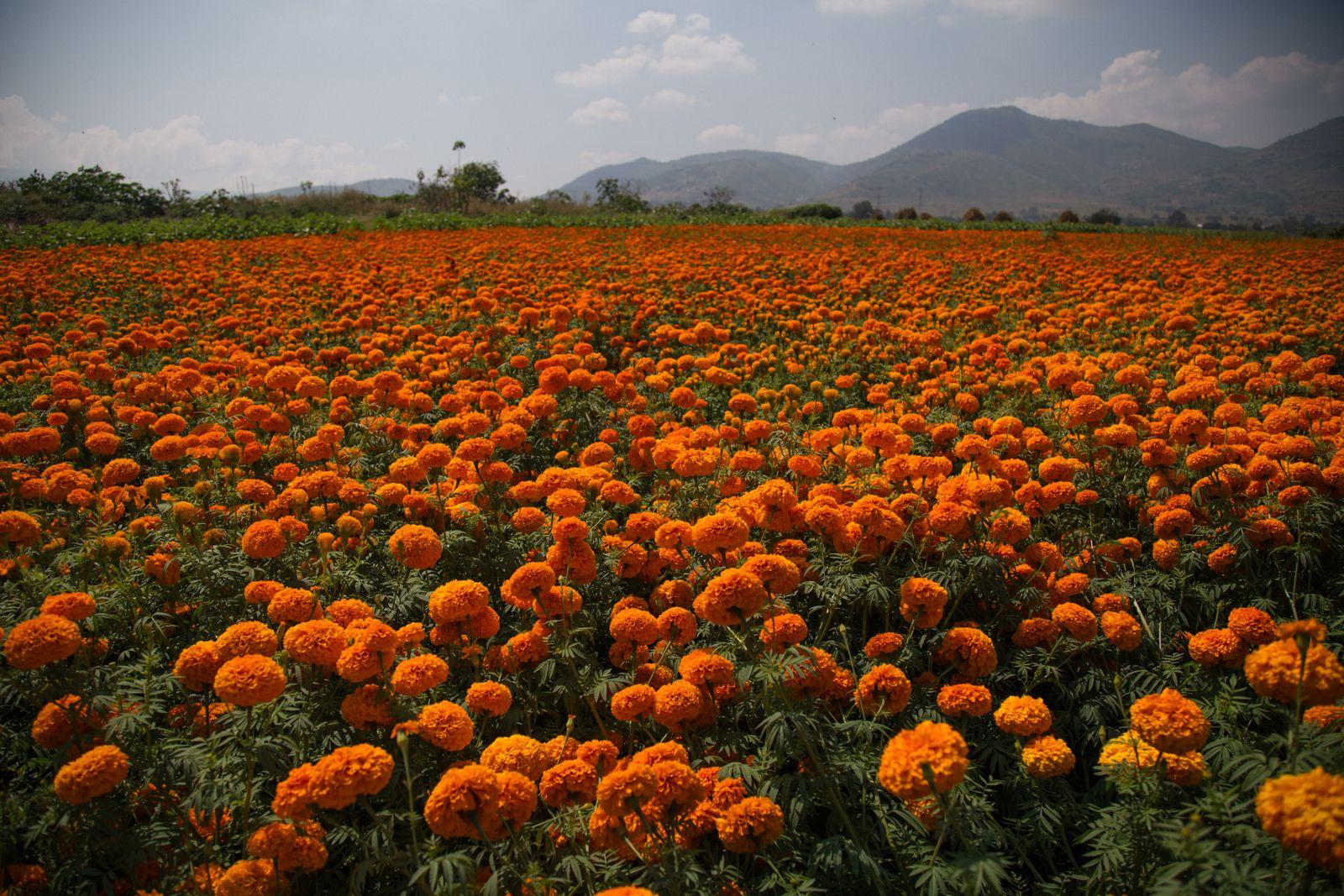
Botany first. Marigold is the genus Tagetes, roughly 50 annual and perennial species in the daisy family, Asteraceae, formally named by Linnaeus in 1753. The genus is native from the southwestern United States down through Mexico and into South America. The Nahua name for the flower was cempōhualxōchitl.
That origin drives the meaning. The Almanac describes marigolds as "known for their bright colors and strong odor" and notes they "have long been associated with death and grief," a prominent fixture in Day of the Dead festivities, used to decorate gravesites and home altars. Britannica notes that Día de Muertos is typically observed on November 1 and 2, and explains the flower's job: the bright colour and strong scent of the cempasúchiles are believed to guide spirits back to the world of the living. Families build ofrendas, dress graves, and lay petal paths home. Tagetes erecta is the species most closely tied to the celebration, and UNESCO added Mexico's Indigenous festivity dedicated to the dead to its Representative List of the Intangible Cultural Heritage of Humanity in 2008.
Marigold garlands do comparable work in Hindu worship, strung for temple offerings and hung across doorways at festival time.
So of the pair's three assigned meanings, the passion and the joy sit closer to marigold. A flower carried into a cemetery to make the dead feel welcome is not a mournful flower. It is loud, gold and celebratory.
Three marigolds, two misleading names
Garden centres sort Tagetes into three groups:
- African marigold (Tagetes erecta), also called the Aztec marigold. Tall, with dense pompom heads. Per the Almanac, these "do not originate in Africa and got their name when the flowers were brought through northwest Africa along a trade route."
- French marigold (T. patula). Shorter and bushier, and again per the Almanac, "named due to their popularity in French gardens" rather than for any French origin.
- Signet marigold (T. tenuifolia). Small single flowers over fine, lacy foliage.
The Mary's gold mix-up
The English word marigold comes from "Mary's gold," in honour of the Virgin Mary, but it was first applied to a different plant: Calendula officinalis, a European species. The Almanac agrees, noting that pot marigolds are "native to southern Europe and a member of the Calendula genus, are not a true marigold." The Marian name story belongs to calendula. The October birth flower is Tagetes, a Mexican genus that Europeans met only after 1492.
The distinction matters if there is a cat or a dog in the house. The ASPCA lists pot marigold, Calendula officinalis, as non-toxic to dogs and cats. Tagetes is the other one: Pet Poison Helpline rates Tagetes marigolds mildly toxic to dogs and cats, with stomach upset from eating them and skin irritation from the sap the usual signs. Cosmos is not on the ASPCA's list at all, in either direction, so treat it as unproven rather than proven safe. In a pet household the surer picks are the ones the ASPCA does list as non-toxic to dogs and cats: roses, alstroemeria, gerbera daisies and sunflowers.
Why is cosmos the quieter half of the pair?
Cosmos is a second daisy-family genus, and Kew's Plants of the World Online accepts 36 species. The native range covers scrub and meadowland in the Americas, from Colorado and Missouri south through Mexico, where the great majority of those species grow, then through Central America down to northern Argentina. Cosmos bipinnatus, the feathery garden species, has naturalised across much of the eastern United States and eastern Canada, which is why it turns up self-sown in Ontario well outside any garden.
Its name is contested, so no single gloss should be stated as settled. The Old Farmer's Almanac traces it to the Greek kosmos, order and harmony of the universe, and tells the story behind that: Spanish priests in Mexico grew cosmos in their mission gardens and named it for the orderly arrangement of the petals. A second reading derives it instead from kósmima, Greek for jewel. The travel history, as the Almanac tells it, runs like this. Cosmos reached Spain from Mexico in the 16th century, and England in the 18th.
The Almanac gives cosmos order and balance, peace and innocence, plus luck and many medicinal uses. Colour conventions sit on top of that:
- Red: love and passion.
- Pink: a mother's love, which makes it an easy pick for a parent's October birthday.
- Yellow: friendship.
- White: faithfulness and devotion.
Conventions, not rules. A cosmos-led bouquet reads gentler than a marigold-led one, which suits an unprompted just-because delivery better than it suits a milestone.
Which October birthday bouquet suits the person?
Pick the half of the pair that matches the recipient, then build the palette around it.
- Bold and high-contrast: the marigold reading. Hot orange, gold and rust, dense round heads, saturated colour throughout.
- Soft and airy: the cosmos reading. Pale pinks and whites, fine foliage, deliberate space between the stems.
Both are easier to deliver as a colour story than as a literal stem, which is what autumn mixed bouquets do well. Marigold's range is straightforward to echo in roses, spray roses and gerbera daisies; the cosmos effect comes from how loosely a bouquet is tied, not from any one flower in it. Cindy's Flowers hand-ties every arrangement in our Toronto studio, and orders placed before 3 PM, Monday to Saturday, go out for same-day delivery across Toronto and the GTA. Browse what's in season right now, or start from our birthday flowers page if the date is the whole point.
Getting the October pair into a Toronto bouquet
Neither flower is a staple of the year-round cut trade. Both are frost-tender annuals grown mainly as garden plants, so their Ontario season closes with the first hard frost, and October is the tail of it rather than the middle. You will still see marigolds in Toronto front-garden borders and at market stalls in early October, cosmos leaning over fences beside them, and then they are done for the year.
For a birthday on the 12th, take the meaning and the colour rather than the exact species, and build with stems that hold in a vase. The fall flowers that actually last here covers what is genuinely in season in Toronto in October, and the routine that keeps any of them going is set out in our guide to making cut flowers last longer. One caution on autumn palettes: chrysanthemums are the default fall filler, and the ASPCA lists them as toxic to dogs, cats and horses, so say so when you order if a pet lives at the address.