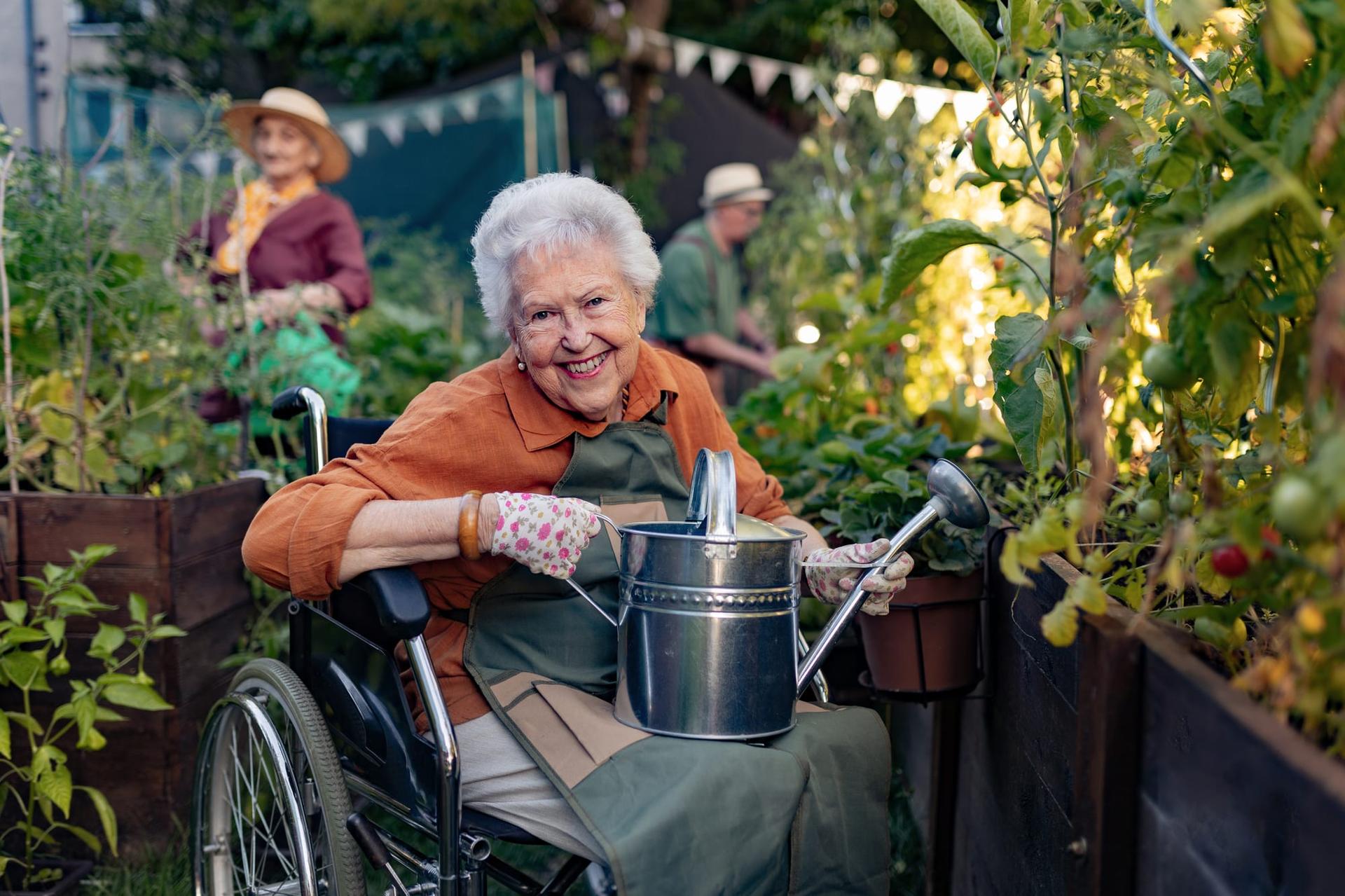
Gardening for seniors and people with disabilities works best when the garden is built to meet the gardener. That means beds at the right height for standing or sitting, narrow enough to reach the middle. Add firm paths wide enough for a wheelchair or walker, and lighter, longer tools used in short sessions. Easy-access raised beds stand 3 feet (90 cm) or more for gardeners who stand and about 2 feet (60 cm) for gardeners who use wheelchairs, according to Oregon State University Extension.
Why is there no single best raised bed height for seniors?
Because it depends on whether the gardener stands or sits. Oregon State's 2023 guide, "Gardens are for everyone," explains the taller figure: at 3 feet (90 cm), a standing gardener's work surface is no lower than the fingertips.
Measure the person, then compare three designs:
- Tall bed, for standing gardeners: 3 feet (90 cm) or more high, no more than 4 feet (1.2 m) wide (Oregon State).
- Side-approach bed, for seated gardeners: walls about 2 feet (60 cm) high and a bed about 3 feet (90 cm) wide (University of Missouri Extension). Capping wooden walls with a board about 38 × 140 mm or 38 × 184 mm (a 2-by-6 or 2-by-8 in North America) makes a seat, Missouri adds.
- Table-style bed, to roll under: about 3 feet (90 cm) high on legs, with room underneath for a mobility aid (Oregon State). The work surface then sits in the gardener's lap, KidsGardening notes.
Beds higher than 18 to 24 inches (45 to 60 cm) need retaining walls with foundations and supports, Missouri warns.
For roll-under tables, the US 2010 ADA Standards make a useful benchmark: work surfaces 28 to 34 inches (710 to 865 mm) high, with the space from 9 to 27 inches (230 to 685 mm) above the ground counted as knee clearance. Oregon State's 3 feet (915 mm) sits just above that range. At 34 inches (865 mm), only about 7 inches (18 cm) is left for the box and its base, while Missouri says most plants need at least 6 to 12 inches (15 to 30 cm) of rooting zone, so grow only the shallowest-rooted plants.
How wide can a raised bed be?
Width comes down to reach. Adult beds should be no more than 4 feet (1.2 m) wide, and children's 3 feet (90 cm), so the gardener can reach the centre, Oregon State says. Against a wall or fence, KidsGardening's limit is 2 feet (60 cm).
How wide should garden paths be for a wheelchair or walker?
Paths 3 to 4 feet (0.9 to 1.2 m) wide fit both wheelchairs and wheelbarrows, Oregon State University Extension says, and KidsGardening asks for at least 4 feet (1.2 m), preferably 5 (1.5 m). The common 36-inch (915 mm) figure is the US ADA Standards' minimum walking width, which gets a chair down the row but leaves no room to turn it. Turning takes a 60-inch (1525 mm) circle or a T-shaped space inside a 60-inch (1525 mm) square, and a U-turn around a bed end narrower than 48 inches (1220 mm) needs 42-inch (1065 mm) paths widening to 48 inches (1220 mm) at the turn, unless the turn is 60 inches (1525 mm) wide. Without one, the gardener reverses out: leave a 5-foot (1.5 m) turning spot at the end of each path.
Public gardens may face legal rules, not benchmarks: in the US many must comply with the ADA, Oregon State notes, and elsewhere accessibility law differs by country.
Paths should be smooth and level, hard-paved in concrete or asphalt or laid in compacted gravel, and kept clear of hoses and tools, which are trip hazards, Oregon State advises.
Tools and containers that do the lifting
The US ADA Standards put unobstructed forward reach between 15 and 48 inches (380 and 1220 mm) above the ground, so keep taps, tool hooks and wall planters inside that band.
Choose tools for comfort first, because one that tires your hand in five minutes won't get used:
- Long-handled trowels, weeders and cultivators, so the reach comes from the handle, not the back.
- Thick, cushioned grips for stiff or sore hands; foam pipe insulation over an old handle works too.
- Ratchet pruners, which cut in stages, so a thick stem takes several light squeezes, not one hard one.
- A kneeler that flips into a low seat, with side handles to push up from.
- A wheeled cart for anything heavy.
- Brightly coloured handles, easier to spot in the grass for a gardener with low vision.
Plastic or fibreglass pots are lighter to move than terracotta or concrete. KidsGardening suggests hanging baskets on a pulley so they can be lowered, and warns that any planter must be secure enough not to tip if someone leans on it.
Which plants keep gardening for seniors low-effort?
The forgiving ones, grown in soil that holds water. Raised beds dry out faster than in-ground gardens, and the taller the bed, the more often it needs watering, University of Minnesota Extension notes; potting soil alone dries out too quickly.
A soaker hose on a timer or self-watering pots take most of the watering off the list, and because raised beds cost labour and money to build (University of Missouri Extension), start with one bed and add more once a season shows what works.
Three container-friendly flowers appear as non-toxic to cats and dogs in the ASPCA's guidance:
- Pot marigold (Calendula officinalis) grows readily from seed. It isn't Tagetes, the French and African marigolds, which the Pet Poison Helpline lists as mildly toxic.
- Dwarf sunflowers suit a deep pot in full sun.
- Snapdragons grow best in daytime temperatures of 65 to 70 °F (18 to 21 °C) or cooler, South Dakota State University Extension says, and may not thrive in hot summer months; they also need regular deadheading.
Several famously easy garden plants need a pet warning. Hosta, lily-of-the-valley, iris and foxglove are all on the ASPCA's toxic list for dogs, cats and horses; lily-of-the-valley and foxglove affect the heart, and NC State Extension rates foxglove highly poisonous to people too. Daylilies are close to carefree, but true lilies and daylilies are highly toxic to cats, and a small amount of any part, pollen included, can cause fatal kidney failure. If a cat lives there or visits, leave lilies and daylilies out, and check anything else against the ASPCA's list before planting; our guide to whether lilies are poisonous to cats has the detail. For pots that also feed pollinators, see our guide to a bee-friendly garden.
How do you pace the work and stay safe outdoors?
Short sessions, cool hours and clear ground. People aged 65 or older are more prone to heat-related illness, the US Centers for Disease Control and Prevention (CDC) says, partly because they are more likely to have a chronic condition, or to take a prescription medicine, that changes how the body handles heat. When a heat warning is out where you live, the weeding can wait for a cooler morning.
- Start early, with a hat, sunscreen and water on the bench. If your doctor limits your fluids or you take water pills, ask how much to drink in hot weather, as the CDC advises.
- Change jobs every 10 to 20 minutes and switch the part of the body doing the work, from pruning to raking, say, as Oregon State suggests. Stand up slowly after kneeling or sitting low.
- Wear gloves for soil, compost and thorny stems, keep your tetanus protection up to date, and have a deep or soil-dirty cut checked promptly.
- Carry a phone when gardening alone.
- Know the signs of heat illness: heavy sweating, a fast, weak pulse, dizziness, muscle cramps, nausea or headache. Move somewhere cool, loosen clothing, put cool, wet cloths on your skin and sip water. The CDC says to get medical help right away if you vomit or symptoms worsen or last over an hour, and for people 65 and older it advises seeking care right away for symptoms like these.
- Treat heat stroke as an emergency. The CDC's warning signs include a body temperature of 103 °F (39.4 °C) or higher, confusion and passing out. Call emergency services (911 in North America, 999 in the UK, 112 in the EU); meanwhile, the CDC advises moving the person somewhere cooler, cooling them with cool cloths and giving them nothing to drink.
If a heart or lung condition, or a regular medicine, affects how much heat or exertion is safe for you, ask your doctor or pharmacist, not a garden guide.
Where horticultural therapy fits
Horticultural therapy is gardening with a treatment plan. The American Horticultural Therapy Association (AHTA) defines it as horticultural activities facilitated by a registered horticultural therapist "to achieve specific goals within an established treatment, rehabilitation, or vocational plan". Organisations differ by country: the AHTA registers therapists in the US, and in the UK the charity Thrive runs social and therapeutic horticulture programs.
For a parent in rehab or long-term care, ask the care team whether a garden program runs there. Our guide to the health benefits of gardening covers the wider evidence.
When the garden moves indoors
Indoors, fit the plants to the person too: after a hip replacement or a move to a smaller home, a plant that needs lifting, repotting or daily watering is a chore.
A moth orchid (Phalaenopsis) on an east-facing sill asks very little, and spider plants, parlour palms and Christmas cactus sit beside it on the ASPCA's non-toxic list for dogs and cats.