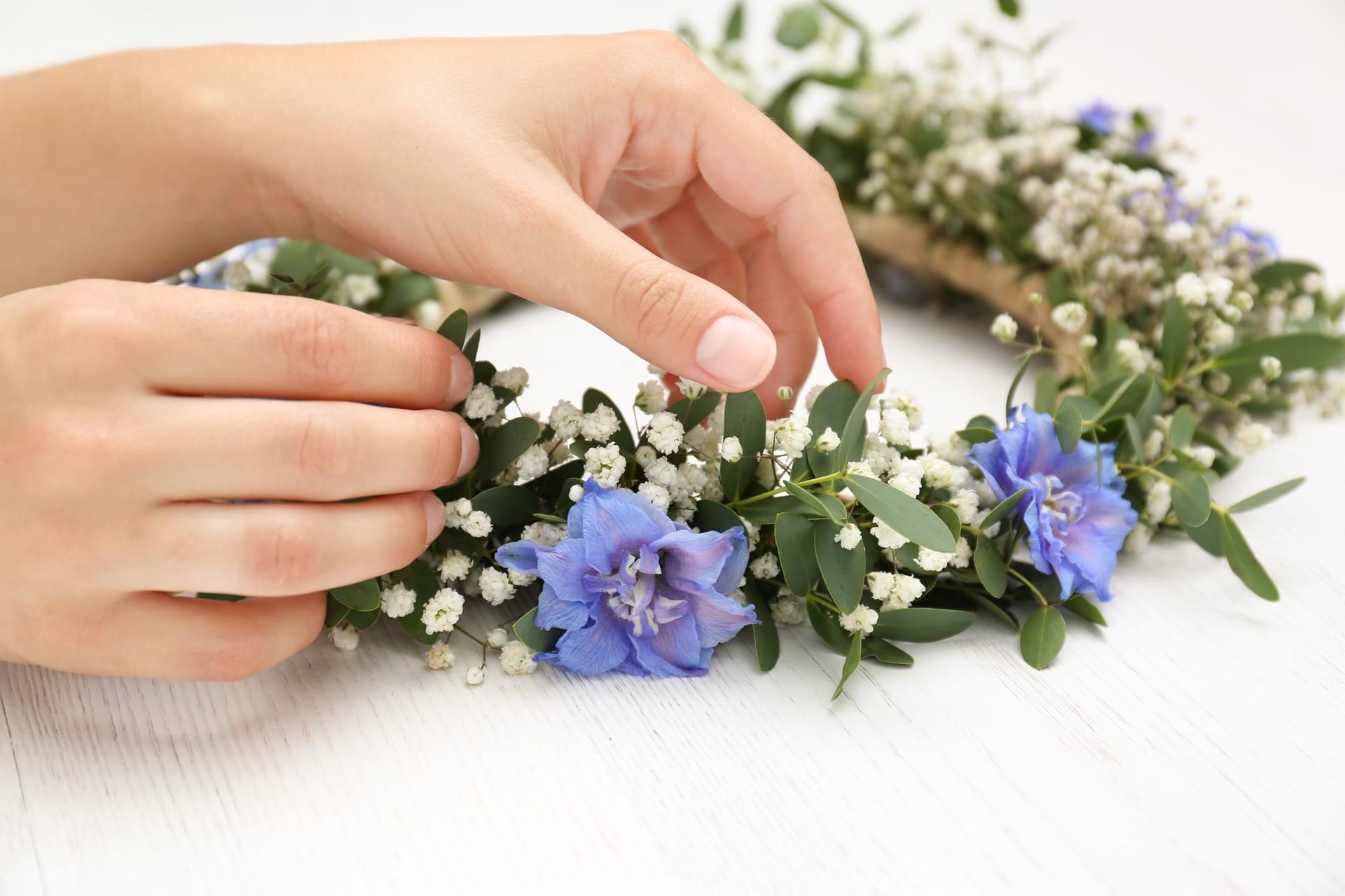
Start with a circle of florist wire cut to the wearer's head, then bind small clusters of blooms and foliage onto it with floral tape, working in one direction so each cluster hides the stems of the one before. Six to ten clusters usually close the circle. Tie off with ribbon, mist lightly, and keep the finished crown cold until it goes on. Assembly takes about forty minutes. The prep that comes first, conditioning the flowers properly, is where most crowns are won or lost. Order the stems the day before you build: Cindy's Flowers delivers hand-tied bouquets same-day across Toronto and the GTA on orders placed before 3 PM, which leaves them a full night in deep water.
What do you need to make a flower crown?
Five things, none of them expensive: florist wire, floral tape, snips, ribbon, and roughly fifteen to twenty small blooms with a similar number of foliage sprigs. Florist wire is sold by gauge, and the numbering runs backwards, so 18-gauge is thick enough to hold a circle while 24-gauge is fine enough to bind small, light blooms without bulking up the frame.
- 18-gauge florist wire for the frame, one length per crown
- 20 or 22-gauge wire for binding anything heavier than a spray rose
- Floral tape, the waxy sort that sticks only to itself once stretched
- Wire cutters, or scissors you don't mind ruining
- Ribbon, about a metre, in a colour that disappears against hair
- Flowers and foliage, conditioned in deep water for several hours first
A ring of pliable vine or a doubled length of thick twine will stand in for the wire if you'd rather skip it. Whatever the base, small heads on short stems beat one dramatic bloom every time. Look through the current bouquets with that in mind and you'll start spotting crown material everywhere.
How do you make a flower crown, step by step?
Eight steps, and the order genuinely matters. Prepping every flower before you touch the frame is what separates a forty-minute crown from a two-hour one.
- Measure. Run string around the head, just above the ears and across the middle of the forehead, then add two centimetres so the crown sits without pinching.
- Shape the frame. Cut wire to that length plus five centimetres, bend a small hook into each end, and curve it by hand. A hand-shaped ring follows a head better than a perfect circle does.
- Tape the frame. Wrap the ring in floral tape, stretching as you go. The stretch activates the wax; untensioned tape slides straight off.
- Prep the flowers. Trim stems to about four centimetres, strip any leaf that would sit under tape, and sort what's left into focal blooms and filler.
- Build clusters. Tape small posies of two or three stems: one focal bloom, one filler sprig, one leaf. Prebuilding these is the biggest time-saver in the whole job.
- Bind on the first cluster. Lay it flat against the frame with the heads pointing around the circle rather than outward, then tape it down with three or four tight turns.
- Overlap and repeat. Set each new cluster so its heads cover the taped stems of the last. Keep the tape tight, because a loose wrap lets flowers pivot the moment the wearer moves.
- Close the circle. Tuck the final stems under the first cluster's heads, hook the wire ends together, wrap the join, and tie ribbon over the seam.
Crowns worn low on the forehead look better weighted at the front and tapered toward the back. A half-crown, flowers across the front and bare taped wire behind, is easier to pin and less likely to snag hair.
Which flowers hold up best in a flower crown?
A crown has no water source, and that is the entire design problem. Oklahoma State University's cut-flower guide is blunt about the cost: while it is common to handle flowers dry and rehydrate them later, vase life generally suffers. So pick blooms built to cope with it.
- Strawflower (Xerochrysum bracteatum), the golden everlasting. Its papery petals are actually bracts, which is why it barely changes out of water and why dried heads keep for years.
- Statice (Limonium sinuatum), all papery, funnel-shaped blossoms, tagged by NC State Extension as a long-lasting cut and dried flower with summer bloom and fall interest.
- Baby's breath (Gypsophila paniculata), good fresh or dried, flowering from early summer to early fall. One Ontario caveat: it is classed as invasive around the Great Lakes, so spent stems go in the bin, never onto a garden pile or into a ravine.
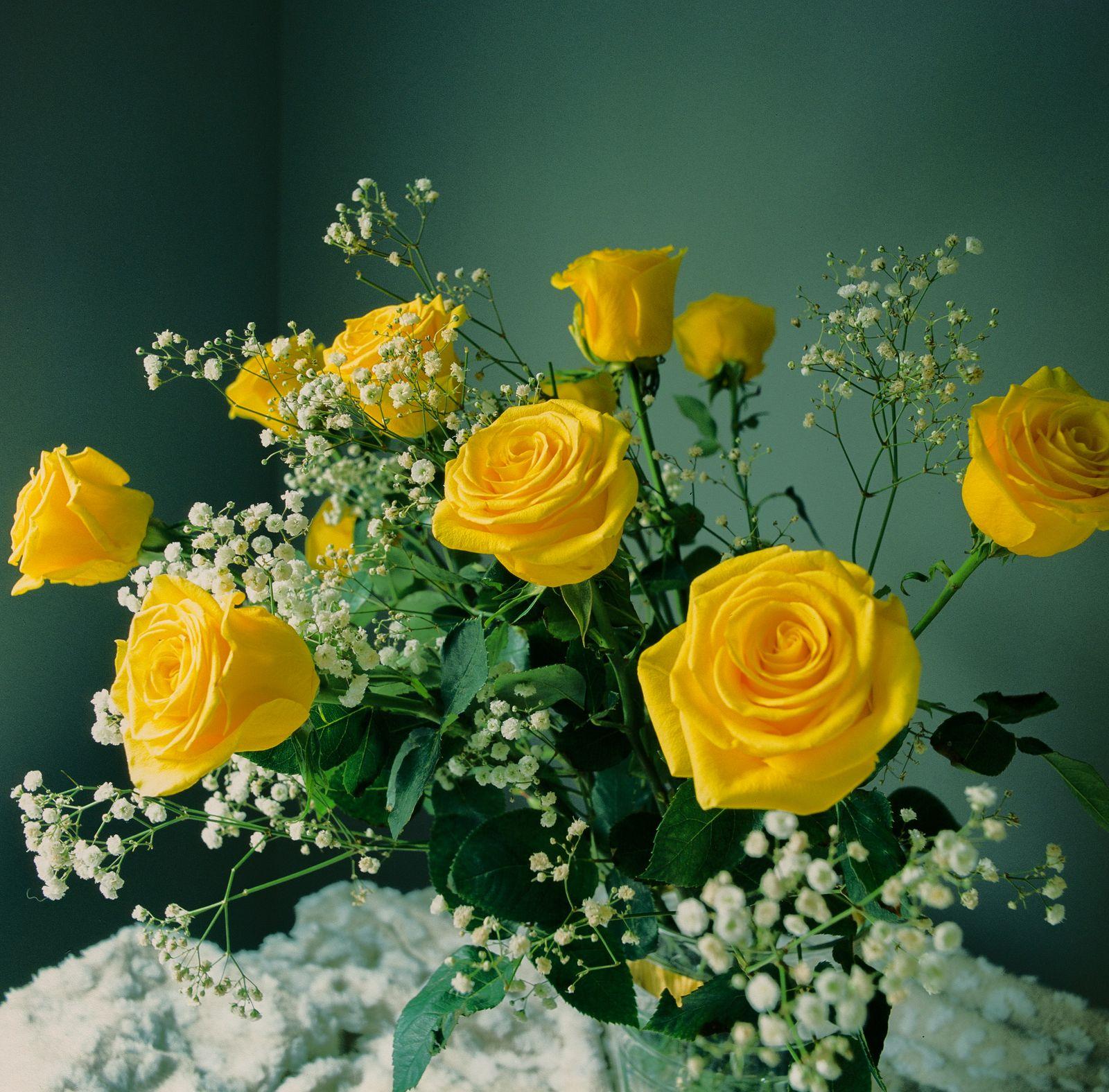
- Spray roses, waxflower and small chrysanthemums, with eucalyptus or ruscus for greenery. Roses repay good conditioning, and our rose care guide covers that groundwork.
Skip anything big, heavy and thirsty. Hydrangea and fully open garden roses shed water quickly, and on a crown there is nothing left for them to draw on. Lilies are the wrong weight and the wrong shape, they drop staining pollen at eye level, and one safety note applies in every home: lilies are highly toxic to cats, and every part of the plant, pollen and vase water included, can cause sudden kidney failure. A mixed bouquet from Cindy's Flowers is a forgiving place to start, since it already carries several head sizes plus the filler stems a crown needs.
Can you make a flower crown without wire?
Two ways, and both predate florist wire. The first is a woven base: soak lengths of willow, grapevine or ivy until they bend without cracking, twist them into a ring, and push short stems into the weave, adding a turn of twine wherever a flower feels loose.
The second is to braid the stems themselves. Cross two flexible stems, lay each new one over the last, and twist so the stems trap each other, adding blooms until the braid reaches head size. Children have been doing a version of this forever: split a daisy stem with a thumbnail and thread the next stem through the slit.
Stem choice decides whether either method works. Chrysanthemums, statice and daisies have stems tough enough to bend and hold their shape. Tulips and ranunculus are hollow or soft, and they crush under the first twist.
How do you keep a fresh flower crown from wilting?
Cold, humid, and nowhere near fruit. Cut flowers wilt because water loss can be rapid, and a stem drinks only while its xylem, the water-conducting channels, stay unblocked. As temperature rises, respiration and water loss increase and wilting follows, according to Oklahoma State University Extension. Everything below slows that down.
- Condition before you cut short. Give stems several hours in deep water. Warm water is taken up faster than cold, and the extension's rehydration treatment for wilted stems starts at around 43°C.
- Build late. Every hour a crown spends assembled is an hour its stems spend dry.
- Refrigerate, never freeze. Most cut flowers are held at 0 to 2°C, and flowers stored at 5°C can deteriorate up to four times faster than those kept at 0°C. A home fridge is warmer than a florist cooler, but on a humid Toronto afternoon it beats the kitchen counter by a wide margin.
- Humid, not wet. Storage aims for relative humidity above 90% but below 100%. Once droplets form on the petals, botrytis can take hold, so a loosely closed box with a damp cloth beats heavy misting.
- Keep it away from the fruit bowl. Ripening fruit gives off ethylene, and air carrying just 100 parts per billion can damage flowers nearby. Roses, carnations, baby's breath, lilies, alstroemeria, delphinium and snapdragon all sit on the sensitive list.
Even done perfectly, a fresh crown is a one-day piece: bright through a ceremony, an afternoon and an evening. Flowers meant to last the week belong in water.
Where did the flower crown come from?
Much further back than the festival photos suggest. English has its own word for a wreath worn on the head, a chaplet, called stephanos in Ancient Greek and corona in Latin, and it was worn for celebrations, festive occasions and holy days.
In ancient Greece the plant carried the message. Oak belonged to Zeus, laurel to Apollo, ears of wheat to Demeter, grapevine to Dionysos, myrtle to Aphrodite. Rome made the code official: a general celebrating a triumph wore laurel from the bay tree, Laurus nobilis, while one granted the lesser honour of an ovation wore myrtle, Myrtus communis.
The living traditions are the better story. The Ukrainian vinok is worn by girls and young unmarried women, a custom running back to old Slavic practice that predates the Christianization of Kievan Rus'. On Ivan Kupala, young women floated their wreaths on water with a lit candle to read their romantic future. Midsummer, traditionally 24 June, echoes it across the Baltic: Latvian women wear flower wreaths while the men wear oak leaves, and in Lithuania girls float wreaths on a river or a lake.
The festival crown most people picture is a 21st-century revival rather than an unbroken line, popular at outdoor music events like Coachella. The instinct behind it hasn't changed: flowers worn rather than displayed, for a wedding, a birthday, a Midsummer party, or a Saturday when a bouquet sent just because ends the day as a crown.