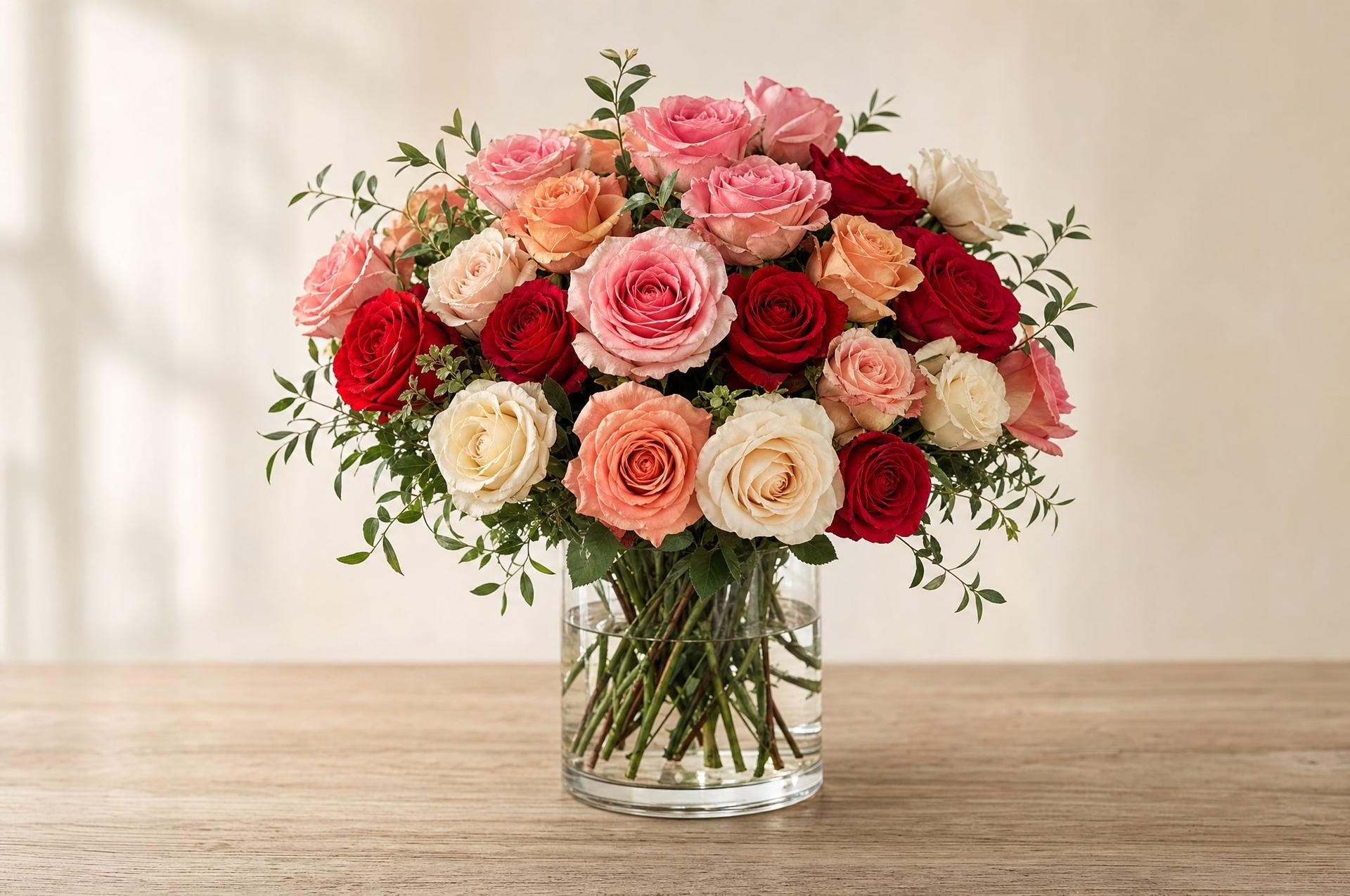
How Long Do Cut Roses Last in a Vase?
By horticultural convention, cut roses last about 7 days with basic care and 7 to 12 days with diligent care, occasionally 14 for premium long-stemmed varieties. University of Illinois Extension classes roses among the shorter-lived cut flowers: neglected, they fade in under a week, while carnations can run closer to two.
Every technique below pulls one of two levers: keeping water moving up the stem, or keeping bacteria out of the vase.
What Should You Do When Roses First Arrive?
Get the stems into water within the hour, fresh cut first. University of Illinois Extension advises removing at least 1 inch (2 to 3 cm) with sharp, clean pruners, cutting underwater or immediately before the stem enters water, so no air bubble sneaks in and blocks uptake.
Cut at roughly 45 degrees, then strip only the foliage that would sit below the waterline. Leave the upper leaves and thorns alone: UF/IFAS Extension notes that leaves drive the transpiration pulling water up the stem, and shaving thorns wounds it. Fill a clean vase about two-thirds with lukewarm water and the flower-food sachet, then, following RHS practice, let the roses rest somewhere cool for two to three hours before display.
How Often Should You Change the Water?
Completely every two to three days, or immediately once it turns cloudy, per University of Illinois Extension. Roses drink heavily, so check the level daily and top up with fresh water; a stem end sitting above the waterline simply stops drinking.
Rinse the vase at every change and add fresh flower food. UF/IFAS Extension finds commercial preservative, a blend of sugar, acidifier, and biocide, outperforms homemade mixes. Out of sachets? Illinois Extension's tested substitute is 3 parts water to 1 part lemon-lime soda, plus about 1 tablespoon of bleach per gallon. Pull yellowing leaves daily as well.
Trimming Rose Stems the Right Way
Re-trim roughly half an inch (1 to 2 cm) at every water change, because a cut end reseals and clogs with bacteria within two to three days. Always cut at about 45 degrees with a sharp knife or bypass pruners; dull scissors crush the channels that move water.
Roses are woody-stemmed, and the RHS notes a short vertical slit, up to about 5 cm through the base, can further improve uptake. Ignore the old advice to hammer woody stems flat: mashed tissue is an open invitation to bacteria.
Where Should You Display a Vase of Roses?
Somewhere cool and bright, out of direct sun and away from radiators, vents, and drafts. Keep the vase away from the fruit bowl too: UF/IFAS Extension notes that ripening fruit releases ethylene gas, which measurably speeds petal aging. Moving roses to a cold room overnight is an old florist trick that genuinely buys days.
On pets: the ASPCA lists true roses (Rosa spp.) as non-toxic to cats and dogs; the practical risks are thorn scratches and pets drinking treated vase water. If a mixed bouquet contains lilies, though, keep it away from cats entirely. The FDA warns that every part of a true lily, including the vase water, can cause fatal kidney failure in cats.
Can You Revive Drooping or Bent-Neck Roses?
A drooping rose can usually be revived. Bent neck, the flop just below the bloom, means an air bubble or bacterial plug is stopping water short of the head. The standard florist fix: wrap the head and stem straight in wet newspaper, re-cut underwater in still water (a running tap is aerated), and stand the rose in warm water for a few hours.
An alternative restart is a 45-degree re-cut followed by an hour in water around 100 to 110°F (38 to 43°C), then back to cool water with food. For badly dehydrated roses, submerge the entire flower for 30 to 60 minutes so the tissues rehydrate directly. In our experience, a rose that hasn't lifted within a few hours is spent; remove it before decay spreads.
Common Rose-Care Mistakes to Avoid
Four errors cause most early failures. Skipping the arrival cut tops the list: an untrimmed stem end is sealed and can't drink, the classic route to bent neck. Stretching out water changes comes second; dirty water breeds the bacteria that clog stems, and cloudy water is the warning sign.
The other two are placement and improvisation. Heat, direct sun, drafts, and a nearby fruit bowl all cut days off a bouquet, and folk additives such as pennies or aspirin are unreliable next to commercial preservative. An anniversary arrangement deserves a week or more on the table, not three days beside a warm window. These habits protect any fresh bouquet, but roses, shorter-lived by nature, repay them fastest.