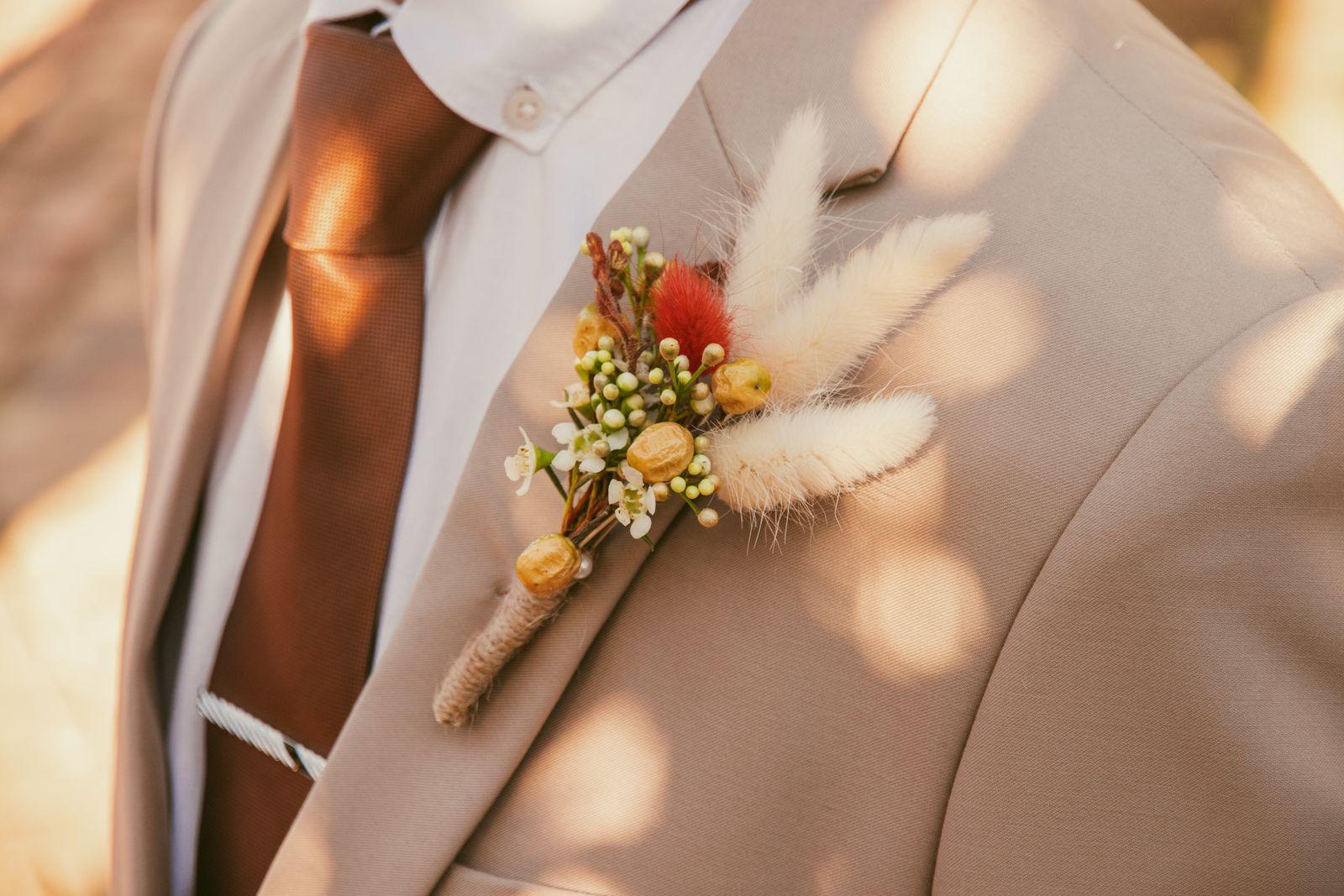
A boutonniere is a single flower or small floral cluster worn on the lapel of a suit or tuxedo jacket. Merriam-Webster defines it as "a flower or bouquet worn in a buttonhole," and buttonhole is exactly what British English calls the same thing. It sits on the left lapel, stem pointing down. Grooms, groomsmen, fathers and grandfathers wear one at a wedding; so does anyone in formal dress at a prom, a graduation or a ceremony. Cindy's Flowers builds boutonnieres to order in our Toronto studio, every style priced on the page before you ask.
What Is a Boutonniere, Exactly?
The word is French for buttonhole, and that is the entire idea: a flower pushed through the working buttonhole on a jacket lapel. Britannica Dictionary keeps the occasion in its definition, describing flowers "that men sometimes wear on their jackets on special occasions (such as weddings)," and lists buttonhole as the British term.
What a florist actually hands you is usually a little more than one stem. The Wikipedia entry on the boutonnière notes that modern ones are often pinned to the front of the lapel and "feature more than a single stem: leaves or accents, constituting a mini-bouquet, like a smaller corsage." That is the version most couples picture: one focal bloom, a leaf, a sprig of something textural, and a stem wrapped in ribbon or floral tape.
Corsage or Boutonniere: The Difference
The difference is where the piece is worn, not what goes into it. A boutonniere is small and lives on a lapel. A corsage is larger and goes on the wrist, on a band, or pinned to a dress or a handbag. Both get built from the same flowers on the same morning, which is why they are almost always ordered as a pair.
If you are hunting for the female equivalent of a boutonniere, the corsage is the answer people usually mean, though that split is convention rather than rule. Anyone wearing a jacket with a lapel can wear a buttonhole.
At a wedding the pieces track roles instead. The same reference puts the traditional list plainly: "In some cases, the groom, his groomsmen and the father of the bride all wear boutonnières." Mothers and grandmothers are normally offered a corsage and asked which format they would rather have, because a pinned corsage needs firm fabric and will not sit properly on fine silk or a knit. Our wedding boutonnieres and corsages page shows both formats priced per piece, and if you are still working out the headcount, our checklist of who gets flowers at a wedding goes through it person by person.
Which Side Does a Boutonniere Go On?
The left. The reason is duller than the one you have probably been told. Boutonnieres "are traditionally worn on the left lapel, the traditional location for the buttonhole, and the same side as a pocket handkerchief," according to the Wikipedia entry. It is tailoring, not romance. The popular line about the left side being chosen because it sits over the heart is folklore, not the explanation the reference gives.
Position it stem-down, high on the lapel and near the pocket line. If a pocket square is in play too, remember that both of them live on the left, which is part of why an oversized buttonhole starts to crowd the jacket.
Buttonhole, Loop, Pin and Magnet
Four fastenings exist, and the jacket usually decides which one you get.
- Through the buttonhole. If the lapel buttonhole is cut all the way through, the stem passes through it and the flower sits flat. There is a size threshold: doing this "is difficult if the flower has a large calyx, such as for a carnation, and requires a large buttonhole of at least 1+1/8 in (29 mm) long for there to be enough room to fit a standard-sized flower's calyx." Plenty of jackets have a decorative buttonhole that is stitched closed.
- The loop. Behind some lapels sits a thick thread, below and parallel to the buttonhole, made to hold the stem. The same source calls these loops "rarely included on current coats" and "traditionally a mark of high-quality tailoring." If your jacket has one, use it.
- The pin. The default, and necessary when the buttonhole is not pierced through or when the arrangement is too big to fit through one. Shawl collars do not traditionally carry a buttonhole, so a shawl-lapel tuxedo is usually a pinning job — though some are made with one, and some hide a small pocket behind the left lapel for the stem. The cost is borne by the fabric: repeated pinning can eventually damage cloth or a silk facing, which matters on a rented dinner jacket.
- The magnet. A modern fastener, with one plate behind the lapel and one in front, and no holes in anything.
Ask About Pacemakers Before You Choose a Magnet
Here is the part the magnetic-fastener listings leave out. The American Heart Association tells anyone with a pacemaker or an implantable defibrillator to avoid close or prolonged contact with magnets, and to keep magnets at least six inches from where the device is implanted, because a magnet can activate a switch that stops an ICD from delivering lifesaving shocks. A lapel fastener sits on the upper chest, well inside that six inches.
The U.S. Food and Drug Administration gives the same six-inch distance for consumer electronics containing magnets, and says the risk to patients is low. Low is not zero, and this is a two-second question to ask. For a father or a grandfather with a pacemaker or ICD, order pins.
The Flowers That Hold Up on a Lapel All Day
A boutonniere spends its entire life out of water, warm, pressed against wool and hugged repeatedly. That governs the flower choice more than colour does.
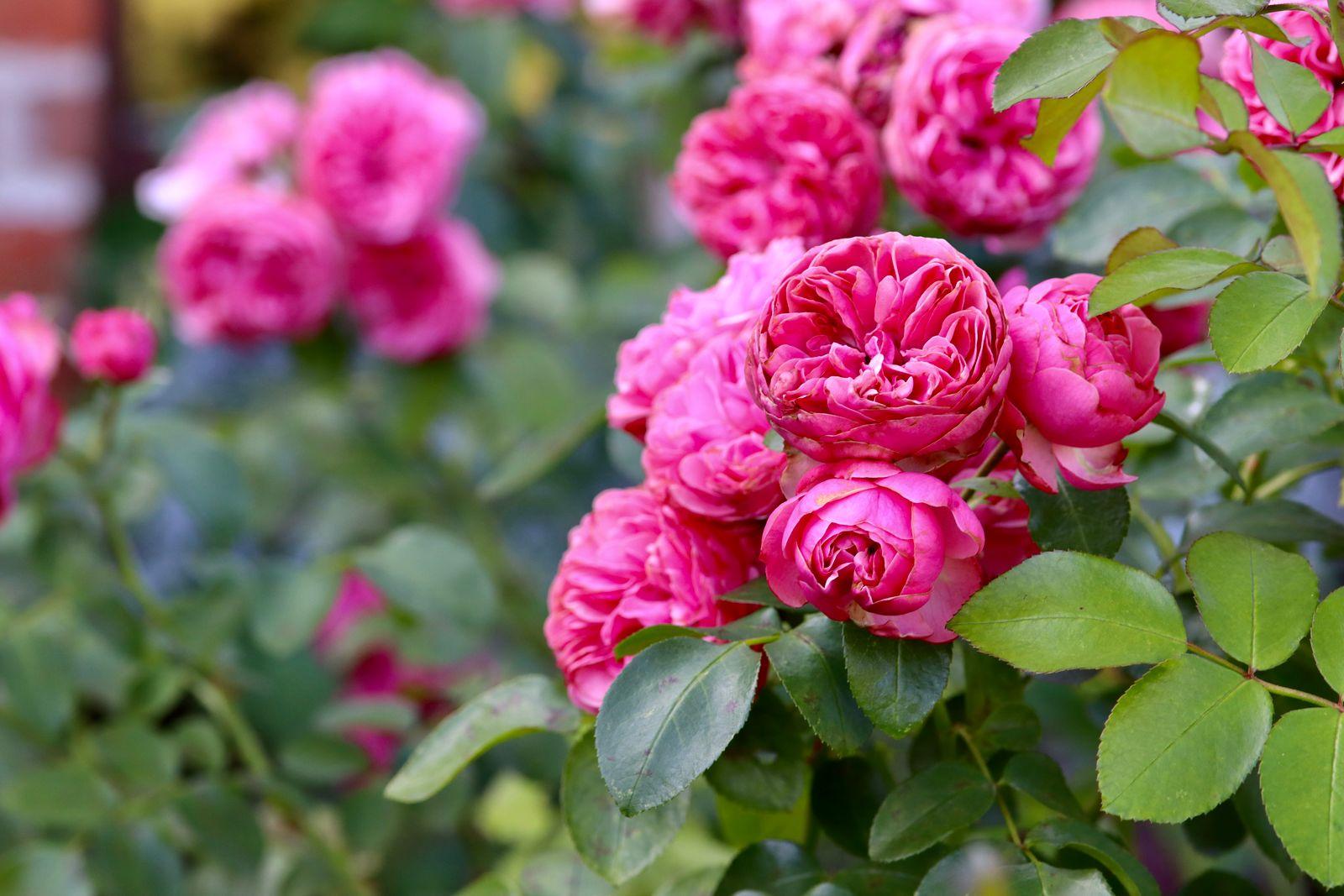
Spray roses are the workhorse of the category: small heads, firm petals, and enough varieties to match almost any palette. If you want the buttonholes to echo a gift bouquet going out the same weekend, our rose delivery range is the simplest place to pick a shade from, and roses are on the ASPCA's non-toxic list for dogs and cats. Freesia works well as an accent and is named pet-safe in the ASPCA's own bouquet guidance, though it has no entry in the searchable database.
Carnations are the classic formal buttonhole and the reason the 29 mm rule exists, since their calyx is bulky. Note that the ASPCA lists carnations as toxic to dogs, cats and horses, so a boutonniere set down on a side table overnight should not be left where a pet can reach it. The same caution applies to eucalyptus, the standard greenery in a modern buttonhole: it is ASPCA-toxic to dogs, cats and horses, and NC State rates the plant high-severity poisonous and lists it as causing contact dermatitis, which is worth knowing if you are assembling a dozen pieces by hand. Our guide to eucalyptus in wedding flowers covers the varieties in more detail.
Prom and Grad: Who Buys What?
There is no rule here, only a convention, and the convention is that each person orders for their date: one buys the corsage, the other buys the buttonhole. Plenty of couples now split the cost or place a single order for both, which is easier to colour-match and cheaper to deliver.
Match the flowers to the outfit rather than to each other. At a wedding or prom, boutonnieres "often match the flowers (corsages) of the bride or date," so the one question worth asking before ordering is what colour the outfit is. A photo of the fabric beats a colour name every time, because "blush" means about nine different things.
Toronto proms cluster in late May and June, the same weeks the wedding calendar fills up, so order earlier in that stretch than feels necessary. For a convocation, a buttonhole survives a long ceremony better than a bouquet does. The bouquet can arrive separately through our graduation flower delivery.
What Does a Boutonniere Cost?
Less than almost anything else on a wedding flower order. In our 2026 Wedding Flower Price Study, a census of the prices florists publish on their own websites, boutonnieres average $31 in Canada (CAD, across 170 florists who publish a boutonniere price) and $27 in the United States (USD, across 270). In the United States it is the cheapest item we measured, and in Canada only the bud vase is as low.
Finding a price is the harder part. Only 47% of florists publish any wedding pricing at all, on our corrected estimate, in both countries. We wrote up that finding in full in how many florists publish wedding prices.
Cindy's Flowers publishes its own figures instead of making you ask: boutonnieres from $30, corsages from $45, no consultation fee, and nothing bundled into a fixed package. You can total an entire order yourself at build your package, where every piece is listed with its price, then send it over and get a written line-by-line quote back within one business day. The rest of the pieces, from bridal bouquets through to ceremony installations, sit under Toronto wedding flowers.