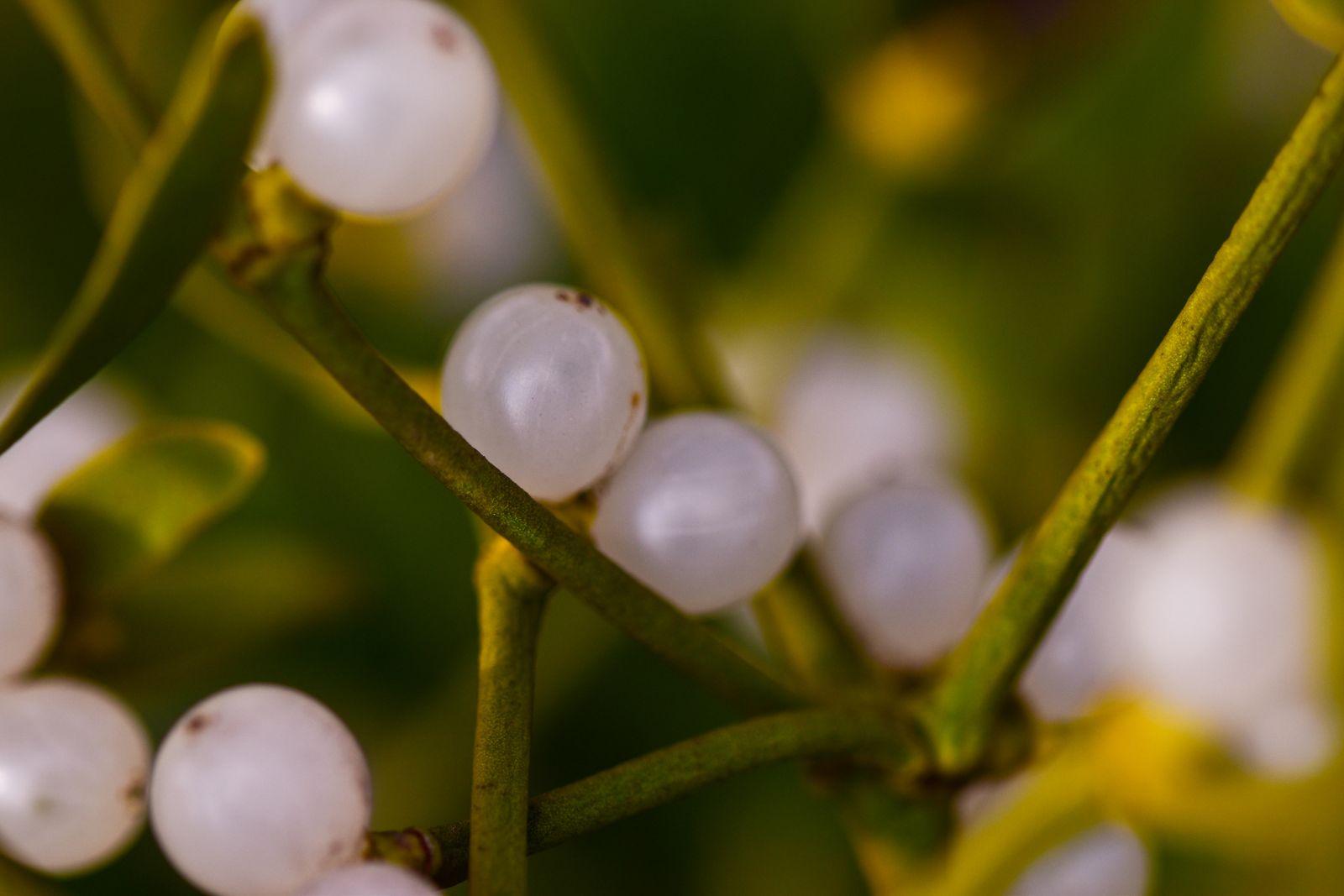
Mistletoe means love and reconciliation by long convention, and the kiss underneath it is an English parlour custom rather than an ancient rite. The plant itself is a hemiparasitic evergreen shrub that lives in the branches of a host tree, holding green leaves and white berries through the coldest weeks of the year. That trick of staying alive in a bare winter canopy is where every meaning attached to it begins. Cindy's Flowers works the same midwinter idea in fresh stems, hand-tied in our Toronto studio for Christmas delivery across the GTA.
What does mistletoe actually symbolize?
Mistletoe stands for love, peace and life that carries on, and all three readings trace back to one botanical fact: it is green and berried in December while the tree holding it is bare. The University of Nebraska-Lincoln Extension notes that the North American genus name, Phoradendron, means thief of the tree in Greek. Lovely symbol, unsentimental plant.
The meanings are conventions people attached over time, not properties of the species:
- Life in the dead of winter. An evergreen fruiting above a leafless oak reads as vitality when nothing around it does.
- Fertility. Pliny the Elder reports that Gaulish druids believed it made barren animals fruitful, the oldest surviving version of the idea.
- Truce and reconciliation. Repeated constantly, sourced thinly. The tale of enemies laying down weapons beneath a sprig is folklore about folklore, with no medieval source anyone can point to.
- Romance, by the 1800s. The kissing custom did far more to fix mistletoe's romantic meaning than any myth managed.
For the wider vocabulary of romantic stems, our guide to what flower colours mean covers the ones that carry the message better than a parasite ever could.
Where the kissing custom comes from
Because an English parlour game gave it a rule, and the rule was fun. Washington Irving set it down in The Sketch Book in 1820: young men plucked a berry from the sprig for every kiss claimed, and once the berries ran out, so did the privilege.
The sprig normally hung inside a kissing bough, a hoop of evergreens dressed with apples and candles that decorated English houses before the German Christmas tree became fashionable in the 1840s. The custom seems to start in servants' halls and work its way upstairs, which is why the earliest written mentions sound faintly scandalized. Nothing about it is ancient. It is Georgian, domestic and a little cheeky.
The modern equivalent needs no doorway and no audience. A hand-tied bouquet for date night does the same work with better odds.
Did the Norse myth and the druids really involve mistletoe?
Both stories are real. Neither says quite what December retellings claim.
Baldr and the plant nobody swore in
Snorri Sturluson's Prose Edda, written in Iceland in the 1220s, tells how Frigg made every thing in the world swear not to harm her son Baldr, and passed over the mistletoe as too young to bother with. Loki found out. He put a mistletoe shaft in the hands of the blind god Hodr, and Baldr died of it.
The tidy ending most retellings add, where Frigg's tears become the white berries and she blesses the plant so that anyone beneath it is kissed, is not in the medieval text. It's a later, softer edit. It is also the version quoted every single Christmas.
Pliny, one Roman, one paragraph
Nearly everything said about druids and mistletoe rests on a short passage in Pliny the Elder's Natural History, written around AD 77: mistletoe cut from an oak with a golden sickle on the sixth day of the moon, two white bulls sacrificed, the plant credited with making barren animals fertile and given a name Pliny reports as meaning all-healing, though his Latin may attach that name to the moon rather than the plant. Worth remembering who's speaking. Pliny was a Roman naturalist describing a people Rome had conquered more than a century earlier and whose priesthood it had since outlawed, and the druids left no writing of their own. One outsider's paragraph has been carrying two thousand years of holiday trivia.
Not a cut flower: mistletoe is a hemiparasite
All three in part, and the parasite half is only half true. Britannica puts it plainly: as hemiparasites, mistletoes contain chlorophyll and can make some of their own food. They draw water and minerals from the host through a structure called the haustorium, which fuses into the branch, then photosynthesize the rest themselves.
It is a flowering plant, just not a showy one. European mistletoe carries yellowish-green flowers roughly two to three millimetres across, pollinated by insects, which is why it reaches a doorway as a berried sprig and never as a cut stem in a vase. The species is dioecious, meaning male and female plants are separate, so only the female ones carry berries. A sprig with nothing to pluck is usually a male.
Birds do the planting. The seeds ride in a sticky coating called viscin that hardens on contact and grips a branch tenaciously, with the mistle thrush in Europe and the phainopepla in the American southwest among the best-known couriers. That habit named the plant. Mistletoe comes from mistle plus the Old English tan, meaning twig, and the traditional reading of mistel is dung, giving dung-on-a-twig, after the droppings people saw the seedlings sprout beside. Etymologists are less certain than folklore is, but the observation behind it was sound.
One correction worth making: mistletoe is not usually a tree killer. Britannica notes that mistletoe alone rarely kills the trees it inhabits, though heavy growth can weaken a host, especially one already in poor health. Dense infestations produce the deformed growths called witches' brooms.
Mistletoe in Ontario
Not the Christmas kind. Phoradendron leucarpum, the North American species harvested for December, is native to Mexico and the continental United States rather than Canada, and the Missouri Poison Center notes it is cold-sensitive enough to grow only in the southern half of the continent. Nebraska Extension puts the harvest range from New Jersey to Florida and west through Texas.
Ontario does have a mistletoe of its own. Eastern dwarf mistletoe (Arceuthobium pusillum) is the only dwarf mistletoe in eastern North America, a centimetre or so of shoot on spruce, and nobody has ever hung it over a hallway. Anything sold here for the doorway travelled north on a truck, which is a fair thing to weigh against a hand-tied mixed bouquet built in the city the morning it goes out.
Is mistletoe safe around children and pets?
No, and the accurate version is more useful than either the panic or the shrug. For people, the Missouri Poison Center files American mistletoe as low risk: a child's small ingestion means stomach upset, and the sticky juice can redden skin. The ASPCA lists American mistletoe as toxic to dogs, cats and horses, with vomiting, diarrhoea, difficulty breathing, a low heart rate and, more rarely, low blood pressure among the reported signs. Leaves, stems and berries all carry it.
What that means for a Toronto home with a cat, a dog or a toddler in it:
- Berries fall. A sprig hung high still drops them on the floor, where the smallest member of the household finds them first.
- Holly is not the safe swap. The ASPCA lists holly as toxic to dogs, cats and horses too.
- Poinsettia sits in the middle. The ASPCA calls its toxicity over-rated but still lists the plant as toxic to dogs, cats and horses.
- **Roses and Christmas cactus (Schlumbergera) are on the ASPCA's non-toxic list** for both dogs and cats, which makes them the simpler December choice in a house with animals.
- Cats and lilies are a separate, far more serious problem, written up in full in our guide to whether lilies are poisonous to cats.
If anything is swallowed, call your vet or a poison centre. Don't wait to see whether it settles.
So what do you send instead of a sprig?
Mistletoe is a decoration with a good story rather than a gift, and the sentiment underneath it, affection said out loud in the darkest month of the year, transfers cleanly to flowers meant to be handed over. Cindy's Flowers hand-ties every arrangement in our Toronto studio and delivers same-day across Toronto and the GTA on orders placed before 3 PM, Monday to Saturday, so a December bouquet can arrive the same afternoon somebody needs it. Have a look at what's in the shop this week, and let the parasite keep the doorway.