Dahlias are Ontario's late-summer headliner, and the timing is no accident. Planted in spring, they open from July or August and keep flowering until the first hard frost (Longfield Gardens), which around Toronto usually means mid-October: the Old Farmer's Almanac puts the city's first light frost at about October 13. That window is short, tender, and genuinely spectacular. These Mexican natives produce blooms anywhere from 5 cm across to 30 cm dinner plates, in nearly every colour but blue. Here's what makes them worth the fuss, when to catch them at their peak, and how to keep cut stems looking sharp on your table. Because that window closes with the first frost, Cindy's Flowers hand-ties the season's stems in our Toronto studio and delivers same-day across the GTA, Monday to Saturday, on orders placed before 3 PM.
When are dahlias in season in Ontario?
In Ontario, dahlias peak from late summer into early fall. Spring-planted tubers start blooming in July or August and don't stop until frost (Longfield Gardens). Around Toronto, the Old Farmer's Almanac puts the first light frost at about October 13, which makes August and September the surest stretch for local, field-grown dahlias.
Once frost blackens the plants, the local crop is finished until next summer, so there's a real now-or-never feeling to a September dahlia. Geography buys some gardens extra time: the Almanac's first-frost dates across the GTA range from roughly September 21 in Brampton to October 27 in Oakville, so one yard might still be cutting blooms weeks after another has blackened. Watch for them at Ontario flower farms and Toronto farmers' markets, where a bucket of fresh-cut dahlias is one of the clearest signs that summer is tipping toward autumn.
The show-stopper's range: tens of thousands of cultivars
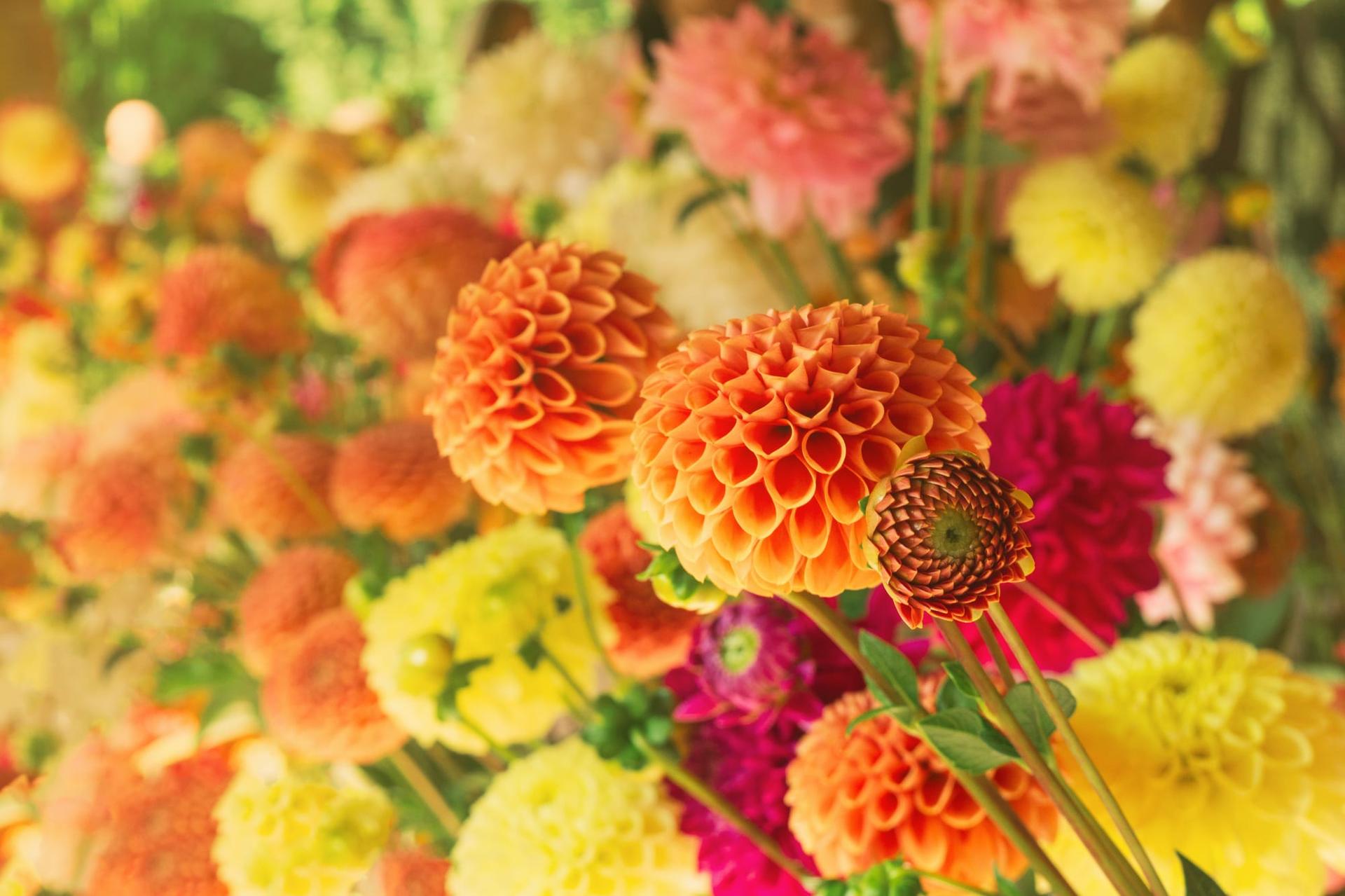
No common cut flower offers more variety than the dahlia. The Royal Horticultural Society is the genus's international cultivar registrar, though it publishes no running total; the figure passed around in dahlia circles runs into the tens of thousands of named varieties, bred over generations from a handful of the roughly 49 wild species in the genus (Wikipedia). They appear in forms from flat, open singles to tightly wound pompons and those famous dinner-plate giants, in colours covering the whole spectrum except one.
That exception is blue. A true-blue dahlia has never been bred, despite a cash prize offered back in 1846 for anyone who could manage it (Wikipedia). The flower lacks the final chemical step, a sixth hydroxyl group on delphinidin, needed to make pigment genuinely blue. Breeders reach sumptuous mauves, purples and lilacs, but never sky.
Size is where dahlias really perform. Blooms run from about 5 cm to a full 30 cm across, on plants that can stretch past two metres tall (Wikipedia). For an arranger that range is a gift: warm bronzes and corals for an autumn table, soft whites and blushes for something gentler, burgundies so deep they read almost black. Here's a quick field guide to what you'll spot in late summer:
- Dinner-plate types, up to 30 cm wide, all drama with only a few blooms per plant.
- Ball and pompon forms, small, tightly wound spheres that hold their shape for days.
- Cactus and decorative types, the spiky and full-petalled classics florists reach for.
One quirk surprises people: most dahlias barely smell of anything. They draw pollinators with colour instead of fragrance (Wikipedia), which is partly why they read as such purely visual flowers. Because a single plant can offer so many shapes and shades at once, dahlias make a natural centrepiece for a mixed seasonal bouquet, where one dinner-plate bloom can anchor a dozen smaller supporting stems. One thing to know before you send one: the ASPCA lists the dahlia as toxic to dogs, cats and horses, so if animals share the home, keep the stems and trimmings out of their reach, or ask us to build around roses and alstroemeria, which the ASPCA lists as non-toxic to dogs and cats.
The genus carries some history, too. It grew in Mexico and Central America long before European contact, and the Aztecs called it cocoxochitl, a name that nods to its hollow stems (Wikipedia). Spanish botanist Antonio José Cavanilles named it Dahlia in 1791, honouring the Swedish botanist Anders Dahl (Wikipedia). Today it's the national flower of Mexico.
Do dahlias come back every year in Ontario?
Not on their own. Dahlias are tender tubers, hardy only to about USDA Zone 8 and killed outright by sub-zero temperatures (Wikipedia). Toronto is nowhere near that: Natural Resources Canada's 2025 plant hardiness map places the city around Canadian zone 7a, and the Canadian and USDA scales are separate systems that don't map one-to-one. Either way the ground here freezes hard, so a tuber left in it through a GTA winter almost always freezes or rots (Cold Springs Flower Farm).
Gardeners who want the same plants next season have to lift and store them. Once the first hard frost blackens the foliage, you dig the tubers, brush off the soil, and keep them somewhere cool, dark and slightly humid, ideally around 4 to 10°C, until spring (Cold Springs Flower Farm).
Many GTA growers run it as a yearly rhythm: plant in spring once the soil warms, cut all summer, then pack the tubers away in October. Skip that ritual and you're shopping for new tubers come April. It's genuine work for a plant that gives maybe ten weeks of bloom, which is exactly why plenty of people would rather leave the growing to the farms and enjoy the results by the armful.
How do you keep cut dahlias looking their best?
Treat them as a here-and-now flower. The American Dahlia Society puts the ideal vase life of a cut dahlia at around five days once it reaches you (American Dahlia Society). That's shorter than a rose, and the giant dinner-plate types last even less, roughly three to four days, because their enormous heads drink through their water reserves so quickly (Longfield Gardens, which gives three to five days as the average across dahlias generally).
A few small habits stretch every day you've got:
- Trust what you see. Dahlias don't keep opening after cutting (Longfield Gardens), and the American Dahlia Society considers about three-quarters open a perfectly good stage to cut at, so that's roughly how full a bloom will stay.
- Strip the lower leaves so nothing sits underwater and sours the vase (American Dahlia Society).
- Recut the stems on arrival, then keep the water clean, cool, and out of direct sun.
- Refresh that water often; dahlias are thirsty and reward a clean drink.
As a rule, the smaller ball and pompon forms hold up best in a vase, while the dinner-plate giants give you the shortest, most dramatic show. One placement note: because the ASPCA lists dahlias as toxic to dogs, cats and horses, put the vase somewhere a curious animal can't get at it. The same cool-water logic keeps any late-summer arrangement fresh, and our guide to caring for mixed bouquets walks through the basics stem by stem.
What do dahlias symbolize, and when should you send them?
By modern florist convention, dahlias stand for dignity, elegance, commitment, and an enduring bond (Petal Republic). It's worth saying that this is a recent reading rather than an inherited Victorian one: Kate Greenaway's *Language of Flowers* (1884) files the dahlia under "instability." Either way the meaning is convention rather than botany, and today's version makes them a thoughtful pick for milestones: a work anniversary, a new home, a friendship worth marking out loud. One thing dahlias are not, despite a stubborn myth, is August's birth flower.
The two official August birth flowers are the gladiolus and the poppy, not the dahlia (Old Farmer's Almanac). It's an easy slip, since dahlias are everywhere in August, but if you want to be technically correct for an August birthday, those are the two to request. Both carry the same caution as the dahlia: the ASPCA lists gladiolus as toxic to dogs, cats and horses, and the Pet Poison Helpline lists poppies (*Papaver*) as toxic to dogs and cats, so where there are animals in the house, ask for roses or alstroemeria alongside them.
Symbolism aside, dahlias are a pleasure to give while they last, and when their season closes with the frost, the sentiment behind them doesn't have to. A just-because bouquet carries the same quiet thinking-of-you in any month, and you can browse what's fresh right now to see the season's best stems. Cindy's Flowers hand-ties every order in our Toronto studio and delivers same-day across the GTA when you place it before 3 PM, Monday to Saturday. Catch the dahlias while Ontario's gardens are still generous.