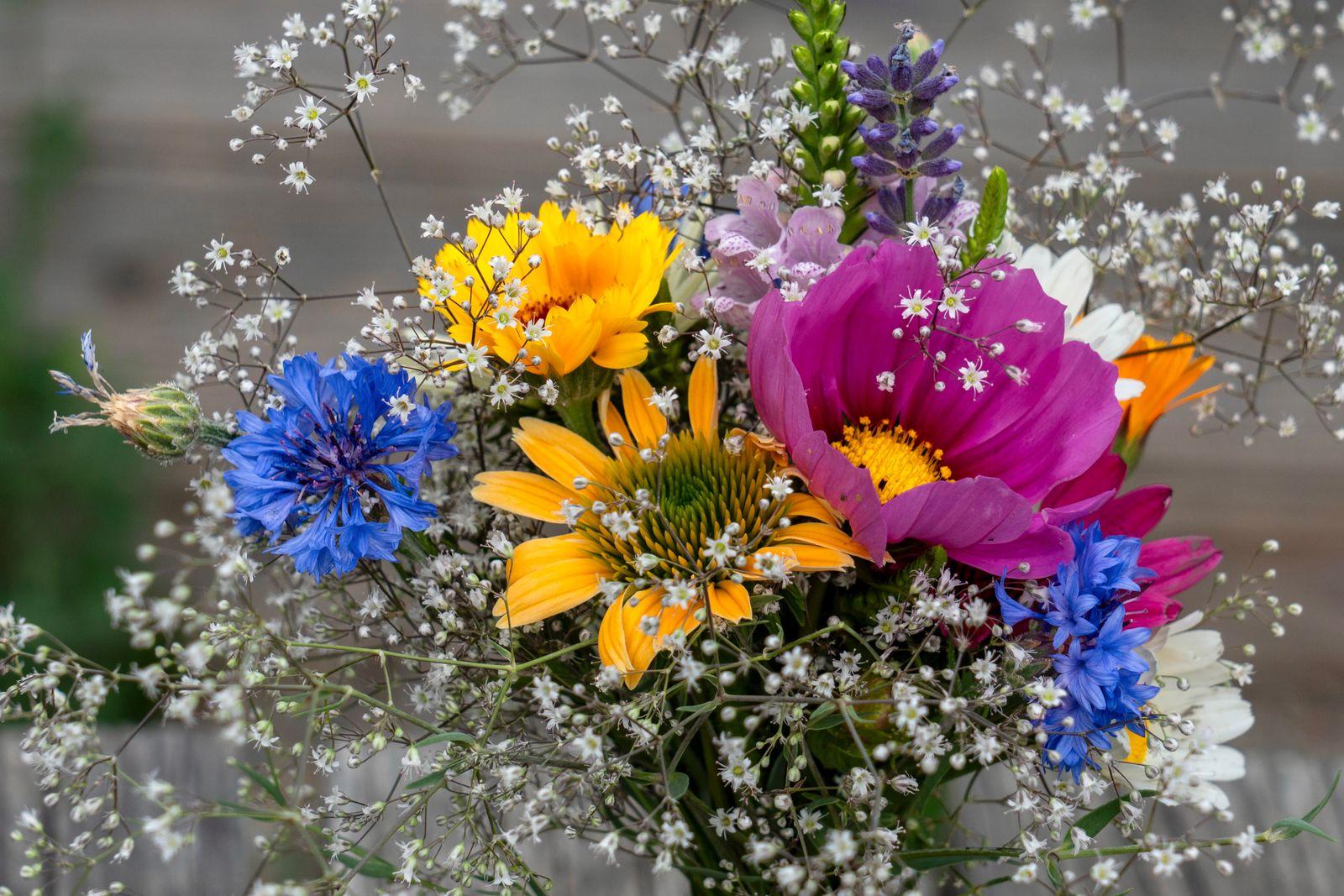
The best summer flowers to brighten a Toronto home are the sun-lovers that peak when the city does: sunflowers, dahlias, zinnias, and fragrant garden phlox, with big blowsy hydrangeas for softer, cottage-style bunches. Toronto's outdoor growing season runs about 161 days, from a last spring frost around May 4 to a first light frost near October 13 (Old Farmer's Almanac), and July and August sit right at its bright, humid peak. That's when local colour is boldest and cut flowers are at their most generous. Here's what to bring home, and how to make it last. Toronto's window for these is a matter of weeks rather than months, so when the peak itself is what you want in the vase, Cindy's Flowers hand-ties summer bouquets in its Toronto studio and delivers them same-day across Toronto and the GTA on orders placed before 3 PM.
The three flowers that define a Toronto summer
Ask a Toronto florist what summer looks like and you'll hear three names before you finish the question: sunflowers, dahlias, and zinnias. Sunflowers (Helianthus annuus) are native to North America, which is part of why they feel so at home in an Ontario July. Here's a detail most people miss: only young sunflower buds actually track the sun across the sky. Once the flower head matures, it stops moving and settles facing east for good.
Dahlias are the show-offs of the group. They bloom from midsummer until frost (Old Farmer's Almanac), which in Toronto means roughly July until the first light frost around October 13. Native to Mexico and Central America, they have no tolerance for cold, so their garden run ends the night the temperature finally drops. That short, brilliant window is part of what makes them feel special. One thing to check before you order them: the ASPCA lists dahlias as toxic to cats, dogs and horses. If there are pets in the house, sunflowers and roses are both on the ASPCA's non-toxic list.
Zinnias round out the trio. These heat-loving annuals flower nonstop until frost, and they're a true cut-and-come-again bloom: snip a stem and the plant branches and sets more buds. They're pollinator magnets too, so a summer bed full of them hums with bees and butterflies. A jar of zinnias or sunflowers dropped off just because is one of the simplest ways to make someone's kitchen feel like July.
When does Toronto's summer flower season peak?
Local bloom availability climbs through June and crests across July and August. With a growing season of roughly 161 days (Old Farmer's Almanac), Ontario growers get a generous run, and the Toronto Flower Market, which links nearby farms directly with city florists, sets up monthly from May to October. If you want flowers that were standing in a field a day or two ago, this is the window to buy them.
A quick, honest caveat about peonies: they're a late-spring flower here, not a summer one. Local herbaceous peonies bloom from roughly mid-May to late June, then they're done for the year. Anything labelled "peony" in an August arrangement has been imported, which is worth knowing before you set your heart on local ones for a summer birthday.
So what carries the middle and end of the season? Garden phlox (Phlox paniculata), a fragrant perennial native to eastern North America, flowers for four to six weeks through the warm months (Toronto Botanical Garden). Coneflowers and black-eyed Susans, both tough native perennials, shrug off drought and push on into late summer (Toronto Master Gardeners). To see what's actually on the bench this week, browse the current bouquets rather than guess.
Hydrangeas and gladiolus for statement bunches
For sheer presence, little in a summer bouquet beats a hydrangea. Each of those mophead clusters is really dozens of tiny flowers packed together, which is why one or two stems can fill a whole vase. They read lush and a touch old-fashioned in the best way, and they sit happily beside looser garden flowers like phlox and zinnias. Hydrangeas are thirsty, so keep the water topped up; if they flag on a hot afternoon, they often revive after a long drink. One caveat before you commit to them: the ASPCA lists hydrangea as toxic to cats, dogs and horses, the whole plant carrying cyanogenic glycosides, so it is not the stem to choose for a household with a curious animal in it.
Gladiolus earns a place too, and not only because it's August's traditional birth flower (Old Farmer's Almanac). Its tall, spired stems bring height that rounder summer flowers can't, which makes it a natural anchor for a big, celebratory bunch. Put the two together and you can build something generous and eye-catching without a single rose in the mix. Gladiolus carries the same pet caveat as hydrangea, though: the ASPCA lists it as toxic to cats, dogs and horses, with the corms the most concentrated part. If you want that vertical line in a home with animals, snapdragons give similar height and are on the ASPCA's non-toxic list.
How do you keep summer flowers fresh in the heat?
Summer's real enemy is heat, and a vase on a sunny sill is a slow oven. Mostly, the fix is water discipline. The Royal Horticultural Society's cut-flower advice is refreshingly simple:
- Recut every stem at an angle before it goes in the vase, since more surface area draws up more water.
- Strip any leaves that would sit below the waterline, because submerged foliage rots and sours the water.
- Change the water every couple of days to keep it clean.
- Keep the arrangement somewhere cool, out of direct sun and away from heat sources.
A couple of flower-specific notes help as well. Zinnias take especially kindly to a sharp recut, giving you days more colour in return. And if peonies made it into an early-summer bunch, they're superb cut flowers that hold for a week or so, opening best when cut at the 'marshmallow' stage, when the bud gives softly to a gentle squeeze but hasn't opened yet (Old Farmer's Almanac); peonies are another flower the ASPCA lists as toxic to cats, dogs and horses, so leave them out of a bouquet headed for a home with pets. For the full routine on mixed summer arrangements, our guide to caring for mixed bouquets walks through it step by step.
What do summer birth flowers mean?
Flowers come with a little tradition attached, and summer's are easy to gift around. By long-standing convention, July's birth flowers are larkspur and the water lily, while August's are gladiolus and the poppy (Old Farmer's Almanac). Three of those four come with a warning attached: the ASPCA lists larkspur and gladiolus as toxic to cats, dogs and horses, larkspur seriously so, with respiratory paralysis among the reported signs, and the Pet Poison Helpline lists poppies as toxic to cats and dogs as well. Of the four, only the water lily is absent from those lists. The sunflower, despite feeling like the most August flower imaginable, isn't the month's traditional bloom at all: that's an informal, seasonal association rather than the classic assignment.
Sunflowers do carry meaning of their own. By modern florist convention they stand for adoration, loyalty, and longevity, which makes them a warm, unfussy way to tell someone you're steadily in their corner.
One safety note belongs here, because lilies turn up in so many summer arrangements. True lilies (Lilium species) and daylilies (Hemerocallis species) are highly toxic to cats: the petals, leaves, pollen, and even the vase water can trigger severe, potentially fatal kidney failure, and very small amounts are dangerous (ASPCA). Lilies are not the only flower on that list, though, and a lily-free bouquet is not an all-clear on its own: dahlias, hydrangeas, gladiolus, peonies and tulips are all listed as toxic to cats and dogs too. If the home you're brightening has a cat or a dog, tell us when you order. Sunflowers, roses, alstroemeria and snapdragons are on the ASPCA's non-toxic list and make a bright summer bunch on their own.
How do you choose summer flowers for a home?
Match the flowers to the room and the person, not only the calendar. A bright kitchen or a sunroom can carry the bold sun-lovers, sunflowers, dahlias, and zinnias, which hold their own against strong light and busy counters. A bedroom or a quiet reading corner tends to suit softer, more structured stems. If the big, bold look isn't someone's taste, our tulips stay available year-round and lean elegant rather than exuberant. Tulips are on the ASPCA's toxic list as well, so if pets share the home, roses or alstroemeria are the swap to ask for.
Think about scale, too. One generous bunch on a dining table does more than several small jars scattered around the house. And summer, more than any season, is built for the no-reason gift: flowers left on a doorstep simply because the garden's peaking and you were thinking of someone.
If you're sending rather than cutting your own, timing is the thing to get right. Cindy's Flowers hand-ties every arrangement in its Toronto studio and delivers same-day across Toronto and the GTA on orders placed before 3 PM, Monday to Saturday. Order in the morning and a summer bouquet can be brightening a kitchen table the same day.