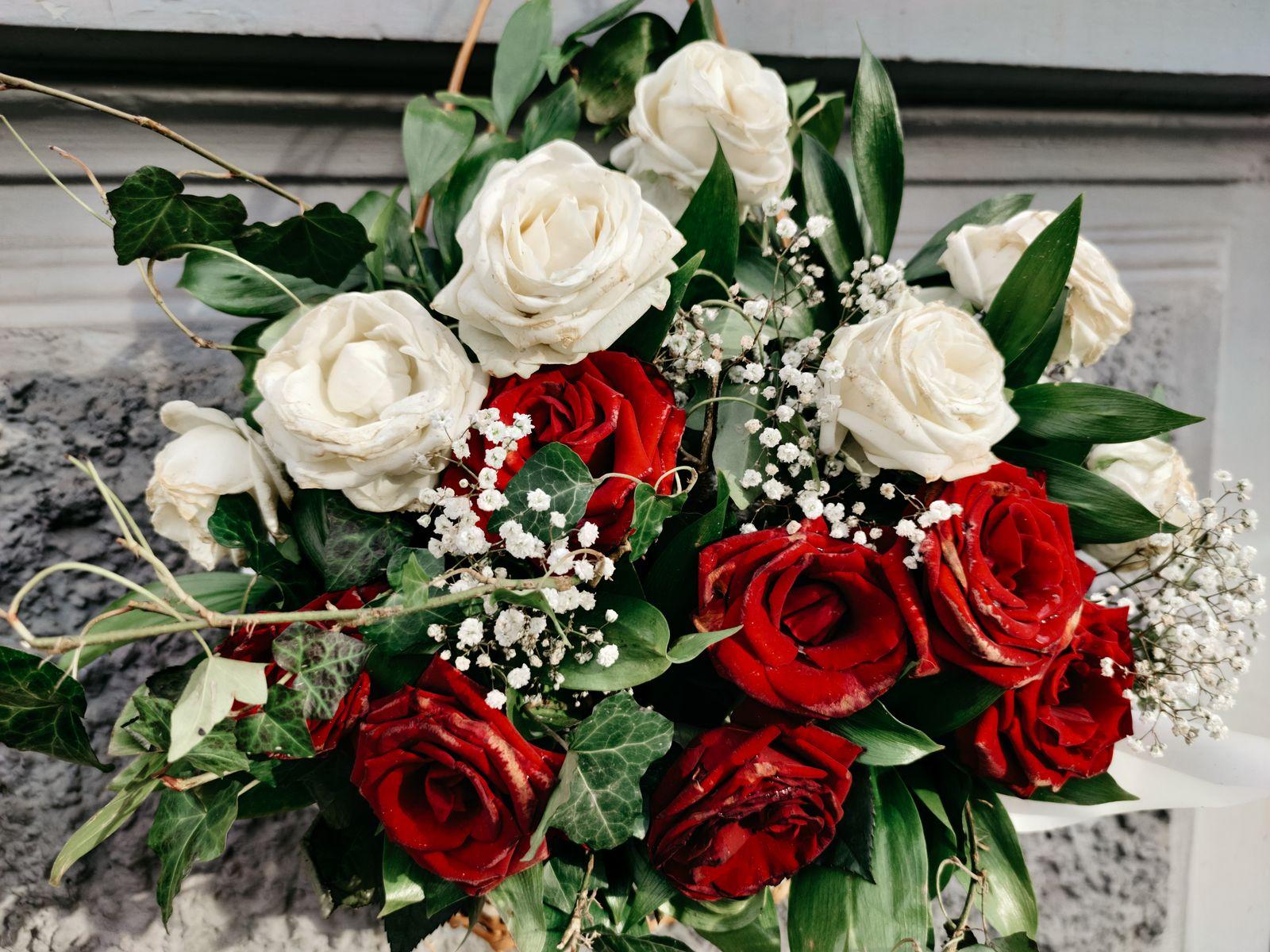
Canada Day flowers are arrangements built around red and white, the country's national colours, to mark July 1. The holiday celebrates Confederation in 1867, and red and white have long been Canada's national colours, so a red-and-white bouquet reads as festive without a single flag. The most dependable July blooms for the look are red and white roses, carnations, alstroemeria, lisianthus and gerbera daisies. Skip anything fussy or heat-shy: early July in Toronto runs hot, and the best Canada Day flowers hold up on a picnic table. For a table that needs flowers on July 1 itself, Cindy's Flowers hand-ties red and white from the stems that take the heat and delivers same-day across Toronto and the GTA on orders placed before 3 PM.
Why are Canada Day flowers red and white?
The colour code is no accident. The Dominion of Canada came together on July 1, 1867, but the anniversary took more than a decade to become a holiday in law: an 1869 bill was withdrawn, and it was Senator Robert Carrall's bill, passed in 1879, that finally made Dominion Day a statutory holiday. It was officially renamed Canada Day in 1982. Red and white are commonly associated with King George V's 1921 proclamation of Canada's royal arms, though that proclamation didn't formally designate them; through long common use the pair became the country's colours anyway. Long before they framed the maple leaf on the flag, they were the nation's colours.
Colour speaks in a bouquet, too. By the old language-of-flowers convention, red stands for love and passion while white signals purity and new beginnings. Scaled up to a country's birthday, that reads as pride and a fresh start rather than romance. It is a message you never have to spell out. Set red and white on the table on July 1 and the room understands at a glance.
The best red-and-white flowers for July 1
Good intentions meet a hot patio here. Some flowers sulk in July heat; others barely notice it. For a red-and-white arrangement that survives a backyard barbecue, build on the dependable ones:
- Roses. The obvious choice, and a strong one. Deep red paired with creamy white roses looks structured and holds its shape on a table for days.
- Carnations. Tough and underappreciated. They come in true red and clean white, outlast almost everything else in the vase, and fill a bouquet generously.
- Alstroemeria. Lightly freckled, long-lasting, and it keeps opening fresh buds for a week or more.
- Lisianthus. Rose-like and ruffled, elegant in deep burgundy or pure white when you want something softer than a rose.
- Gerbera daisies. Big, bright, flag-bold faces in red and white that kids gravitate toward. They are thirsty and prone to stem blockage, though, so change the water every day or two rather than leaving them to it.
- Snapdragons and red-and-white chrysanthemums add height and texture to finish the palette. Snapdragons are the one stem here that genuinely dislikes a hot day: they are highly sensitive to ethylene gas, shatter their florets when they get a dose of it, and their spires bend more at warm temperatures. Keep them indoors, cool, and nowhere near the fruit bowl.
Red and white Asiatic lilies make the most dramatic version of the look. One firm caution before you send them: true lilies and daylilies are highly toxic to cats, and every part of the plant, including the pollen and the vase water, can trigger fatal kidney failure.
Lilies are not the only stem on this page worth checking, though, so here is the rest of the list. Of the flowers above, the ASPCA lists roses, alstroemeria, gerbera daisies and snapdragons as non-toxic to both cats and dogs; carnations and chrysanthemums it lists as toxic to cats, dogs and horses. Lisianthus does not appear on the ASPCA list either way. If the arrangement is going to a home with a cat, leave the lilies out altogether and build on roses, alstroemeria and gerberas instead. Alstroemeria, sold as Peruvian lily, is the standard swap when someone wants the lily silhouette: it is a different plant entirely, and the ASPCA lists it as non-toxic to cats and dogs.
A quick word on peonies, since it comes up every summer. Southern Ontario's local peonies finish by late June, so any peony you spot around July 1 has almost certainly been imported. Still gorgeous, just not homegrown that week, and one more for the pet list: the ASPCA lists peonies as toxic to cats, dogs and horses. When in doubt, browse what is genuinely fresh across all our flowers and build the palette from there.
Does Canada have a national flower?
No, it does not. Despite what a lot of Canada Day trivia claims, Parliament has never legislated an official national flower. The closest contender is the bunchberry (Cornus canadensis), a low-growing white woodland bloom that won roughly 80 percent of a public poll run by Master Gardeners of Ontario in 2017, the country's 150th year. It is a cherished unofficial favourite, nothing more.
The maple is the symbol most people picture, and fairly so: the maple tree became Canada's national arboreal emblem in 1996. That is a tree, though, not a flower. Closer to home, Ontario's provincial floral emblem is the white trillium, adopted in 1937. It is genuinely lovely, with one honest catch for a summer arrangement: trilliums are spring woodland wildflowers that bloom in late April and May, and they are not grown as cut flowers. Mention the trillium as a symbol, not a stem to order.
One myth to retire while we are here. People often say picking a white trillium is illegal in Ontario. It is not. Picking one can badly damage the plant, and harvesting wildflowers is banned in provincial parks and conservation areas, so leave them be, but no province-wide law forbids it.
July's birth flower and a patriotic palette
Born in July? Tradition gives you two birth flowers: the larkspur and the water lily. Larkspur, with its tall spires, is the one you can actually work into a Canada Day arrangement. It comes in crisp white plus soft pinks and violets that sit nicely beside red roses, and by tradition it carries a light, open-hearted meaning that suits a summer party.
Larkspur comes with the sharpest warning on this page after the lilies, though, and it is worth reading before you order. The ASPCA lists larkspur and the rest of the Delphinium genus as toxic to cats, dogs and horses: the diterpene alkaloids in it can bring on muscle tremors, stiffness, weakness and convulsions, and in serious cases cardiac failure or death from respiratory paralysis. Do not put it in an arrangement bound for a household with animals. White snapdragons, kept cool and away from ripening fruit, give you the same vertical line without that problem.
Tempted to go beyond red and white? A red, white and blue arrangement tips a hat to July 4 celebrations and works for dual-holiday households. True blue is rare in flowers, so florists usually reach for blue delphinium, hydrangea, or thistle to get there. Two of those carry the caution above: delphinium is the same genus as larkspur, and the ASPCA lists hydrangea as toxic to cats, dogs and horses too, on account of the cyanogenic compounds throughout the plant. If there are pets in the house, leave both out. For a purely Canadian, patriotic look, red and white still says it best anyway, and it says it without a word.
Ordering Canada Day flowers across Toronto and the GTA
Timing matters most around a holiday. Canada Day 2026 falls on a Wednesday, July 1, right in the middle of the week, so plenty of GTA households will want flowers on the day itself rather than the weekend before. Cindy's Flowers hand-ties every arrangement in our Toronto studio and delivers same-day across Toronto and the wider GTA when you order before 3 PM, Monday through Saturday. For a Wednesday Canada Day, an order placed before the cutoff still qualifies for same-day delivery.
Torn between stems? A hand-tied mixed bouquet is the flexible pick: it lets our florists build around the freshest red and white flowers of the week instead of locking you into one type. Sending to a friend's barbecue in Etobicoke or a family dinner in Scarborough works the same way. Order to the address, flag the buzzer or gate if there is one, and we handle the rest.
How do you keep Canada Day flowers fresh?
Cut flowers live or die on a few small habits, and July heat raises the stakes. When you get the arrangement home, recut each stem about an inch from the bottom at a 45-degree angle, ideally under running water, so no air lock stops the stem from drinking. Clear away the lower leaves that would otherwise sit in the water, since submerged foliage rots and feeds bacteria. Refresh the water every two to three days, and use the flower-food packet if one is tucked in.
Roses are the divas of the vase. If you have ever wondered what kills roses fast, it is usually one of five culprits: dirty or unchanged water, leaves soaking below the waterline, direct sun and heat, ethylene gas from a nearby bowl of ripening fruit, and stems that were never recut. Keep the vase cool and out of the afternoon sun, well away from the fruit bowl, and your red and white will outlast the fireworks. Our rose care guide covers the full routine if you want it.